Haworthia Balcony Cultivation Tips and Detailed Cultivation Process
For some small apartments, if the owners want to grow plants and flowers, the balcony is the only place where they can do it. Using the limited balcony space to grow plants and flowers fills the tiny space with a bit of life. Today, let us learn together how to cultivate Haworthia on a balcony. Owners who love greenery should not miss it.
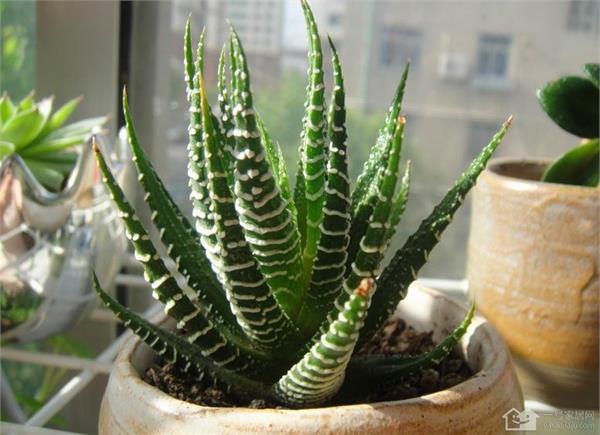
Below is the specific cultivation process:
1. About choosing pots: Because the root system of Haworthia is a thick, long taproot, a relatively deep pot should be chosen (as shown in Figure 1).
Except for 'Ice Lantern' and 'Neon', for which I use purple clay pots, I use Wanxiang pots for all the others, in all specifications and sizes. In the past I liked to use the same specification and size uniformly, but I found that under the same management and the same conditions, some grew well and some did not. This is because if a small seedling is put in too large a pot, the water in the pot evaporates too quickly, and small seedlings generally do not have very strong root systems to begin with, so they cannot absorb water, grow slowly and are in poor condition; if a large plant is put in too small a pot, because its root system is good, the water in the small pot is absorbed too quickly, resulting in insufficient water and nutrient supply, so it also will not grow in very good condition. So to sum up, what kind of pot to choose depends on the size of the plant. (Because I use one pot per plant, my experience with the problems of seedlings grown together in seed trays is still limited.)
2. About soil mixing: When it comes to soil, the first thing I want to say is to mix it yourself according to your own cultivation environment and watering methods. Since getting into this hobby, I have been visiting greenhouses in the surrounding area, and some old hands like to use more grit, while others like to use more peat, so follow your own preference. Let me talk about my soil mix: about 35% 3-6MM Nihon Akadama plus about 35% 3-6MM Kanuma soil plus about 25% volcanic rock, with the rest made up of bamboo charcoal and rice husk ash at about 5%, plus a little bit of Xiaolü medicine. (For mature plants I no longer use peat granules; Akadama and Kanuma basically make up more than 90%, plus a layer of slow-release fertilizer.)
The above soil mix is based on plants that have roots. As for soil used for rooting or leaf cuttings, use Pindstrup peat instead of peat granules. The difference between peat and peat granules lies only in air permeability. (Because I am a balcony grower and like enclosed cultivation, the ventilation is not as good as in a greenhouse, so different situations call for different soil mixes.) Below is my soil mix:
3. About watering: From the very beginning I have heard many people say these four words: water thoroughly when completely dry. It is correct but not complete. I like to grow Haworthia in grit, so it dries out relatively quickly, but what counts as completely dry? Some people like the toothpick method, some like the weight method, and some rely entirely on experience, but for seedlings with weak roots, I think there is another way to tell whether they are completely dry: shake the plant and feel whether the root system is very loose, whether it does not feel as firmly anchored as it did right after watering. I often shake them every few days to check, and when I feel it is about right, I water.
Water at noon in the depths of winter, and in the evening or at night in the height of summer, so as not to freeze or burn the roots. I said earlier that water thoroughly when completely dry is correct but not complete; the most important thing is that after watering, they must be placed in a ventilated place to air for a period of time, because the soil needs to become moist; too wet plus enclosed cultivation is a disaster for someone like me who likes enclosed cultivation!
4. About the environment: I like enclosed cultivation, outdoor enclosed cultivation. In spring, autumn and winter I use a glass tank for enclosed cultivation, and in summer I honestly put them indoors to get through the summer. The advantage of enclosed cultivation is high humidity and a large day-night temperature difference; this is the environment Haworthia likes best. There are limits, though: the temperature generally should not exceed 35 degrees, and the humidity should not exceed 80%. As for light, they cannot be exposed to direct sun; for Haworthia, too-strong ultraviolet light easily causes damage, so soft scattered light is needed. As for what "soft" is like, I cannot explain it clearly either; it can only be understood, not put into words. In winter, just put them indoors.
The above is the relevant introduction in this article. I believe that after reading it you have a simple understanding of this as well. If needed, you can continue to follow No.1 Home Network to learn more information.