How to grow Peperomia obtusifolia 'Variegata'? Growing tips and precautions
Many homeowners like to grow some green plants at home; for one thing, we can enjoy them, and for another, they can help purify the air. Today, I would like to introduce a small ornamental houseplant called Peperomia obtusifolia 'Variegata'. Its leaves are heart-shaped with a metallic sheen. Next, let's take a look at its growing tips and precautions.
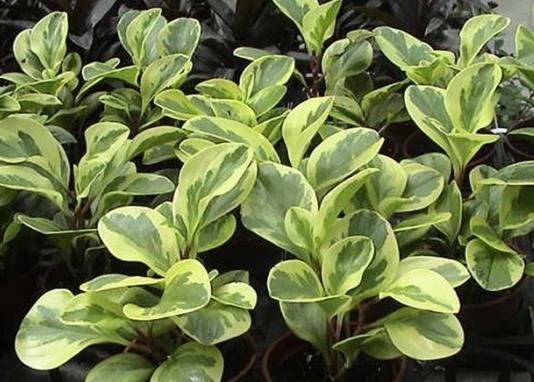
Best propagation time: division is suitable in spring and autumn; leaf cuttings from May to June;
Best growing soil: Peperomia obtusifolia 'Variegata' requires loose, fertile, well-drained soil, which can be mixed with river sand, mud material and leaf mold;
Growing humidity requirements: Peperomia obtusifolia 'Variegata' likes a moist climate environment, and requires the relative air humidity of the growing environment to be 60-75%;
Best growing temperature: the optimum growing temperature for Peperomia obtusifolia 'Variegata' is 18°C-30°C. It is averse to cold and frost, and the overwintering temperature needs to be kept above 10°C. When the winter temperature drops below 4°C, it enters a dormant state. If the ambient temperature approaches 0°C, it will die from frost injury;
Best growing light: Peperomia obtusifolia 'Variegata' is averse to direct sunlight and is best grown in semi-shade.
Precautions for growing Peperomia obtusifolia 'Variegata':
Fertilizer and water requirements:
Peperomia obtusifolia 'Variegata' has high fertilizer and water requirements, but it is most vulnerable to indiscriminate fertilizing, concentrated fertilizer and one-sided application of nitrogen, phosphorus and potassium fertilizers. The fertilizing (watering) principle to follow is "apply dilute fertilizer frequently, use small amounts with more applications, and complete nutrition":
Spring, summer and autumn:
These two seasons are its peak growing seasons. Fertilizer and water management follows the cycle of "Hua Bao" - "Hua Bao" - clear water - "Hua Bao" - "Hua Bao" - clear water (at least two "Hua Bao" applications per week must be guaranteed). The interval period is about: 1-4 days for outdoor cultivation; the interval is shorter on sunny days or during high temperatures, and longer on rainy days or during low temperatures, or do not water at all; 2-6 days for indoor cultivation. Watering should be done in the morning when the temperature is lower. In summer, water in the morning or evening when the temperature is low, and also spray the plant frequently.
Winter:
During the winter dormant period, the main task is to control fertilizer and water. Fertilizer and water management follows the cycle of "Hua Bao" - clear water - clear water - "Hua Bao" - clear water - clear water, with an interval period of about 7-10 days. Watering should be done at noon on sunny days when the temperature is higher.
Pruning essentials:
When the plant height is about 10 cm, it can be appropriately pinched to encourage side branches to sprout and keep the plant shape full. If the plant shape is already too tall, it can also be pruned; pruning can make the plant shape compact and full.
Potting soil replacement:
For reused old pots, they must be soaked in a 1000-fold potassium permanganate solution for more than half an hour, then rinsed with clear water and dried for later use; new pots can be used directly. Generally, first use a smaller flower pot (9 cm plastic pot) for planting. When planting, first place an appropriate amount of substrate at the bottom of the cup, then transplant the screened seedlings into the cup. Small seedlings can be planted slightly deeper, preferably with the base of the plant slightly above level; 1 cluster/pot; the substrate should be moderately firm, filled to 9/10 of the cup, gently shake the pot soil, and water with half-soaked settling water or just surface water.
Propagation essentials:
Peperomia obtusifolia 'Variegata' is mostly propagated by cuttings and division.
Cuttings: In April-May, select healthy top branches about 5 cm long as cuttings, keep 1-2 leaves on the upper part, and after the cut surface dries, insert them into a moist sand bed. Leaf cuttings can also be used: cut off a leaf with its petiole with a knife, let it dry slightly, then insert it obliquely into the sand bed; rooting occurs in 10-15 days. In a greenhouse with temperature control equipment, it can be done all year round.
Division: mainly used for propagating colorful-leaf varieties. The potting soil can be made of leaf mold, peat soil plus some perlite or sand, with an appropriate amount of base fertilizer added. During the growing period, apply topdressing once every half a month. For watering, water that has been left standing in a water tank for 1-2 days is best. Reduce watering in winter. Temperature changes directly affect leaf color. The suitable winter temperature for colorful-leaf types is 18-20°C; for green-leaf types it is about 15°C. It is afraid of heat in midsummer, so it can be placed under a shade shed and sprayed with water to cool down, but note that both excessive heat and excessive moisture can cause stems and leaves to turn black and rot. In winter, place it in a well-lit place; in summer, avoid direct sunlight. Repot once every 2-3 years.
The cultivation substrate for Peperomia obtusifolia 'Variegata' requires an organic substrate with good air permeability and good water retention, such as peat soil plus perlite or vermiculite, at a ratio of about 6:1. Excessive moisture in the cultivation substrate should be avoided; generally maintain a water content of 40-60% in the cultivation substrate.
It is usually placed in a bright indoor location or a shaded outdoor spot. The optimum temperature is 20-26°C, and the winter temperature should be above 5°C. Spray water on the leaves frequently to maintain relatively high air humidity. It can also be appropriately pruned after being grown for a period of time or transplanted into a courtyard for ornamental purposes.
Pest and disease control:
Peperomia obtusifolia 'Variegata' has relatively few diseases, mainly ringspot virus disease, which causes stunted growth and distorted leaves in affected plants; it can be sprayed with an equal-amount Bordeaux mixture. There are also root and crown rot and canker scab, which can be sprayed with a 50% carbendazim wettable powder 1000-fold solution.
Pests occasionally include scale insects and slugs, which should be controlled promptly.
Hydroponic cultivation of Peperomia obtusifolia 'Variegata'
Hydroponic and soil cultivation of Peperomia obtusifolia 'Variegata':
Hydroponic cultivation of Peperomia obtusifolia 'Variegata': Peperomia obtusifolia 'Variegata' is an excellent example of a plant that is very easy to keep alive in hydroponics. With 4-5 leaves per plant, it adapts very easily to an aquatic environment, does not rot, and is easy to grow. It likes a warm, humid, semi-shady environment, is not tolerant of high temperatures, and is averse to direct sunlight; it is drought-tolerant, so watering should not be excessive, especially in autumn and winter when watering should be reduced. If the air is dry, spray more water on the leaves. It is averse to frost.
Soil cultivation of Peperomia obtusifolia 'Variegata': the cultivation substrate for Peperomia obtusifolia 'Variegata' requires an organic substrate with good air permeability and good water retention, such as peat soil plus perlite or vermiculite, at a ratio of about 6:1. Excessive moisture in the cultivation substrate should be avoided; generally maintain a water content of 40-60% in the cultivation substrate.
It is usually placed in a bright indoor location or a shaded outdoor spot. The optimum temperature is 20-26°C, and the winter temperature should be above 5°C. Spray water on the leaves frequently to maintain relatively high air humidity. It can also be appropriately pruned after being grown for a period of time or transplanted into a courtyard for ornamental purposes.
The above is the relevant introduction in this article. I believe that after reading it, you have gained a simple understanding of it. If needed, you can continue to follow No.1 Home Network to learn more information.