What are the cultivation methods and precautions for the velvet Calathea?
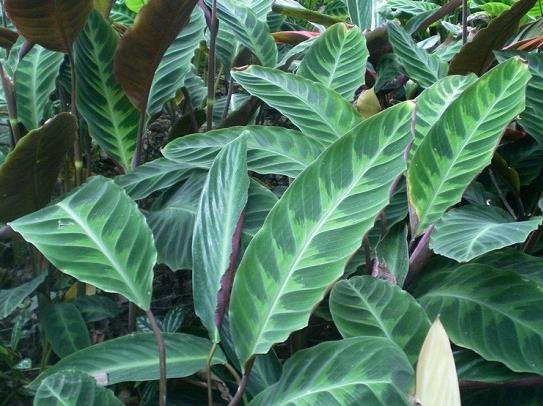
The velvet Calathea is a foliage plant with high ornamental value, and many homeowners like to grow it at home. We also see it in some public places; the velvet Calathea is green with zebra-like dark green stripes. Next, the editor will explain to you how we should cultivate it in daily life, and what precautions to note during cultivation.
Velvet Calathea
Best propagation time: Propagation of the velvet Calathea is generally carried out in spring from April to May or in late autumn together with repotting;
Best growing soil: The best growing soil for the velvet Calathea is fertile, well-drained leaf mold or peat soil;
Growing humidity requirements: During the growing period, the velvet Calathea requires relatively high air humidity, preferably above 80%. Mist several times in the morning and evening, but the potting soil should not be too wet, otherwise the roots are easily damaged.
Best growing temperature: The suitable temperature for the growth of the velvet Calathea is 18-25°C, from March to September it is 21-27°C, and from September to the following March it is 18-21°C. In winter the temperature should not be lower than 13°C, and in summer it should not exceed 35°C, otherwise it is extremely unfavorable to the growth of the velvet Calathea, causing stem and leaf growth to stop or the plant to freeze and die.
Best growing light: Light should not be too strong; provide a little shade in summer, and a semi-shaded environment is best, so the leaves are fresh in color.
Precautions for cultivating the velvet Calathea:
Watering key points: The velvet Calathea is very sensitive to water. During the growing season, water thoroughly to keep the potting soil moist. But if the soil is too wet, it will cause root rot and even death, so special attention should be paid.
At the same time, if the air humidity is low, the leaves will immediately curl, reacting very sensitively. For indoor cultivation, the air humidity must be kept at 70%-80%. In winter, keep it slightly dry; if too wet, the leaves easily turn yellow and wither.
Fertilizer application: During the growing period, fertilize once every half month, and appropriately add phosphate fertilizer.
Potting soil replacement: Repot the velvet Calathea every autumn; the potting soil can be a mixed soil of culture soil, peat soil and coarse sand.
Propagation key points: The velvet Calathea is mainly propagated by division and tissue culture.
Vigorously growing plants can be divided once every 1-2 years. When dividing and repotting, do not plant too deep; just plant all the roots into the soil, otherwise the growth of new shoots will be affected. For large-scale propagation, the tissue culture method is generally used.
1. Division propagation: Carry out in spring from April to May or in late autumn together with repotting. During operation, lift the overly dense plant out of the pot, separate the robust and neat clumps, pot them separately, water thoroughly, and place them in a semi-shaded place for care. But low temperatures in early spring easily damage the roots and affect the survival rate. Generally, division should not be done too early; it is more suitable to divide when the temperature is relatively stable. Each plant should have more than 3-4 small plants, and a certain amount of original soil should be retained as much as possible to avoid affecting the growth and shaping of the plant. When planting separately, use a culture soil made of loose leaf mold or peat soil plus 1/3 perlite and a small amount of sand.
2. Tissue culture propagation: Young stems or unexpanded leaf petioles are commonly used as explants. After routine disinfection, under aseptic conditions cut the petioles into 3 mm small segments and the young stems into 3 mm nodal segments, and inoculate them on MS medium supplemented with 6-BA 5 mg/L and naphthaleneacetic acid 0.02 mg/L to induce callus and adventitious bud formation. The adventitious buds can differentiate adventitious roots on MS medium with 0.5 mg/L naphthaleneacetic acid. Rooted plantlets are transplanted into a substrate of half peat and half perlite, maintaining relatively high air humidity, and the survival rate is above 95%.
Pest and disease control:
The velvet Calathea is mainly harmed by: leaf spot disease and leaf blight; spraying with lime Bordeaux mixture can control them.
The main pests of the velvet Calathea are: whitefly damage, which can be killed by spraying with 25% phosmet emulsifiable concentrate at 1000 times dilution.
The above is the relevant introduction in this article. I believe you have gained a simple understanding of it after reading it. If needed, you can continue to follow No. 1 Home Network to learn more information.