Detailed Guide to Water Propagation of Rieger Begonia: Easily Root Beautiful Varieties
Some homeowners like to grow plants at home; for one thing, they purify the indoor air, and for another, they serve a decorative purpose. Today, what we are going to learn about is the propagation of Rieger begonia. There are many propagation methods, and next we will look at the water propagation method for Rieger begonia.
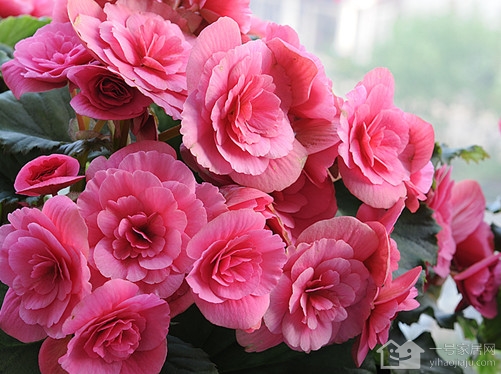
Using the vegetative organs of a plant (roots, stems, leaves) for cuttings to form independent plants is called the cutting method. Plants grown this way grow faster than seedlings and can be grown into large plants in a short time, especially for some plants that are difficult to flower; for flowering plants,
The rooting medium for cuttings can be many things, mainly soil, sand, and water. Water propagation is a relatively hygienic, simple, and quite advanced method, but you should change the water frequently to keep it clean; purified water is best. If you use tap water, it should be left to stand for 2-3 days. To prevent bacteria from breeding, you can add coins, charcoal, and the like to the water. Begonias can also be water-propagated; the effect on Rieger begonia is weak, but you can give it a try.
Cutting methods can be divided into leaf cuttings and stem cuttings. Leaf cuttings use the leaves of the plant as cuttings, causing them to produce roots and leaves and thus become a complete plant. But plants that can be propagated from leaf cuttings are very special; begonias can do it. Rieger begonia can be propagated from leaf cuttings, but you must select thick leaf stalks, veins, or fleshy leaves, and the success rate is extremely low. Stem cuttings are more common, generally using softwood and hardwood. There is also root cutting; these roots refer to adventitious buds produced on the roots, and such plants are also rather special, so they will not be discussed here.
Just talking about the propagation method for Rieger begonia: when doing stem cuttings, the length of the stem should be moderate. Use a blade to cut the lower part of the stem into a horseshoe shape, insert it one-third deep into the soil, water gently, and be careful not to let water accumulate, otherwise it will cause waterlogging; plants obtained by stem cuttings do not have underground tubers. After 3 weeks, the leaf cutting can also grow fibrous roots from the lower part of the leaf stalk, but it takes another month and a half before adventitious buds grow from the lower part of the leaf stalk and gradually emerge from the soil.
Propagation Tips for Rieger Begonia
First, regarding the choice of propagation season. Rieger begonia has strong reproductive capacity and in principle can be propagated in all four seasons, but based on my own growing experience in the north, the highest success rate is in late autumn and early winter. Late autumn and early winter are often also the best time to prune and shape many plants, and the newly grown branches cut off at this time can be used as cuttings. The temperature is best kept at around 20 degrees; at this time rooting is relatively fast and the success rate is also the highest.
Second, regarding the cutting medium. The cutting medium I personally use is vermiculite; at the flower market wholesale market, 10 yuan can buy a large bag, which is enough for propagation. In addition, coconut coir bricks are also very practical after soaking in water, and the price is not expensive either; about seven or eight yuan buys a large coconut brick, which can be used to raise seedlings for twenty or thirty pots. At this time, gardening friends must not cut corners and casually use all sorts of messy potting soil for cuttings; although there is still a chance of success that way, it basically comes down to luck. If the potting soil is contaminated with pathogens, the success rate is basically zero.
Third, regarding the cutting steps. We can let the cut cuttings dry for about one or two hours, and after the cut surface is dry, insert them into the cutting medium, then water a little to moisten the medium. (You can also spray and soak the medium with water in advance.) Place them in a spot with scattered light and good ventilation, and after about half a month, the cuttings will be able to root.
What everyone needs to be reminded of is that Rieger begonia propagation techniques require patience. Many gardening friends cannot wait and like to frequently pull out the cuttings to see whether they have rooted, which easily causes the newly grown young roots to die. Here is a little trick to let you know whether our cuttings have rooted: observe whether new leaves have grown on the branches. If they have, that means our propagation has succeeded.
In addition, gardening friends with a bit more skill can even try the leaf cutting method. That's right, use a single leaf to root a whole large pot of begonia. Generally, choose vigorous, relatively mature leaves, cut the lower end of the leaf stalk diagonally at about 45 degrees with a blade, and then proceed according to the above Rieger begonia propagation method; propagation can also succeed. However, because begonias grow very fast, there is no need to challenge the leaf cutting method, unless gardening friends want to improve their propagation skill, in which case Rieger begonia is sure to be a great variety that makes your confidence soar!
The above is the relevant introduction in this article. I believe that after reading it you now have a simple understanding of this. If needed, you can continue to follow No.1 Home Network to learn more information.