How to cultivate Guelder Rose? Detailed explanation of the key points of Guelder Rose cultivation techniques
Guelder Rose is a treasure from head to toe; both its flowers and its fruit have their uses. So do you know how to cultivate Guelder Rose? What exactly are its cultivation techniques? What are its morphological characteristics? Let's take a look together.
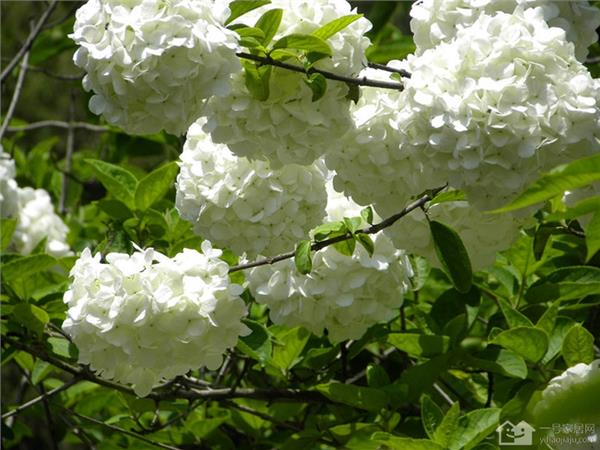
I. Cultivation techniques for Guelder Rose
1. Humidity management
It likes a slightly moist to dry climate environment.
2. Temperature management
Cold-hardy. It struggles to get through summer during the high-temperature period and cannot tolerate muggy heat, otherwise it will enter a semi-dormant state and its growth will be hindered. The most suitable growing temperature is 15-30°C.
3. Light management
It likes a semi-shaded environment, but after being kept indoors for a period of time, it should be moved outdoors to a shaded spot for a period of care (about one month), and alternated back and forth in this way. When kept indoors, place it in a spot with bright light as much as possible, such as a well-lit living room, bedroom, study, and similar places, but avoid direct sunlight hitting it. In early spring, late autumn, and winter, since the temperature is not very high and the sunlight is not strong, you can give it direct sunlight in the morning and evening.
4. Fertilizer and water management
It likes the potting soil to be dry or slightly moist, but its root system is afraid of waterlogging. If water accumulates in the flower pot, or if you water and fertilize it too frequently, it is easy to cause root rot. The principle for watering and fertilizing it is "alternate dry and wet; when dry, dry it out thoroughly; do not water if it is not dry; when you water, water it thoroughly":
5. Spring and autumn
These two seasons are its peak growing seasons. Fertilizer and water management follows the cycle of "Huabao" - clear water - "Huabao" - clear water, with an interval of about: 1-4 days for outdoor care; shorter intervals during sunny days or high temperatures, and longer intervals or no watering during rainy days or low temperatures; 3-6 days for indoor care; shorter intervals during sunny days or high temperatures, and longer intervals or no watering during rainy days or low temperatures.
6. Summer
During the high-temperature period in summer, it grows slowly and has low requirements for fertilizer and water, so fertilizer and water need to be moderately controlled. Fertilizer and water management follows the cycle of "Huabao" - clear water - clear water - "Huabao" - clear water - clear water, with an interval of about: 1-3 days for outdoor care; shorter intervals during sunny days or high temperatures, and longer intervals or no watering during rainy days or low temperatures; 3-5 days for indoor care; shorter intervals during sunny days or high temperatures, and longer intervals or no watering during rainy days or low temperatures.
7. Winter
In winter the plant grows slowly, and the main task is to do a good job of controlling fertilizer and water. Fertilizer and water management follows the cycle of "Huabao" - clear water - clear water - "Huabao" - clear water - clear water, with an interval of about 4-8 days; shorter intervals during sunny days or high temperatures, and longer intervals or no watering during rainy days or low temperatures. Try to schedule watering at noon on sunny days when the temperature is relatively high.
II. Morphological characteristics of Guelder Rose
Guelder Rose is a deciduous shrub, 2-3 m tall. The branchlets, petioles, and peduncles are all hairless. The underside of the leaves has clustered tufts of hair only in the leaf vein axils, or sometimes a few long appressed hairs on the veins as well.
The bark of Guelder Rose is dark grayish-brown, with longitudinal strips and layers of corky strips; the branchlets are brown to reddish-brown, with obvious ridges. The leaves are dark green, simple, and opposite; ovate to broadly ovate, 6-12 cm long and 5-10 cm wide, usually shallowly 3-lobed, with a rounded or truncate base, palmately 3-veined, the lobes slightly spreading outward, the middle lobe longer than the lateral lobes, the apex gradually pointed or abruptly pointed, the margin with irregular large teeth, the upper surface yellow-green and hairless, the lower surface pale green, with downy hair in the vein axils; the petiole is stout, hairless, with glandular dots near the end.
The above is the relevant introduction in this article. I believe that after reading it you have gained a simple understanding of this. If needed, you can continue to follow No.1 Home Network to learn more information.