A Detailed Guide to the Propagation Methods and Cultivation Techniques of Coreopsis
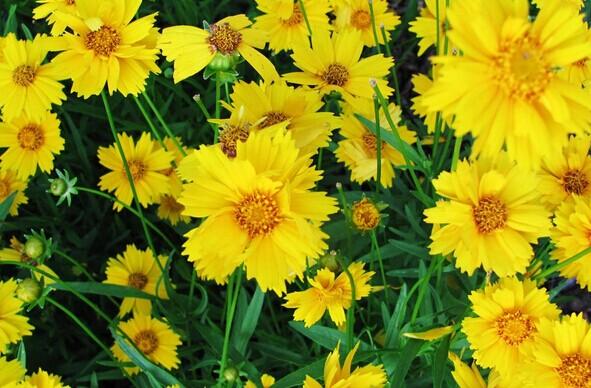
Coreopsis has mostly opposite leaves, rarely alternate, with entire, shallowly lobed or deeply cut margins. The flowers are solitary or in loose panicles, with an involucre in two rows of 3 bracts each, fused at the base. The ray florets form one row, broadly ligulate, in yellow, brown or pink. The disc florets are yellow to brown. Coreopsis is cold- and drought-tolerant, not demanding about soil, light-loving but tolerant of partial shade, highly adaptable, and strongly resistant to sulfur dioxide. Today we will give you a brief introduction to the propagation and cultivation methods of coreopsis.
Coreopsis is easy to grow and often self-propagates. In production, it is mostly propagated by sowing or division, and in summer it can also be propagated by cuttings. Sowing is generally done indoors in pots in early spring. Usually a sowing pot or wooden box with a diameter of 30cm and a depth of 5cm is chosen, the drainage hole is covered with a broken tile, and then coarse gravel 1/3, coarse-grained potting soil 1/3, and sowing soil 1/3 are added in turn. Then, use a wooden strip to press the soil surface flat and level, and keep the soil 1cm below the rim of the pot. After soaking the pot soil thoroughly by the "pot immersion method," lift the pot out, wait until the water has fully seeped in, and then sow.
When sowing, open the seed packet and scatter the seeds directly and evenly into the pot. Alternatively, mix the seeds with fine sand and then scatter them evenly into the pot. After sowing, cover with a thin layer of fine soil, then cover the surface with glass, and place newspaper over the glass to reduce water evaporation. Before the seeds sprout, keep the soil moist; do not let the seedbed alternate between dry and wet, or become too dry or too wet. In the morning and evening, lift the glass for a few minutes to ventilate, and keep it covered during the day. After the seeds germinate and emerge, remove the covering promptly, gradually expose them to light, and transplant once 1-2 true leaves have grown.
The management of coreopsis is relatively simple. After the seedlings grow true leaves, apply nitrogen fertilizer once. When they reach 2-3 true leaves, they can be transplanted. After one transplant, they can be planted into flower beds. After planting, water thoroughly promptly so the roots make close contact with the soil. During the growing period, apply liquid fertilizer 2-3 times as a top dressing, using phosphorus and potassium fertilizer together with the nitrogen fertilizer.
The soil for planting coreopsis should usually be kept alternating between dry and moist; waterlogging must not occur. After rain, drainage should be carried out promptly to prevent waterlogging. High temperature, high humidity and poor ventilation make aphids and other pests and diseases likely, so pesticides should be sprayed promptly for control. To make coreopsis bloom more, you can remove the spent flowers after blooming and apply a top dressing once in July-August; by National Day it can have abundant flowers and lush leaves.
The achenes of coreopsis are borne on the capitulum, black, without a pappus, and mature successively from August to October. The harvested part for seed collection is the capitulum of coreopsis. Usually from August to October each year, choose capitula whose achenes are mostly mature and cut them off, dry them in the sun and then place them in a dry, cool place, remove impurities in bulk, and sort out the seeds. Coreopsis seeds are relatively large in grain size. Moisture-proof paper bags are mostly used for packaging.
The harvested seeds should be graded on the premise of ensuring the purity of this species, normal moisture content, and no contamination by foreign matter. The germination rate of grade-one seeds is >=98%, that of grade-two seeds is >=95%, and that of grade-three seeds is >=92%. When seeds of each grade are used, their germination rate is allowed to be 5% lower than the corresponding standard. As storage time extends, the germination rate standard should also be lowered accordingly.
The above is the propagation and cultivation method of coreopsis shared with you by the editor. I hope it is helpful to you!