A Detailed Guide to the Main Hippeastrum Varieties and Their Flower Meanings
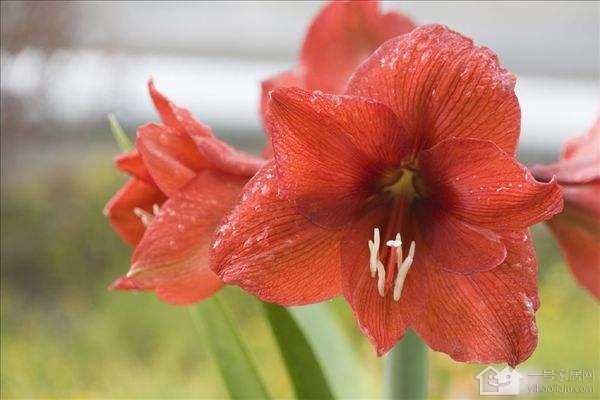
Hippeastrum (Hippeastrum vittatum), also known as amaryllis and lily-of-the-hundred-branches, belongs to the Amaryllidaceae family and the genus Hippeastrum. Its flower stalks stand tall and graceful, and its blooms are large, colorful and eye-catching. It is a common bulbous flower that can be planted in gardens and is also an excellent cut flower material. It is a perennial herb native to South America. Its bulb is thick and large like an onion, and its leaves are basal, strap-shaped, bright green and glossy. It blooms from March to May, with a hollow flower stem bearing 3 to 6 flowers at the top in an umbel. The flower colors include red, white, pink, orange-red and variegated patterns. The capsule contains hundreds of thin, membrane-like seeds, and the seeds are black. It is a material for flower beds, potted plants and cut flowers.
I. Basic Information About the Hippeastrum
Name: Hippeastrum vittatum (Ait.) Herb;
English name: Barbados lily;
Aliases: zhu ding hong, zhu ding lan, amaryllis, hua zhou lan, bai zi lian, bai zhi lian;
Family name: Amaryllidaceae;
Genus name: Hippeastrum;
Origin: native to Peru and Brazil. Now widely cultivated.
II. Morphological Characteristics of the Hippeastrum
Perennial herbaceous plant, with a plump bulb, nearly spherical, 5-7 cm in diameter, with a pale green or yellowish-brown outer skin. The leaves are arranged in two opposite rows, strap-shaped, with acuminate tips, 6-8 in number, and the leaves mostly emerge after the flowers. The common peduncle is hollow and covered with white powder, bearing 2-4 flowers at the top. The flowers are trumpet-shaped, and the flowering period lasts from winter to spring, or even later. Most modern cultivated forms are hybrids, with very large blooms and brilliant colors, including bright red, rose red, orange-red, pale red and white. The largest flowers can reach more than 20 cm in diameter, and there are also double-flowered varieties. Ecological habits: it prefers a warm and humid climate, with an optimum growing temperature of 18-25°C. It dislikes extreme heat, and the sunlight should not be too intense, so it should be maintained under a shade net. It is afraid of waterlogging. During the winter dormant period, it requires a cool climate, preferably 10-12°C, and must not go below 5°C. It prefers sandy loam rich in humus and with good drainage.
III. Main Varieties of the Hippeastrum
Common cultivated varieties include: Red Lion, with deep red flowers. Hercules, with orange-red flowers. Rilona, with pale orange-red flowers. Telstar, a large-flowered type, with bright red flowers. Flower Record, with orange-red flowers and broad white longitudinal stripes. Souvereign, with orange flowers. Minerva, a large-flowered type, with red flowers and a white center. Picotee, with white flowers tinged with pale green and red edges. Recently, Europe has also introduced new varieties suitable for pot cultivation, among them Las Vegas, a bicolor variety of pink and white. Calimero, a small-flowered type, with bright red flowers. Amigo, a late-flowering type, with deep red flowers, considered the best pot variety. Nagano, with orange-red flowers and a snow-white center.
IV. Flower Meaning of the Hippeastrum
Birthday flower: Hippeastrum; the flower of Pope Zephyrinus of Rome during the period when Christians suffered persecution. Since ancient times, Christianity has had the custom of linking saints with specific flowers, which arose because the church often decorated the altar with blooming flowers when commemorating saints. In medieval Catholic monasteries, various flowers were grown almost like in a horticultural center, and over time the church associated the 366 days' saints with different flowers respectively, forming the so-called flower calendar. At that time, most monasteries were located in Southern Europe, and Southern Europe has a Mediterranean climate, which is extremely suitable for growing flowers and plants. The hippeastrum was chosen as the flower to commemorate Pope Zephyrinus of Rome during the period when Christians suffered persecution. The hippeastrum belongs to the Amaryllidaceae family and is a bulbous plant native to South Africa. It is commonly planted in Southern Europe. Its growing environment must have sufficient light. Flower meaning: fragrance; the hippeastrum gives off a rich scent. If it is planted by a first-floor window, the house will be filled with sweet fragrance. Therefore its flower meaning is "fragrance." People born under the blessing of this flower have noble character and always appear especially striking and dazzling wherever they are, so they have many admirers, but because of your noble temperament, those admirers do not dare to make further advances. If you really meet someone you like, it is best to be proactive and seize the good opportunity!
The above is the relevant introduction in this article. I believe that after reading it, you also have a simple understanding of it. If needed, you can continue to follow No. 1 Home Network to learn more information.