How to grow succulents in water? Master these care points and precautions
More and more people like succulents, and many have a question: can succulents be grown in water? The editor checked it out, and indeed they can. It just requires more attention to things like changing the water and fertilizing. You also need to pay attention to air circulation and so on. In short, you have to be as careful as if you were raising a baby. Below, let's look at succulents grown in water.
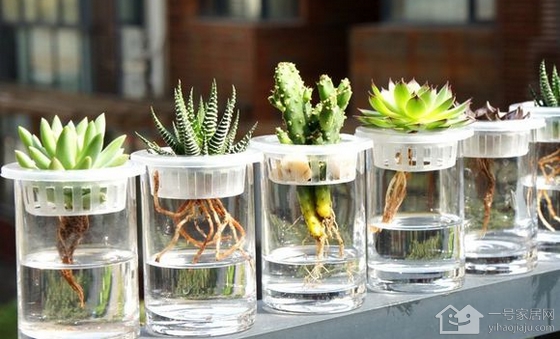
Like other plants, succulents can also be grown hydroponically, and as long as you find a suitable method, they can grow quite well! After a long experiment of several months of hydroponics, it was found that compared with soil, it is cleaner, and in the early stage rooting is also faster and less prone to pests. In the early stage, hydroponics is much better than soil culture and is very beneficial to plant growth. For succulents that are not in very good condition when you get them, using hydroponics to help them recover is also a good choice. However, in the later stage, due to nutrient deficiency, whether in size or in clustering, hydroponics is clearly inferior to soil culture.
Compared with soil-grown succulents, hydroponic succulents are much cleaner, and in the early stage of hydroponics they root quickly and are less prone to pests. However, in the later stage of hydroponics, nutrient deficiency is prone to occur.
There are no high requirements for containers for hydroponic succulents; ordinary vessels can all be used as hydroponic containers, but when growing succulents hydroponically you need to pay attention to the following aspects:
1. Water level
The water level and the position of the roots are very important. Too much water will cause root rot, while too little water will cause the roots to dry up and the whole plant to lack water. The water level for succulents has a lot to do with their variety.
For Haworthia cooperi and Haworthia obtusa types with relatively well-developed roots, you can add more water to the container so that the roots are completely submerged in water; for Crassulaceae Echeveria types, which themselves have very few roots and do not need much water, it is enough for the roots to just touch the water.
Of course, you can also leave some space and let the roots extend down on their own to absorb water.
2. Pay attention to changing the water
For hydroponic succulents, you need to pay attention to changing the water to avoid root rot caused by insufficient oxygen in the water. In addition, changing the water can also remove some moss and the like growing in the water, increase the water's permeability, and benefit photosynthesis in the roots.
3. Fertilizing
Hydroponic succulents are prone to nutrient deficiency in the later stage, so when growing succulents hydroponically you can apply fertilizer appropriately.
For fertilizing, you can choose to drip in a 0.2% potassium permanganate solution at a ratio of 1:5 to the water volume. This can both prevent and control the growth of moss in the water and also has a sterilizing effect and prevents root rot, while at the same time providing the plant with manganese and potassium nutrients and promoting robust plant growth.
For fertilizing, you can also use the leaf-surface fertilization method. The fertilizers can be 0.1% urea, 0.15% monopotassium phosphate, and 2% superphosphate, sprinkled on the leaf surface on a sunny and windless day. Remember that this method must not be used at bright midday, otherwise it will cause leaf burn.
4. Root pruning
If the root system of hydroponic succulents grows too densely, you should appropriately remove old roots and shorten long roots to encourage the sprouting of new roots and enhance root vitality. In addition, if root rot is found, it should be removed promptly and the water changed promptly.
Although hydroponic succulents are very simple, if succulents under long-term hydroponics are to maintain good growth, you must pay attention to some key care points.
1. Keep the air circulating in the growing environment
Fresh air helps promote the metabolism of succulents. Usually, in indoor rooms where people are frequently active, combined with poor ventilation, the dissolved oxygen content in the water will be significantly reduced, which is not conducive to the normal respiration of hydroponic succulents. Therefore, for rooms with hydroponic succulents, doors and windows should be opened often to keep the indoor air fresh, so as to increase the dissolved oxygen content in the water in the hydroponic vessel and benefit the healthy growth of hydroponic plants.
2. Extra-root topdressing is beneficial to the growth of hydroponic succulents
Extra-root topdressing is a special fertilizing method in which diluted chemical fertilizers or trace elements are sprayed on the leaf surface of the plant and absorbed and utilized through the stomata. It is also called leaf-surface fertilization.
Extra-root fertilization uses a small amount, has a quick fertilizer effect, and is not affected by the absorptive function of the roots. Generally, it can be absorbed 5 hours after spraying. The fertilizer effect can last about 10 days, so extra-root topdressing can be sprayed once every 10 days. But not any fertilizer can be used for extra-root fertilization. Usually only easily soluble fertilizers such as urea, monopotassium phosphate, and superphosphate are used for extra-root fertilization. The suitable concentrations are: 0.1% urea, 0.15% monopotassium phosphate, 2% superphosphate. Extra-root fertilization should be carried out on a sunny and windless day, and must not be carried out at bright midday, so as to avoid leaf burn.
3. Pruning the root system and other matters
The roots of succulents swaying in the water are a feature of hydroponic appreciation, and usually do not need pruning, so as not to affect the ornamental value. However, as time goes by, when the roots grow too long and too dense, it is still necessary to appropriately remove old roots and shorten long roots to encourage the sprouting of new roots and enhance root vitality. In addition, if the plant's fibrous roots rot due to excessively high water temperature or an overly concentrated nutrient solution, the rotten roots should be cut off cleanly in time, and the water should be changed once every 1 to 2 days until the plant sprouts new roots, after which it can return to normal care.
4. Artificial oxygenation better promotes growth
Under hydroponics, succulents usually grow relatively slowly. The main reason is that the oxygen required by the plant roots is relatively insufficient, which leads to slow nutrient transport. During the water culture process of succulents, the roots will continuously consume the dissolved oxygen in the nutrient solution. Although in a natural environment oxygen in the air will also slowly dissolve into the nutrient solution, the amount is very small and far from meeting the oxygen demand of the roots. In order to promote the normal growth of hydroponic succulents, in addition to changing the water regularly, you can also use a miniature oxygen pump to foam and aerate the water (nutrient solution) in the hydroponic container, so that the roots can obtain sufficient oxygen.
5. Application of potassium permanganate
Hydroponic succulents are mostly suitable for growing in a bright environment, but when the water (nutrient solution) in a transparent vessel is exposed to direct sunlight or under conditions of good light scattering, moss is likely to grow, which both affects the ornamental value and consumes oxygen in the water, hindering root growth. In the vigorous growth seasons of spring and autumn, by changing the water (nutrient solution), you can wash off the moss attached to the roots and the inner walls of the vessel. In summer and winter, because the hydroponic vessel contains clean water, once moss appears, in addition to changing the water, you can add a 0.2% potassium permanganate solution at 1/5 of the water volume in the vessel (potassium permanganate tablets are sold in pharmacies, 0.1 g, placed in about 0.5 L of water gives a 0.2% concentration). This can both prevent and control the growth of moss in the water and also has a sterilizing effect and prevents root rot, while at the same time providing the plant with manganese and potassium nutrients and promoting robust plant growth. Just like traditional soil cultivation, if you want hydroponic succulents to grow normally and healthily, timely and appropriate fertilizing is an indispensable care task. Although water also contains a small number of nutrient elements needed by plants, when the plant is growing vigorously this often cannot meet the demand. In order for succulents to grow well in hydroponics, you must not neglect the necessary and reasonable fertilizing.
The above is the relevant introduction in this article. I believe that after reading it you also have a simple understanding of this. If needed, you can continue to follow No.1 Home Network to learn more information.
However, when the water (nutrient solution) in a transparent vessel is exposed to direct sunlight or under conditions of good light scattering, moss is likely to grow, which both affects the ornamental value and consumes oxygen in the water, hindering root growth. In the vigorous growth seasons of spring and autumn, by changing the water (nutrient solution), you can wash off the moss attached to the roots and the inner walls of the vessel. In summer and winter, because the hydroponic vessel contains clean water, once moss appears, in addition to changing the water, you can add a 0.2% potassium permanganate solution at 1/5 of the water volume in the vessel (potassium permanganate tablets are sold in pharmacies, 0.1 g, placed in about 0.5 L of water gives a 0.2% concentration). This can both prevent and control the growth of moss in the water and also has a sterilizing effect and prevents root rot, while at the same time providing the plant with manganese and potassium nutrients and promoting robust plant growth. Just like traditional soil cultivation, if you want hydroponic succulents to grow normally and healthily, timely and appropriate fertilizing is an indispensable care task. Although water also contains a small number of nutrient elements needed by plants, when the plant is growing vigorously this often cannot meet the demand. In order for succulents to grow well in hydroponics, you must not neglect the necessary and reasonable fertilizing.The above is the relevant introduction in this article. I believe that after reading it you also have a simple understanding of this. If needed, you can continue to follow No.1 Home Network to learn more information.