Pachyphytum oviferum has extremely high ornamental value; learn how to grow this succulent
Pachyphytum oviferum, also known as thick-leaved plant or white beauty, is a succulent plant similar in appearance to Sedum rubrotinctum; it is a common ornamental plant whose flowers usually bloom in early summer and have a certain ornamental appeal. It can be planted on a balcony, windowsill, or placed on a desk, all of which are good choices. Pachyphytum oviferum is indeed a great desktop decoration. Next, we introduce Pachyphytum oviferum pictures to make sure you can tell at a glance which one is the "beauty."
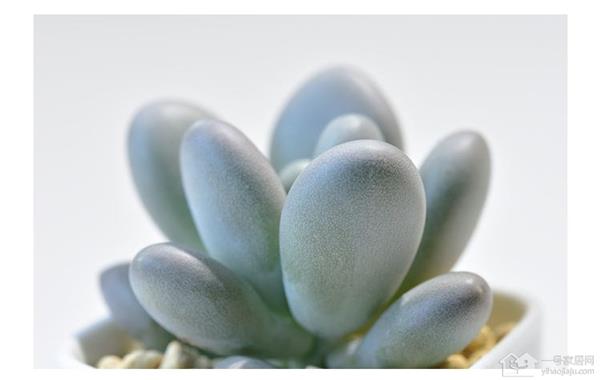
I. Morphological characteristics of Pachyphytum oviferum
Stem
In the early growth stage, the plant has an upright short stem; later the stem becomes prostrate to pendulous, reaching up to 20 cm long, with a diameter of 0.7-1.3 cm wide.
Leaves
The fleshy leaves are alternate, arranged in an elongated rosette, obovate to obovate-elliptic, 3-5 cm long, 1.8-3 cm wide, about 0.8-1.7 cm thick, with rounded-obtuse tips and smooth surfaces; leaf color ranges from bluish gray-green to light purple, covered with a thick white powdery bloom.
Flowers
Sepals are about 1.3-2.3 cm long and about 1.0-1.6 cm wide. Petals are elliptic, about 0.7-1.0 cm long and about 0.3-0.45 cm wide, ranging from purplish red to red. Lobes are upright. Anthers are pale yellow.
Plant form
The whole plant can reach 6-10 cm in diameter, with about 12-25 leaves per plant; under normal growth conditions the plant form is compact.
II. Growth habits of Pachyphytum oviferum
It prefers a warm, dry environment with ample light, is highly drought-tolerant, and requires loose, well-draining sandy loam. It grows well in climates with warm winters and cool summers, and does not tolerate hot, humid summer weather.
It is a tropical plant that loves sunlight and tolerates drought, slightly tolerates partial shade, and is not cold-tolerant; it is suitable for growing in a sunny, cool, and dry environment, and dislikes damp shade and hot, stuffy conditions. The minimum winter temperature must be above 10 degrees. It requires well-draining soil, preferably a mix of sand and small gravel.
III. Types of Pachyphytum oviferum
At present, common types of Pachyphytum oviferum include Pachyphytum 'Blue Star', Sedum dasyphyllum, Sedum dasyphyllum 'Major', Sedum dasyphyllum 'Minor', and other varieties.
Pachyphytum 'Blue Star': Pachyphytum 'Blue Star' is a succulent of the Crassulaceae family, Pachyphytum genus, native to San Luis Potosi in central Mexico. The plant's leaves are arranged in a ring, spoon-shaped, with leaf tips, arc-shaped leaf margins, thick and smooth leaves with a slight white powdery bloom, and leaf color from grass green to dark green. With ample sunlight, the tightly arranged leaves develop red edges and tips; in weak light, the leaf color becomes light green, the leaves become narrow and long, and the spacing between leaves elongates due to etiolation.
Sedum dasyphyllum: Sedum dasyphyllum is a small succulent or fleshy plant of the Crassulaceae family, Sedum genus. It is native to arid regions of West Asia and North Africa. Sedum dasyphyllum is a perennial succulent plant, 5-10 cm tall, with many-branched stems; the leaves are enlarged, alternate, obovate-orbicular, 2 cm long, green, fleshy, dark green; the dark green fleshy leaves resembling jade are very bright and beautiful under sunlight. It blooms in spring, with pale pinkish-white flowers.
IV. How to grow Pachyphytum oviferum
Temperature: Pachyphytum oviferum by nature prefers a warm, dry, and ventilated environment. In summer, it needs a cool temperature environment, and in winter it needs a warm environment; only when these conditions are met can Pachyphytum oviferum grow well.
Soil: Pachyphytum oviferum has low soil requirements, but it is enough to ensure the soil is loose and well-draining. The soil can be mixed with peat, perlite, and coal cinder at a 1:1:1 ratio, and river sand can be spread on the surface to ensure air permeability.
Light: Pachyphytum oviferum loves sunlight, so it should be given appropriate light. However, in summer, Pachyphytum oviferum should not receive direct sunlight; it can be placed in a ventilated, shady spot to receive appropriate indirect light. In winter, place Pachyphytum oviferum on a balcony.
Watering: Pachyphytum oviferum does not have high water requirements. In summer, it can be watered about 3-4 times a month; in winter, when temperatures are lower, watering can be appropriately reduced; in early spring, watering should be increased gradually, otherwise it is prone to root rot.
The above is the relevant introduction in this article. I believe that after reading it, you have a simple understanding of this. If needed, you can continue to follow No.1 Home Network to learn more information.