A Detailed Guide to the Ecological Habits and Distribution of Haworthia truncata
Haworthia truncata is a succulent plant of the genus Haworthia in the family Asphodelaceae (formerly Liliaceae), native to southern Africa. The plant is low-growing and stemless, with fleshy, upright leaves. Below, let us take a look at an introduction to the ecological habits and distribution of Haworthia truncata.
An Introduction to the Ecological Habits and Distribution of Haworthia truncata
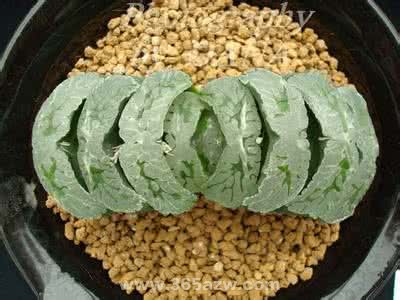
Because the climate is hot and humid, during cultivation the leaves are allowed to protrude above the soil surface for viewing. On the leaf cross-sections of different varieties, various different transparent patterns appear. The leaves of the horticultural variety 'Yushanjin' (Haworthia truncata f. variegata) bear yellow or pink markings, making it even rarer and more precious.
Repot once every spring, using a fertile, loose, well-draining sandy soil with good water retention. Because its root system is relatively deep, during the growing period the fibrous roots should be kept from becoming too dry, which would affect growth, and a deeper pot should also be used for planting.
For example, a slender black orchid pot or an unglazed clay pot; on the one hand it allows the roots to extend, and on the other it also gives the roots good respiration. When repotting, mix a little fine-grained Magamp into the soil as a base fertilizer; you can also place a little fine-grained akadama on the soil surface, which not only increases drainage but also looks quite attractive and lovely.
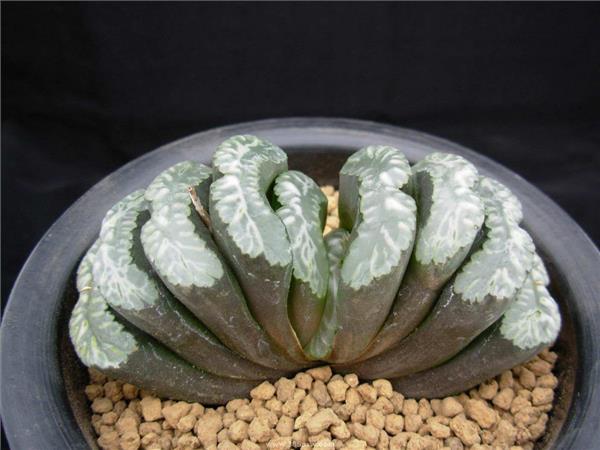
Haworthia truncata prefers warmth, dryness and ample yet soft light. It is drought-tolerant and tolerant of partial shade, dislikes dampness, is not cold-hardy, and cannot tolerate high temperatures or direct strong light.
When temperatures are high in summer, the plant enters a dormant state, growing slowly or stopping completely. At this time it can be placed in a cool, ventilated spot and given appropriate shading, with watering frequency and amount reduced, which prevents the plant from rotting due to stuffiness and dampness.
In winter, place it in a warm spot with ample light; above 10°C you can continue watering so the plant grows normally.
If the temperature is around 5°C, growth will slow, and watering must be controlled (about 2 to 3 times a month). To let the soil surface dry somewhat in the evening, it is best to lightly mist the surface with a sprayer at noon on a sunny day, just enough to moisten it, avoiding frost damage to the plant from low nighttime temperatures.
Spring and autumn are the plant's vigorous growing seasons, when water demand is greater. After the soil surface dries, give plenty of water, keeping the soil slightly moist but not waterlogged. About every 10 to 15 days, apply a balanced nitrogen-phosphorus-potassium flower fertilizer (20:20:20), diluted 2000 to 2500 times as a weak liquid fertilizer, watering it on to provide the nutrients needed during the growing period. It must be placed in a bright, well-ventilated spot to keep the plant low-growing without stretching, and to make the "window" patterns more distinct and brilliant.
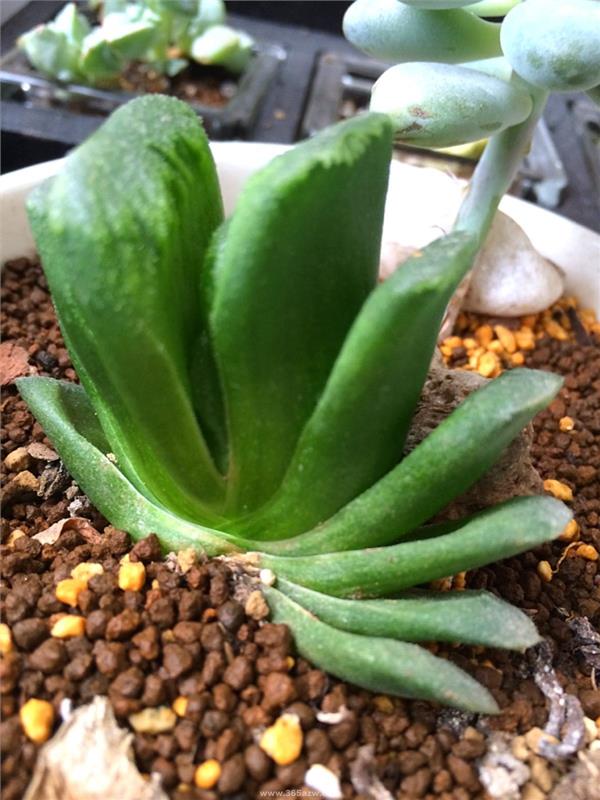
The leaves of the horticultural variety 'Yushanjin' bear yellow or pink markings, making it even rarer and more precious. The varieties of Haworthia truncata are very rich, mainly including Lüdão, Yonggang, Mammoth, Butterfly, Longgong, M-type, Huangji, Xiele, Nazca Line, Volcano, Yushanjin, Xuanwu, Haiye, Guiyancheng, Liuwen, Baiya, Dahei and Gemo.
Haworthia truncata is native to southern Africa and prefers warmth, dryness and ample yet soft sunlight. It is drought-tolerant and tolerant of partial shade, dislikes damp shade, is not cold-hardy, and fears high temperatures and direct strong light. When temperatures are high in summer, the plant enters a semi-dormant state, growing slowly or stopping completely. At this time it can be kept in a cool, ventilated spot, given appropriate shading and reduced watering, to prevent the plant from rotting due to stuffiness and dampness.
In winter it requires ample sunlight; above 10°C you can continue watering so the plant grows normally, and if watering is strictly controlled, it can also tolerate low temperatures of 5°C. Spring and autumn are the plant's vigorous growing seasons; keep the soil moist but not waterlogged, and apply a decomposed, diluted liquid fertilizer once every 10 to 15 days. Repot once every spring, and the potting soil should be a loose, fertile, well-draining sandy soil. Because its root system is relatively deep, a deeper pot should be used for planting.
Division. Carry this out together with spring repotting; the method is to remove the young offsets growing beside the mother plant, let them dry for 1 to 2 days, then plant them separately. Newly planted plants do not need watering; after a week, water moderately. Leaf cuttings. During the growing season, cut healthy fleshy leaves with a semi-lignified base, let them dry for 2 to 3 days, then insert them into sand or vermiculite, keeping them slightly moist; at 20°C to 25°C they root in 3 to 4 weeks. Root cuttings.
After breaking healthy roots off from the base of the plant, still bury them in the soil with about 1 cm exposed above the surface, and buds will sprout from the top and grow into new plants. You can also pull a vigorously growing plant with a well-developed root system slightly out of the soil, cut it off completely 1 cm below the root crown, turn the plant over to let the wound dry, and plant it separately; the remaining roots stay in the soil and will also sprout.
Repot Haworthia truncata once every spring, using a fertile, loose, well-draining sandy soil with good water retention. Because its root system is relatively deep, during the growing period the fibrous roots should be kept from becoming too dry, which would affect growth, and a deeper pot should also be used for planting, such as a slender black orchid pot or an unglazed clay pot; on the one hand it allows the roots to extend, and on the other it also gives the roots good respiration. When repotting, mix a little fine-grained Magamp into the soil as a base fertilizer; you can also place a little fine-grained akadama on the soil surface, which not only increases drainage but also looks quite attractive.
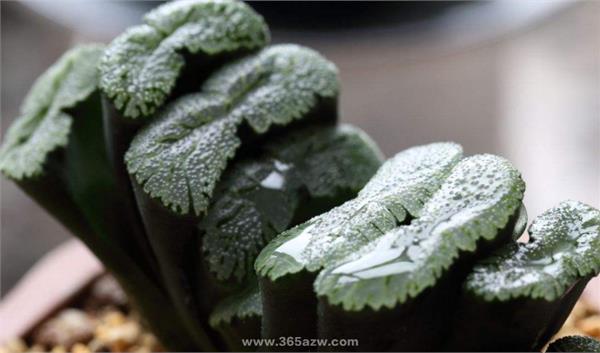
Haworthia truncata can be propagated by division, leaf cuttings and sowing. With the usual division method, this is mostly done together with spring repotting: remove the young offsets growing beside the mother plant, let them dry for 1 to 2 days, then plant them separately in other pots. The newly planted seedlings do not need immediate watering; after about a week, once the wound has dried, water moderately.
For leaf cuttings during the growing season, cut healthy fleshy leaves with a slightly lignified base, let them dry for 2 to 3 days, then insert them into a medium mixed of perlite and vermiculite, cover with plastic sheeting to retain moisture, and they will root in about 3 to 5 weeks. Some enthusiasts use artificial pollination to crossbreed them and produce seeds, using large numbers of seedlings and the differences between individual plants to select their favorite forms and characteristics. Because it belongs to the same genus as "Shou" (Haworthia retusa), the sowing method is much the same.
Haworthia truncata grows slowly and has few pests and diseases. It can be cultivated with just a little spare time, and does not need to be planted in a large pot; its unusual plant shape, thick fleshy leaves and beautiful, varied transparent patterns make it quite nice to display for viewing on a desk, windowsill or other small space.
A little fine-grained akadama not only increases drainage but also looks quite attractive.
Haworthia truncata can be propagated by division, leaf cuttings and sowing. With the usual division method, this is mostly done together with spring repotting: remove the young offsets growing beside the mother plant, let them dry for 1 to 2 days, then plant them separately in other pots. The newly planted seedlings do not need immediate watering; after about a week, once the wound has dried, water moderately.
For leaf cuttings during the growing season, cut healthy fleshy leaves with a slightly lignified base, let them dry for 2 to 3 days, then insert them into a medium mixed of perlite and vermiculite, cover with plastic sheeting to retain moisture, and they will root in about 3 to 5 weeks. Some enthusiasts use artificial pollination to crossbreed them and produce seeds, using large numbers of seedlings and the differences between individual plants to select their favorite forms and characteristics. Because it belongs to the same genus as "Shou" (Haworthia retusa), the sowing method is much the same.
Haworthia truncata grows slowly and has few pests and diseases. It can be cultivated with just a little spare time, and does not need to be planted in a large pot; its unusual plant shape, thick fleshy leaves and beautiful, varied transparent patterns make it quite nice to display for viewing on a desk, windowsill or other small space.