Succulent Plant Variety Introduction and Cultivation Methods
Succulent plants are tenacious little lives; they need only a little water, a beam of sunlight, and a bit of soil to take root in a small flowerpot and slowly grow. Succulent plants often have lovely names that make people fall in love at first hearing, such as Hongzhiyu (Sedum rubrotinctum), Guanyinlian (Sempervivum tectorum), Huangli (Sedum adolphi), and Haworthia... Plant some succulents and let them add a few touches of color and happiness to life! Now let's take a look at succulent plant varieties!
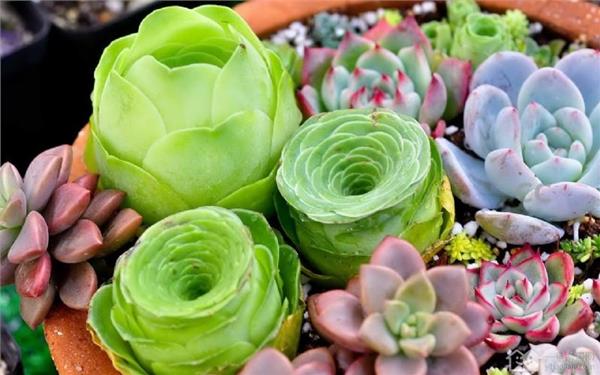
I. Succulent Plant Varieties
1. Hongzhiyu (Sedum rubrotinctum), also known as earring grass and corn kernels, belongs to the order Rosales, family Crassulaceae, genus Sedum.
The leaves are fleshy, long oval-shaped, about 1 cm long, and alternate. The flowers are yellow and star-shaped. In autumn and winter or under strong light, part or all of the leaves turn bright red. The leaf tips are slightly transparent; at this time the leaves are red and green interlaced, with vivid color, like a rainbow or jade, hence the name Hongzhiyu. It likes warmth and is not cold-tolerant. It likes light and has relatively strong drought tolerance. It has strong adaptability and is not strict about soil requirements. Place of origin: Mexico.
2. Huangli, genus name: Sedum, family name: Crassulaceae. The waxy leaves show a particularly golden yellow color. It likes plenty of sunlight; after sunbathing, the edges turn a beautiful red.
3. Guanyinlian (Sempervivum tectorum), also known as houseleek. The plant is low and clustered, and the leaves are arranged in a spiral into a rosette-shaped leaf disk.
4. Zimudan (Sempervivum) is a plant in the family Crassulaceae, genus Sempervivum, a perennial succulent herb; the leaves are relatively thick, mostly in rosette-shaped whorls, similar and most closely related to the genus Aeonium.
5. Zhenzhu Diaolan (Senecio rowleyanus), because it is composed of strings of plump, full, emerald-green oval small leaves, is also called jade beads, lover's tears, Buddhist beads spider plant, jade beads, green bell, and green bell. Zhenzhu Diaolan is not only an excellent hanging foliage plant for indoor rooms, but also a good indoor air-purifying flowering plant.
6. Juanjuan, also known as Dachijuanjuan, Crassulaceae, Sempervivum.
Hongjuanjuan is a classic species of the genus Sempervivum and also a representative of European alpine succulents. It is a perennial succulent herb, and the plant is very low and clustered. The fleshy leaves are spoon-shaped or long obovate. The tips are pointed and slightly covered with a little white fuzz. The thick, fleshy dark red leaves are arranged in a spiral into a rosette-shaped leaf disk, about 2-12 cm in diameter.
7. Haworthia is a relatively popular small succulent plant in recent years.
II. Succulent Plant Cultivation
There are many kinds of succulent plants. The main commonly cultivated ones include Crassulaceae: Aeonium, Crassula, Echeveria, Kalanchoe, and Sedum; Liliaceae: Aloe and Haworthia; Euphorbiaceae: Euphorbia; Agavaceae: Agave and Sansevieria; Aizoaceae: Lithops. In addition, there are some species in Asteraceae, Bromeliaceae, Portulacaceae, and Vitaceae. Crassulaceae plants like warmth and light, and are suitable for well-drained soil. They can be propagated by cuttings or division. The overwintering temperature should preferably be above 5-10°C. Many are good materials for arranging rock gardens and are also suitable for pot cultivation; Liliaceae plants require sufficient sunlight in winter and should be kept cool, and in summer they should be in partial shade; Euphorbiaceae plants require sufficient sunlight and good ventilation, are not cold-tolerant, like high temperatures, and are not tolerant of drought or waterlogging; Agavaceae plants like sunlight, should be cultivated with fertile soil, and in winter should be kept cool and dry with a temperature condition of 8-10°C; Aizoaceae plants like warmth, are not cold-tolerant, like dry and ventilated conditions, and the overwintering temperature in winter should be above 10°C.
The above is the relevant introduction in this article. I believe that after reading it, you also have a simple understanding of this. If needed, you can continue to follow No.1 Home Network to learn more information.