A Detailed Introduction to Chinese Honeylocust Seed Treatment Methods and Planting Methods
The Chinese honeylocust seeds mature in October. After the fruit ripens, it remains on the branches for a long time without falling off naturally, but it is prone to insect damage, so it should be picked in time. It can be picked by hand or removed with a hook knife. The collected fruit is dried in the sun under natural conditions so that the seeds dry and thresh out. Below, we introduce how to plant Chinese honeylocust seeds.
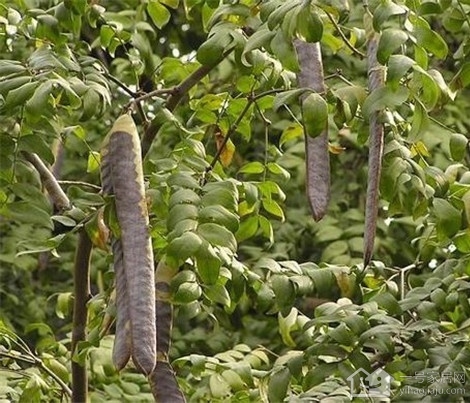
I. How to plant Chinese honeylocust seeds
1. Seed morphology: The pod is linear, flat, not curved, 15-30 cm long and 2-3.5 cm wide, with a surface ranging from blackish purple to blackish brown, glossy, and with inconspicuous transverse cracks. The seeds are mostly oblong-elliptical, brown, glossy, with fine transverse cracks on the surface, and a leathery seed coat that is hard and difficult to peel open. The thousand-seed weight is about 497 grams.
2. Seed retention and seed cultivation: The Chinese honeylocust flowers in May and fruits in October. When the pods turn dark purple, select plants that grow vigorously, have many thorns, and produce large, plump pods, and pick the pods. Fresh pods are soft and the seeds can be removed with scissors. After the pods dry, they become hard and are not easy to open, so a roller must be used to crush the pod skins, and then the seeds are screened out. Store in a dry place. The seeds still have relatively high viability after 5 years of storage.
3. Seed propagation method: Chinese honeylocust seeds have a hard seed coat that is impermeable to water, making water absorption difficult, germination rather difficult, and the germination rate very low. In production, the seeds should be treated with concentrated sulfuric acid, or the seed coat should be damaged mechanically (abraded), which can greatly increase the germination rate. Spring sowing is generally carried out. Soak the treated seeds in water 1 month before sowing, changing the water once every 5-7 days, so that they fully absorb water and the seed coat softens. After the seed coat cracks, sow and raise seedlings. On a prepared seedbed, sow in holes at a row spacing and plant spacing of 20-25 cm, cover with 3-4 cm of soil, and sow 10-15 seeds per square meter. Keep the soil moist regularly. After emergence, take care to cultivate for 1-2 years, then transplant and establish in early spring before budding.
II. Chinese honeylocust seed treatment methods
The seed coat of Chinese honeylocust is relatively thick, and germination is slow and uneven, so germination-promoting treatment is required before sowing. paramjeel believes that treating Chinese honeylocust seeds with concentrated sulfuric acid solution for 15 h will increase the germination rate. In places such as Mississippi in the United States, 20 methods of treating Chinese honeylocust seeds were tested, and it was considered that soaking in hot water or alternating hot/cold water soaking can treat a larger number of seeds, but the seed germination rate is low; making notches on the side or end of the seed and using a heated needle to make a hole in the seed coat (burning) can achieve the best results. There are also reports that using laser treatment with a wavelength of 632.8 mm and a power of 25 mw on Chinese honeylocust seeds and cuttings can increase the seed germination rate and cutting rooting rate to varying degrees. In addition, soaking in 1:4-5 alkaline water for 48 h, then soaking in clean water for 24 h, can achieve a germination rate of 80%-92%. It is also possible in late autumn and early winter to put the cleaned seeds into water, and after they fully absorb water, take them out and mix them with wet sand for storage and germination promotion, then sow in the following spring after the seeds crack.
The seedling-raising site should be chosen where the soil is fertile and irrigation is convenient, and the land should be carefully prepared. For every 667 square meters, apply 3000-5000 kg of organic fertilizer, and build flat beds or raised beds. Use drilling, with a row spacing of 20-25 cm, sow 10-15 seeds per meter of sowing furrow, cover with 3-4 cm of soil after sowing, and keep the soil moist regularly. When the seedlings are about 10 cm tall, thin and finalize the seedlings, with a plant spacing of 10-15 cm. In the same year, the seedlings can reach 50-100 cm in height. If cultivating 2-year-old large seedlings, transplant them in late autumn after the leaves fall, at a row spacing and plant spacing of 0.5 m x 0.5 m.
The above is the relevant introduction in this article. I believe that after reading it, you also have a simple understanding of this. If needed, you can continue to follow No. 1 Home Network to learn more information.