A detailed introduction to tree rose planting techniques, teaching you how to grow tree roses well
Traditionally, cultivating tree roses requires 2 grafting operations, and it takes 3 years to take shape and leave the nursery. Below, let us take a look at the detailed introduction to tree rose planting techniques.
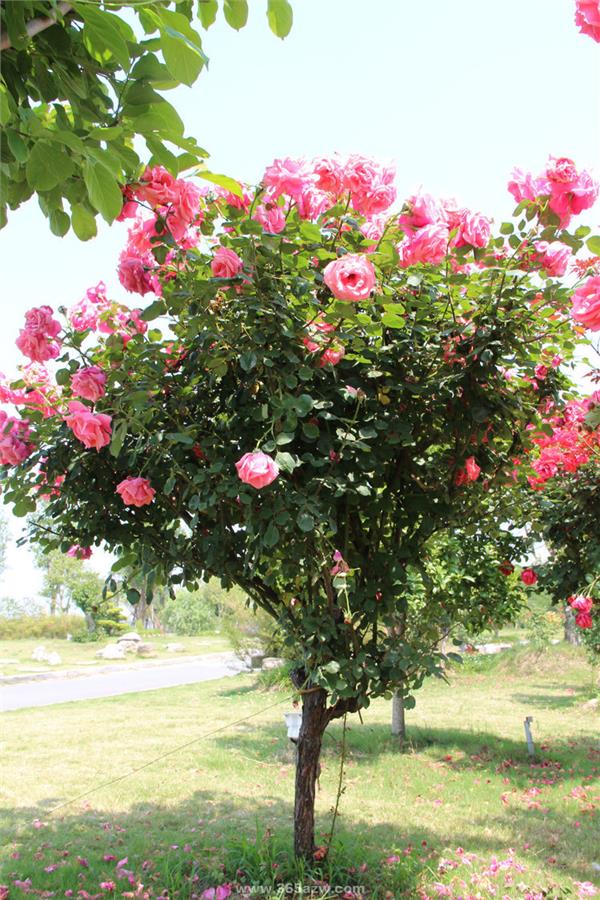
A detailed introduction to tree rose planting techniques
I. Establishment of the nursery
To rapidly propagate tree roses, a double-nursery system should be used. One is the rootstock nursery, and the other is the scion nursery. What the two nurseries have in common is: choose flat, sunny, well-drained, moist and fertile, neutral to slightly acidic soil with a pH of 6 to 6.5, and both should be made into raised beds. During intertillage, apply base fertilizer per mu according to the following formula: 5000 kg of farmyard manure, 20 kg of ammonium phosphate nitrate, 10 kg of urea, 5 kg of carbofuran granules.
The rootstock nursery bed is 1.2 m wide. Insert cuttings of Baiyutang or Fentuan Qiangwei (Rosa multiflora) as rootstock, with both plant spacing and row spacing of 40 cm, and take cuttings from May to July each year. After insertion, pay attention to seedling-stage management. At the Beginning of Winter, heavily prune all branches, leaving only the buds on one or two vigorous branches, while the other weak branches can be cut off close to the root, and take appropriate measures for overwintering and cold protection. The following spring, when the newly sprouted branches reach 50 cm, keep only one vigorous branch per rose plant and cut off all the rest. At this time, apply additional fertilizer once more, applying 3 kg of urea per hundred plants. And irrigate once with a large amount of water. When the vigorous shoot reaches 1.5 m in length, tie it with a thin bamboo pole to prevent it from leaning. At this time, pinch the top, and after the upper part sprouts, keep 3 buds and remove all other suckers. Newly emerging suckers must be removed promptly. 7 to 10 days after pinching, when the rootstock bark is easy to peel, grafting can be carried out.
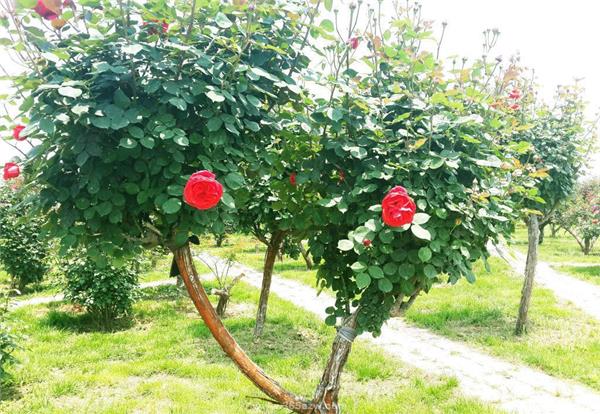
The scion nursery is 1 m wide. Select the large-flowered Tea Rose series and Floribunda Rose series for concentrated planting. Both plant spacing and row spacing are 30 cm. Label by variety to facilitate the selection of scions. And pay attention to seedling-stage management. When grafting, first select vigorous branches with plump graft buds for later use. In order to collect plump graft buds in as short a time as possible, the following measures can be taken: first remove the rose flower buds, spray the bud-donor rose with monopotassium phosphate 5 days in advance, or sprinkle a small amount of urea 7 days in advance and water thoroughly, to facilitate graft bud formation. When taking buds, one principle should be grasped: generally it is best when the graft bud is half a grain of rice in size.
II. Grafting methods
There are many methods for grafting tree roses. The customarily used "patch budding method" is simple, easy to operate, and has the characteristic of a high survival rate. The specific operations are as follows:
Use flower shears to cut off the leaf blade, leaving a 0.5 cm leaf stalk. Pinch the branch tightly with the thumb and index finger of the left hand, with the leaf stalk facing upward, at a 45-degree angle to the ground. Use a budding knife to make a downward diagonal cut 0.5 cm above the graft bud, reaching the xylem, going from shallow to deep, and after passing the bud going from deep to shallow, with a cut length of 2.5 to 3 cm. The bud can then be removed from the branch. Lightly pinch the leaf stalk with the left hand, with the xylem facing upward, and with the right hand peel back a little bark from below the bud, causing the xylem to tilt upward. Lift upward, and the xylem will be separated off. Then quickly use the grafting knife to make a horizontal cut at a smooth part of the rootstock about 1.4 m high, depending on the size of the scion bud. Generally the cut is about 0.5 cm long. On one side of the cut, make another downward vertical cut. Be careful to avoid damaging the xylem as much as possible. Insert the tip of the knife from the intersection of the two cuts, lift the bark, tear downward 2 cm, leave the lower 0.4 cm, cut off the upper 1.6 cm of bark, quickly place the graft bud into the opened bark layer of the rootstock, press it tightly against the rootstock xylem, keep the bud eye, and wrap the interface tightly with a plastic strip 20 cm long and 0.7 cm wide.
III. Key points of grafting
Fast: first, the knife must be sharp; generally after grafting about 200 plants, a new knife should be replaced; second, the movements must be fast. Throughout the entire grafting process, from taking the bud to tying the binding material well, the time used should be controlled within 2 minutes to reduce infection of the wound by pathogens.
Tight: the graft bud and the rootstock cut must be tied tightly and bound securely to avoid water loss.
Wide: the rootstock cut must be 1 to 1.5 mm wider than the graft bud. First, this prevents the graft bud from being larger than the rootstock cut; second, it heals quickly.
Generally grafting heals after 5 to 6 days, and on cloudy days it should be one or two days later. Failed grafts should be regrafted promptly.
IV. Management after grafting
1. Crown control and sucker removal: one week after grafting, cut off the lower two of the 3 side branches left on the rootstock, and pinch the top of the uppermost one. Remove suckers promptly to facilitate graft bud growth. Two weeks later, cut off the last remaining rootstock side branch at the top.
2. Unbinding: after grafting, when the new shoots grow to 10 to 15 cm, remove the binding string. At this time, additional urea is also needed, applying 1 kg per hundred plants. When applying, keep 30 cm away from the roots, rake out a small furrow, cover with soil after application, and in case of dry weather, irrigate once with a large amount of water.
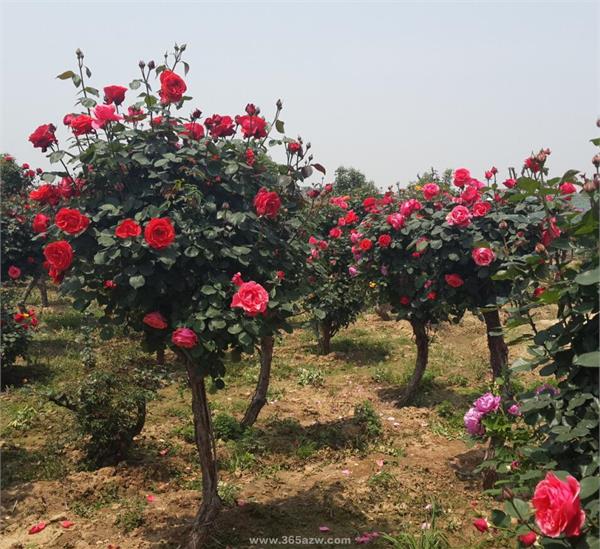
3. Pruning: when pruning, one principle should be grasped: "frequent." Generally, when new shoots show buds, the flower buds should be removed to encourage the new branches to mature and sprout buds elsewhere. If the newly sprouted buds again show buds, they should also be removed, until the crown diameter reaches 40 to 50 cm. At this time, when pruning, try not to let the branches expand outward any further. When the crown becomes dense and spherical, it can leave the nursery.
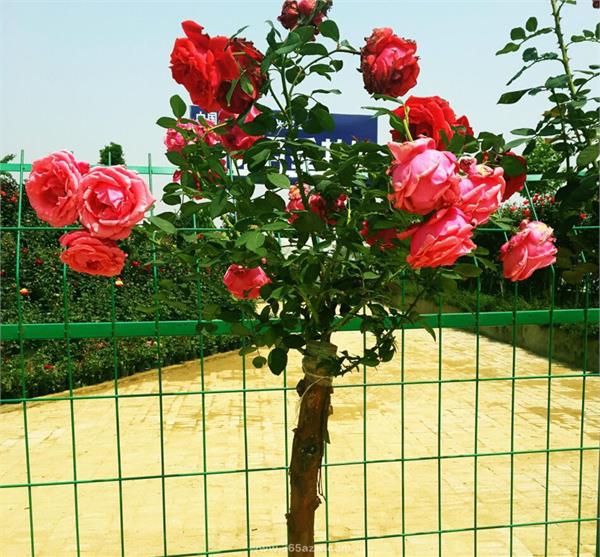
4. Watering: before 9 a.m. and after 5 p.m. are the best times for watering.
V. Prevention and control of common pests and diseases
1. Aphids and red spiders: use omethoate or dichlorvos 1000-fold solution, once a week, spraying 2 times in succession.
2. Scarab beetles and bridge-forming caterpillars: these two insects like to eat tender leaves and flower buds and are the most harmful to roses. Spray 50% methamidophos diluted 1500-fold, once every 7 days, spraying 2 times in succession. Note that both the front and back of the leaves must be sprayed.
3. Powdery mildew: powdery mildew mostly occurs in the rainy season or humid seasons, at temperatures between 18°C and 23°C. Under ventilated conditions, on sunny days with a high temperature of around 30°C, it can disappear on its own within a few days. Traditional spraying uses lime sulfur mixture or carbendazim or triadimefon.
4. Black spot disease: exactly opposite to powdery mildew, black spot disease occurs on the old leaves of roses, and over time the leaves turn yellow and fall off. After it occurs, spray lime sulfur mixture or Bordeaux mixture, thiophanate-methyl, etc., once every 7 to 10 days. Spraying is always done from 5 p.m. to 7 p.m.