How to grow jasmine? Remember these 5 key points
Jasmine is the collective name for evergreen shrubs or vines of the genus Jasminum in the family Oleaceae. Many flower lovers grow jasmine, but many of them are not very clear about how to grow it. Below, let's talk about what jasmine growing methods there are.
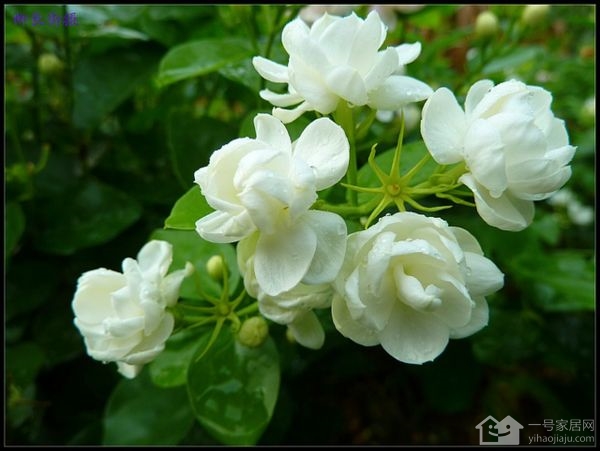
I. Jasmine's growing environment
Jasmine likes a warm, humid environment with plenty of sunlight, and grows best in a well-ventilated, semi-shaded spot. The most suitable soil is slightly acidic sandy soil containing plenty of humus. Most varieties are sensitive to cold and drought, and cannot tolerate frost, waterlogging or alkaline soil. When the winter temperature drops below 3°C, the branches and leaves are prone to frost damage, and if it lasts a long time, the plant will die.
II. Jasmine growing methods
1. Water: Jasmine is not drought-tolerant, but it also dislikes waterlogging. During the rainy season, the water accumulated in the pot should be poured out promptly, otherwise the leaves easily turn yellow. On hot sunny summer days, water twice a day, once in the morning and once in the evening. If the leaves are found to be curling and drooping, spray water on the leaves to promote growth.
2. Soil: For growing jasmine, fertile sandy and semi-sandy soil is best. When planted in slightly acidic soil with a pH of 6 to 6.5, the root system is dense and growth is vigorous. If the soil is heavy clay, lacking organic matter, low in fertility and poorly aerated, then the root system will be sparse, the plant short, the stems and leaves thin, and the flowers few and small.
3. Fertilizing: The peak growing season for jasmine is the hot midsummer period. Apply more organic fertilizer and phosphorus-potassium fertilizer, such as peanut cake meal, bone meal, superphosphate and multi-element flower fertilizer, twice a month. During the summer growing period, jasmine often shows lush branches and leaves but no flowers. The main reason is applying too much nitrogen fertilizer, which causes excessive vegetative growth. In such cases, control the fertilizer and water, and apply more phosphorus-potassium fertilizer to encourage flower bud formation. At the same time, pay attention to light: move the jasmine to a spot with plenty of sunlight and good ventilation. Jasmine likes hot, humid, well-ventilated environments and needs sufficient light. Jasmine is sensitive to cold. In the south, potted jasmine can be grown outdoors through the winter, while in the north, keep it warm in autumn and winter by moving it indoors to a south-facing spot. With strong light, the branches are sturdy, the leaves dark green, and the flowers numerous and fragrant; with insufficient sunlight, the nodes are sparse, the flowers few and not fragrant.
4. Fertilizer and water: The peak growing season for jasmine is the hot midsummer period. Apply more organic fertilizer and phosphorus-potassium fertilizer, such as peanut cake meal, bone meal, superphosphate and multi-element flower fertilizer, twice a month. During the summer growing period, jasmine often shows lush branches and leaves but no flowers. The main reason is applying too much nitrogen fertilizer, which causes excessive vegetative growth. In such cases, control the fertilizer and water, and apply more phosphorus-potassium fertilizer to encourage flower bud formation. At the same time, be sure to move the jasmine to a spot with plenty of sunlight and good ventilation.
5. Pruning: As the flower saying goes, "If jasmine is not pruned, weak branches and few flowers are very obvious" and "Prune hard, and the blooming will be steady." But when people grow jasmine, they often focus on fertilizer and water and neglect pruning, and even begrudge cutting away dead branches after overwintering, so that the branches become thin and weak, the leaves wilt and shrink, the plant shape is unattractive, and the flowers are sparse. For jasmine pruning, besides cutting away the thin, weak branches after overwintering in spring and leaving only the thick base to await new bud growth, summer pruning is very important. After the flowers fade, promptly leave 3 to 5 nodes on the branch and cut off the top tip to encourage new shoots. This ensures vigorous flowering.
The above is the related introduction in this article. I believe that after reading it, you now have a simple understanding of this. If needed, you can continue to follow No.1 Home Network to learn more information.