Detailed explanation of the contraindications and compatibility dos and don'ts for Plantago seed
Verbena is a flowering plant with a rather graceful form, rich and varied flower colors, and brilliant blooms that are very beautiful. Below, let us learn about the cultivation methods for verbena:
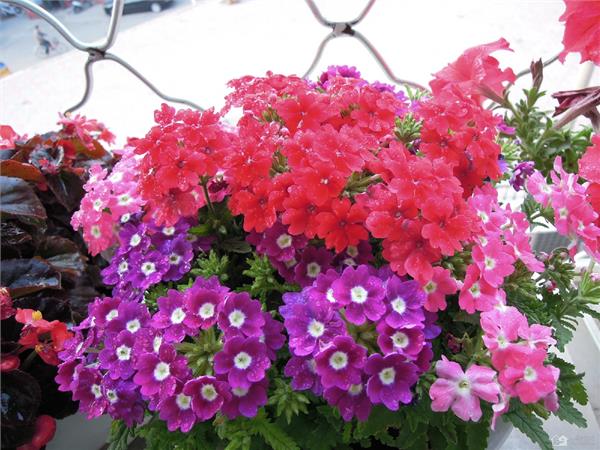
Cultivation methods for verbena
1. Propagation methods for verbena
Verbena can be propagated by sowing or by cuttings. The germination rate of sowing is only about 50%, and at a temperature of 15-17°C, seedlings begin to emerge only after 2-3 weeks. After the seeds are sown, they should be placed in a dark place, and not only should the soil be kept moist, but the air should also be kept humid. Watering cannot be done by pouring directly from above; instead, use a shallow pan or similar container holding water 3-4 cm deep, then immerse the flower pot in it. Let the water enter through the drainage hole in the bottom of the pot, and take it out after the soil is moist; otherwise the germination rate will be even lower. Sowing time is mostly in spring, and flowering generally occurs in July.
Verbena cuttings can be taken from May to June each year. Take semi-lignified branches and cut them into 5-6 cm long sections as cuttings, insert them into a moist sand bed, and shade them immediately afterward. After 2-3 days, they can be exposed to a little morning and evening sunlight to promote growth, and after about two weeks they can sprout new shoots and take root. When the seedlings have grown 5-6 true leaves, transplant them, and when they reach 7-8 cm, plant them in their final position.
2. Watering
Because verbena has a relatively shallow root system, attention should be paid to watering in summer to prevent drought. During the maintenance period, too much or too little water is unfavorable to growth. With too much water, the stems become thin and weak and grow excessively, and the number of flowers decreases; with a lack of water, the plant grows and develops poorly and may set seed early.
3. Light
Light is very important for the growth and development of verbena. From seedling growth to flowering, verbena needs sufficient sunlight; then the stems and leaves grow robustly, the flowering branches are dense, flowering is continuous, and the flower colors are vivid. If it is kept in a semi-shaded state for a long time or receives insufficient light, the stems and leaves tend to grow excessively, flowering decreases, the flowers become smaller, and the flower colors are not vivid.
4. Growing medium
For the soil, use a mixed medium composed of fertile, loose, and well-drained potting soil, peat soil, and coarse sand, with a pH of 6.0-6.5.
5. Fertilizing
Like other herbaceous flowers, verbena has a relatively high demand for fertilizer and water, but the fertilizing (and watering) principle of "light fertilizer applied frequently, small amounts with more applications, and complete nutrition" should be followed, and after fertilizing, the leaves and flowers should be kept dry at night.
6. Pruning
Before flowering, verbena is generally pinched back twice to encourage the sprouting of more flowering branches.
7. Pest and disease control
The main problems are powdery mildew and downy mildew, which can be sprayed with a 1000-fold dilution of 70% thiophanate-methyl wettable powder. The insect pests include aphids and whiteflies, which can be killed by spraying with a 1000-fold dilution of 2.5% derris extract emulsifiable concentrate.
When verbena blooms, it looks like a sea of flowers, very beautiful and attractive. As a potted plant, it is a suitable flower variety for decorating and beautifying the home. That is all for the introduction to verbena cultivation methods. If you want to plant flowers and plants to decorate your home, verbena is a good choice.