What plant is sweet alyssum? A guide to its growing habits
I wonder whether you are familiar with a plant called sweet alyssum, but judging by its form, sweet alyssum is actually quite similar in shape to the hydrangea. That is because the flowers they produce are both spherical in form, and sweet alyssum is also known to us as "jade butterfly ball" and other names; it belongs to the family Brassicaceae and the genus Lobularia (sweet alyssum). So what is sweet alyssum? Let's find out together.
I. What is sweet alyssum
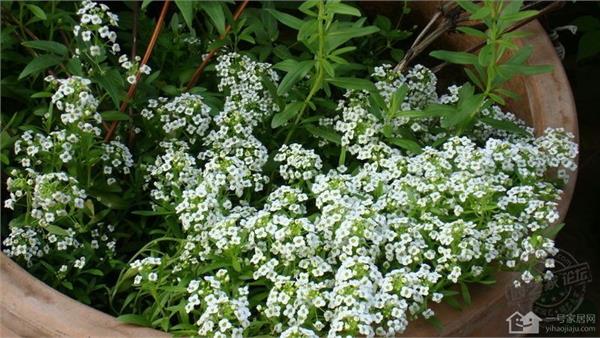
Sweet alyssum is a perennial herb with a woody base, but whether grown as an annual or a biennial, the cultivated plants do not become woody; it grows 10-40 cm tall, and the whole plant is covered with "T"-shaped hairs that have a silvery-gray tint. The stems branch upward from the base and often form dense clumps. The leaves are linear or lanceolate, 1.5-5 cm long and 1.5-5 mm wide, tapering at both ends, with entire margins. Sweet alyssum has excellent ornamental value; it grows in multiple plants and blooms profusely, and seen from a distance it is a mass of white, giving off waves of delicate fragrance. Whether planted in a courtyard or garden, or grown in a pot, sweet alyssum is a great choice.
Sweet alyssum is native to Europe and West Asia. It likes cool conditions and dislikes heat, requires plenty of sunlight, tolerates light shade, prefers loose soil, dislikes waterlogging, and is relatively tolerant of drought and poor, thin soil. Sweet alyssum likes a cool climate, dislikes intense heat, and tolerates frost and cold. It prefers a relatively dry air environment; if rainy days drag on too long, it is easily infected by pathogens. It is afraid of being rained on, and the leaves should be kept dry at night. The optimum relative air humidity is 40-60%.
II. About sweet alyssum
Sweet alyssum is a flowering plant with very good ornamental value; when it blooms profusely, seen from a distance it is a mass of white, and it also gives off waves of delicate fragrance. Whether you plant sweet alyssum in a courtyard or a garden, or grow it as a potted plant, it is a very good choice.
First of all, you should know that sweet alyssum is best sown in autumn. We can propagate it by sowing seeds or by cuttings, and the temperature most suitable for its growth is 20°C. First, we should evenly scatter the sweet alyssum seeds over loose sandy soil, and then press them down lightly. Next, we need to maintain the soil moisture well; after about 5-10 days it will sprout, and when it has 3-4 leaves, it can be placed in a pot to grow.
Sweet alyssum is the same as other flowers and plants: it most fears careless fertilizing, so when fertilizing sweet alyssum we should follow the principles of "light fertilizer applied frequently, small amounts but many times, complete nutrition" as well as "alternate dry and wet; when dry, dry it out thoroughly; if not dry, do not water." And at night, be sure to keep its flowers and leaves dry.
III. The growing habits of sweet alyssum
Sweet alyssum likes cool weather, dislikes heat, and needs sufficient sunlight, but at the same time it is relatively shade-tolerant and is suitable for planting in loose soil; above all, do not let it be flooded. At night, try to keep the flowers and leaves of sweet alyssum dry. When sweet alyssum blooms profusely, it gives off waves of fragrance; whether it is arranged in a garden, flowerbed or elsewhere, it is also a good choice for potted display.
Sweet alyssum is not very strict about temperature and can generally adapt as long as the weather is not especially cold. Once the temperature exceeds 30°C, it easily dies, so in summer the temperature most suitable for sweet alyssum's growth is 15-25°C. Therefore, if you want to grow sweet alyssum, it is best to choose to sow it in autumn or winter. When moving sweet alyssum into a flower pot, you need to place a 2-2 cm thick layer of coarse-grained substrate or ceramic pellets at the bottom of the pot as a drainage layer, and sprinkle some organic fertilizer in the middle as a base fertilizer.
The above is the relevant introduction in this article. I believe that after reading it you now have a simple understanding of this topic. If you need more, you can continue to follow No. 1 Home Network to learn more information.