How to grow Phalaenopsis orchids? Master these care methods
Phalaenopsis orchids have beautiful and elegant flowers. The gracefully upright flower stems stand tall above the glossy emerald green leaves, and the fully bloomed flowers look like colorful butterflies fluttering, gorgeous and elegant, delighting the eye. With one flower in the room, the whole house is filled with spring colors, a feast of beauty. So how should Phalaenopsis orchids be cared for? Let us take a look below at what care methods there are for Phalaenopsis orchids.
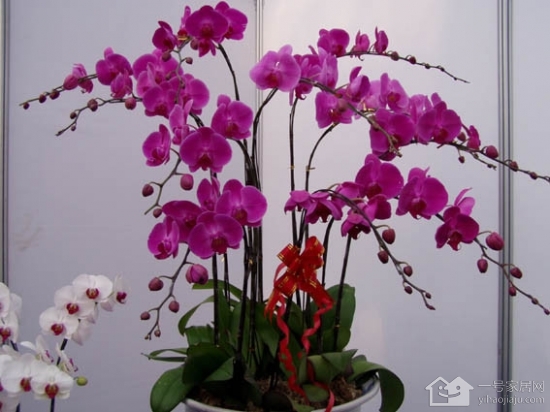
I. Growth habits
Phalaenopsis orchids originate from tropical rainforest regions and by nature love warmth and fear cold. The suitable growing temperature is 15-20°C. Below 10°C in winter, growth stops, and below 5°C they easily die. Native to the tropical regions of Malaysia, Phalaenopsis belongs to the orchid family, genus Phalaenopsis, and is a perennial herbaceous plant. Forest trees along riverbanks and coasts with high temperature and high humidity are where Phalaenopsis orchids attach and grow. Because of their physiological structure, Phalaenopsis orchids can protect themselves from the stress effects of low humidity conditions, but in overly wet environments, high temperature and high humidity often come with disease. The most suitable relative humidity range is 60%-80% RH.
II. Care methods for Phalaenopsis orchids
1. Planting
When potting Phalaenopsis orchids, first fill the bottom of the pot with a permeable substrate, then plant the Phalaenopsis seedling in the pot using 1/3 moss and 2/3 fern roots on top, and press slightly, just enough to fix the orchid seedling in the pot. If planting entirely in moss, the water-soaked moss should be squeezed dry, loosely wrapped around the lower part of the orchid seedling's roots, and lightly pressed, but the moss must not be pressed too tightly, because moss absorbs a large amount of water; if pressed too tightly, it will cause root rot.
2. Repotting
The best time for repotting is late spring and early summer, just after the flowering period, when new roots begin to grow. The temperature during repotting must not be too low; a little carelessness in management can cause root rot and death. Potted small seedlings should be gradually repotted into pots one size larger according to their growth, and small seedlings must never be planted directly into large pots. When repotting small seedlings, there is no need to remove the original growing substrate, so as to avoid damaging the roots. Simply wrap another layer of moss or other potting substrate around the roots and plant into a pot one size larger, keeping the root crown level with the rim of the pot. Well-growing young seedlings can be repotted once every 4-6 months. After repotting, the plant needs to be placed in a shaded place for two weeks; during this period no fertilizer should be applied, only misting or appropriate watering.
3. Light and shading
Orchids grown outdoors need shading: 70%-80% shading in summer, 50%-60% shading in spring and autumn, and 40%-50% shading in winter. Shading materials include shade netting, curtains, or homemade racks of wooden strips and bamboo slats. Homemade shading racks should have strips 4-5 cm wide with 3.3-4 cm intervals, placed about 1 m above the orchid pots. For those placed indoors, Phalaenopsis orchids can be put in a spot with good light, and when the light is strong, curtains can be used for shading; pay attention to ventilation, and they can still be grown well.
4. Fertilizer and water management
Fertilizing Phalaenopsis orchids is basically done together with watering. Generally, major elements and trace elements are dissolved in water in proportion, the pH is adjusted to slightly acidic, and then the whole plant is sprayed, 1-2 times a week, at a concentration of 0.1%-0.2%. It is best to use fertilizers that the plant can directly absorb. The planting density of Phalaenopsis orchids is 20-32 plants per sq m, planted at equal spacing. After planting, watering is mostly done by misting. Soft water should be used for misting to prevent water deposits from being left on the leaf surface and affecting growth. Spraying water not only waters the plant but also increases air humidity, which is beneficial to plant growth and development. Phalaenopsis orchids should be watered appropriately, not excessively. If the temperature is too high or too low, or the air humidity is too dry or too wet, flower buds easily drop. Fertilization should follow the principle of "light fertilizer, small amounts, frequent application." For growing Phalaenopsis orchids, water moss and moss are generally chosen as the growing substrate. The principle of fertilization should be to apply less fertilizer and apply dilute fertilizer. During normal growth periods, apply orchid-specific fertilizer at 2000 times dilution for root fertilization, once every 2-3 weeks depending on growth conditions. Before Phalaenopsis orchids bloom, a compound flower fertilizer mainly based on water-soluble high-phosphorus and high-potassium fertilizer at 1000-2000 times dilution can be chosen, sprayed once about every 10 days. Stop fertilizing during the flowering period and in seasons with lower temperatures.
The above is the related introduction in this article. I believe after reading it you also have a simple understanding of this. If needed, you can continue to follow No.1 Home Network to learn more information.