Snake Plant Basic Information and Care Notes
At a time when keeping plants at home has become widely popular, the snake plant has secured its place thanks to its strong adaptability, decorative appeal, and usefulness. More and more people have grown fond of the snake plant, but because the snake plant is still not widely known enough, many people do not know enough about how to grow it, which leads to many problems during the growing process. Below, let us take a look at an introduction to snake plant care methods.
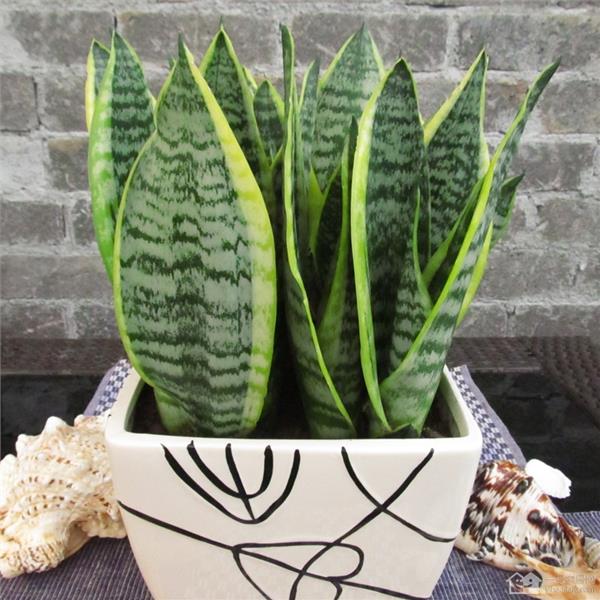
I. Snake Plant Basic Information
The snake plant is a perennial succulent herb. Its rhizome has a creeping feel, and the rhizome bears funnel-shaped leaf clusters. The leaves are upright, leathery and thick, light green, with irregular dark green horizontal banded markings. These markings look very much like the stripes on a tiger, which may be why it is called the snake plant. Generally, snake plants are 50 cm to 70 cm tall, and the leaves are about 3 cm to 5 cm wide. In spring and summer, which is the flowering season for the snake plant, it sends up flowers singly from the rhizome in a raceme, in clusters of 3-5 blooms, with a sweet and elegant fragrance. Common snake plant varieties include golden-edged snake plant, short-leaf snake plant, silver short-leaf snake plant, golden-edged short-leaf snake plant, and stone pencil snake plant. It can be said that the golden-edged snake plant is one of the varieties with relatively high ornamental value, with thin yellow banded stripes along the leaf margins and a light green center with dark green horizontal stripes, looking very beautiful.
II. Snake Plant Care Methods
First, soil selection
The snake plant requires loose soil and needs good air permeability, so when mixing soil for the snake plant, be sure to use 2/3 leaf mold plus 1/3 garden soil. Remember that the soil must be loose and airy, otherwise water will not evaporate easily, leading to rot of the rhizome.
Second, sunlight requirements
The snake plant likes light, so be sure to let it come into contact with sunlight often. It is best to place it somewhere it can receive direct sunlight. If conditions do not allow that, then place it somewhere close to the sunlight. Being placed in a dark place for a long time will cause the leaves to turn yellow.
Third, temperature
The snake plant has fairly high temperature requirements. Its suitable growing temperature is 20-30°C, and in winter it should not go below 10°C, so be sure to pay attention, especially in northern regions.
Fourth, watering
The snake plant also has fairly high water requirements. Generally speaking, if the soil is relatively loose, it needs watering twice a week, while in winter, because of climate factors, only once is enough.
Fifth, repotting
Snake plants are generally repotted once every 2-3 years, and usually only need repotting after the leaf clusters have filled the pot. Because the plant grows upward and has high ornamental value when the pot is small and the plant is dense, the pot should not be large. It is best to plant it in a relatively deep cylindrical flower pot, so that the upper and lower proportions are coordinated and relatively stable, and the underground creeping stems will extend in circles along the pot edge without affecting the plant's growth.
III. Snake Plant Care Notes
1. If the snake plant has been placed indoors for a long time, it should not suddenly be moved directly into the sunlight. It should first be moved to a place with better light and given time to adapt before being exposed to sunlight, so as to avoid scorching the leaves.
2. Watering should be moderate, following the principle of preferring dryness over moisture. Usually wipe dust from the leaf surface with clean water to keep the leaves clean and glossy. In spring, when new plants sprout at the root crown, water appropriately more to keep the potting soil moist; in the high-temperature summer season, the potting soil should also be kept moist regularly; after late autumn, watering should be controlled and the potting soil kept relatively dry to enhance cold resistance.
The above is the related introduction in this article. I believe that after reading it, you now have a simple understanding of this as well. If needed, you can continue to follow No.1 Home Network to learn more information.