What are the flower language and legends of the canna lily?
The canna lily is not demanding about soil, but it grows best in loose, fertile, well-drained sandy loam. Let us now take a look at exactly what the flower language and legends of the canna lily are.
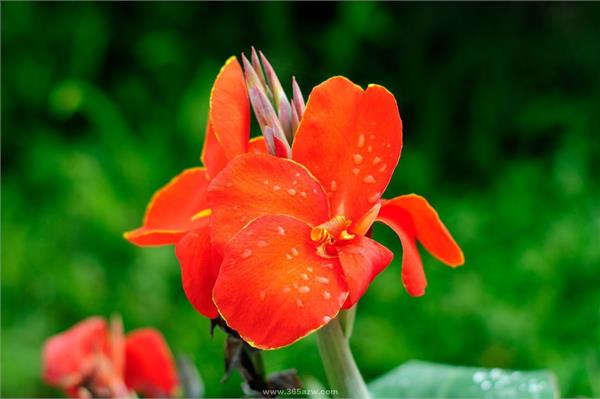
What exactly are the flower language and legends of the canna lily?
The flower language of the canna lily: a solid future
The canna lily originates from India and the tropical regions of South America and tropical Asia, and was developed by hybridizing plants of the same genus native to South America and the subtropics. It likes warmth and ample sunlight, and is not cold-tolerant. When planting it, the soil is required to be deep and fertile; for pot cultivation, the soil must be loose and well-drained. Fertilize regularly during the growing season. In the north, the underground tubers must be dug up before frost and stored in an environment at a temperature of about 5°C. Because its flowers are large and brightly colored, rich in color, with a good plant shape, it is easy to cultivate. The optimum temperature for open-field cultivation is 13-17°C. It is not strict about soil, growing best in loose, fertile, well-drained sandy loam, and it also adapts to fertile clay soil. South of the Yangtze, it can overwinter outdoors in a wind-sheltered spot. Propagate by division or by seed. Division is carried out in April-May, when the buds begin to sprout; cut the rhizome into sections each bearing 2-3 buds and plant them separately.
The legend of the canna lily's flower language
There are many versions of the legend about the canna lily; the following are three of them.
Legend one:
It is said that long ago, on a night with a bright moon and clear breeze, several fairies in the heavenly court who could not bear their loneliness sneaked out of the palace to peek at the mortal world. When their gaze turned to the Changtan region, they could not help exclaiming: what beautiful scenery! They forgot the rules of heaven, felt earthly desires, and decided to go down to the mortal world for a visit.
The fairies pressed down their cloud heads and landed right by the Changtan River. Each broke off a twig and shook it into an oar; each picked a leaf and breathed on it to turn it into a boat. Leisurely and carefree, they rowed and played, singing and laughing, which drew the water creatures in the pool to float up and watch, filled with envy. After midnight, they abandoned their boats and went ashore, followed the mountain path, and walked into the narrow gorge. There they saw a waterfall plunging straight down, the water clear as a mirror, a breathtaking sight. The fairies could not restrain themselves: they took off their outer garments and, one by one, jumped into the pool, chasing each other and playing in the water. The mountain birds chirped; day had already dawned, and the fairies could no longer return to the heavenly court, so they turned into slender, graceful canna lilies, as if forever smiling to welcome visitors from all directions.
Legend two:
It is said that the demon Devadatta, seeing that the Buddha had great power and ability and that his good deeds and reputation grew day by day, became very angry and secretly devised a plan to harm the Buddha.
One day, Devadatta found out the itinerary of the Buddha's outing, lay in ambush on the hill the Buddha would pass, and hurled rolling boulders down to harm him. However, man proposes but heaven disposes: before the boulder could roll down onto the Buddha, it shattered into thousands of small stone fragments. One of the fragments injured the Buddha's toe, and the blood that flowed out was absorbed by the earth, which then grew a beautiful, vivid red canna lily. At the same time, the earth split open and swallowed up the despicable demon Devadatta.
Legend three:
During the Chu-Han Contention, the Hegemon of Chu, Xiang Yu, was trapped at Gaixia, surrounded by songs of Chu on all sides; the morale of his troops wavered and they had no heart to fight. His young and beautiful wife, Consort Yu, to inspire Xiang Yu to break out of the encirclement, resolutely drew his sword and cut her own throat, enacting the moving story in history known as "Farewell My Concubine."
Xiang Yu bade farewell with tears to his dead beloved wife and led his troops in a breakout to the Wu River. With the Wu River ahead and Han soldiers pursuing behind, the Hegemon of Chu saw that the situation was hopeless and, ashamed to face the elders of Jiangdong again, also drew his sword and cut his own throat. The golden whip he carried stuck into the ground and grew into a very hardy green plant called the barbed-wire cactus, just like the majesty and martial valor of the Hegemon of Chu.
After Consort Yu died, her fragrant soul did not disperse; it followed him to the bank of the Wu River. Seeing the barbed-wire cactus that her husband had become, she immediately transformed into a canna lily to stay constantly by the side of the barbed-wire cactus, accompanying her deeply beloved husband day and night.
The decorative role of the canna lily
As for the role of the canna lily, the most obvious is its decorative and accent role: large, brightly colored flowers, rich variety, a relatively tall and sturdy plant, and relatively easy cultivation.
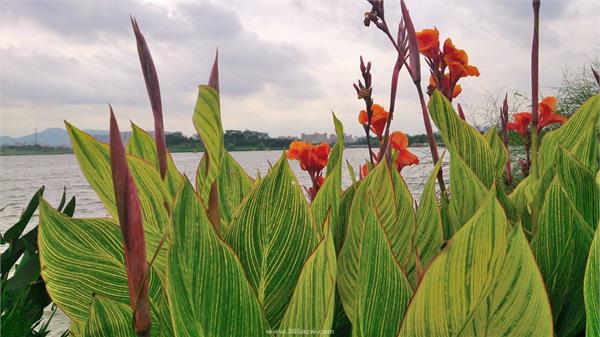
Many fine new cultivars of the canna lily have now been bred. These advantages give the canna lily extremely high ornamental value; it can be used as a potted plant or grown in the ground, placed at home for viewing, or planted near scenic spots and along both sides of streets to beautify the city.
The role of the canna lily for the environment
The canna lily not only beautifies the environment but can also absorb harmful substances such as carbon dioxide, hydrogen chloride and carbon dioxide; it has fairly good resistance. Although its leaves are easily damaged, after being damaged it grows new leaves again and quickly resumes growth.
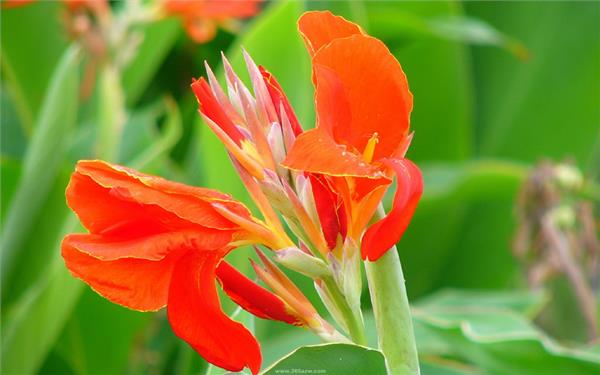
It is precisely because the leaves of the canna lily are extremely easily damaged and react relatively sensitively that people call it a living monitor for detecting harmful gases that pollute the environment.
Therefore, the canna lily has the effect of purifying the air and protecting the environment, and is the best choice for greening cities, beautifying the environment and purifying the air.
The flowering period of the canna lily
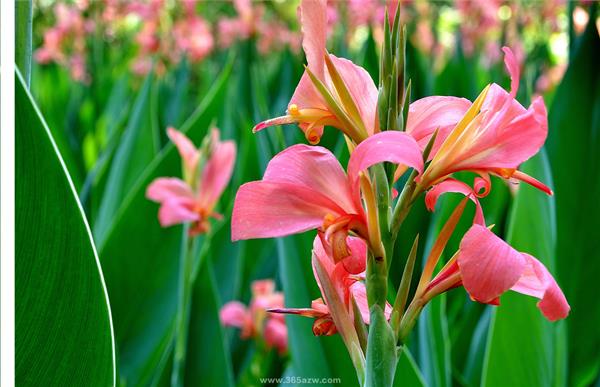
The flowering period of the canna lily is concentrated in summer and autumn; in the north it is June-October, while in the south it can bloom all year round. Its flower colors are many; common ones include bright yellow, vivid red, orange, white, and large flowers with many spots. In addition, the canna lily also has pink, purple and other varieties.