A Detailed Explanation of the Growth Habits and Morphological Characteristics of Black Locust Flowers
Deciduous tree, 10-25 m tall; bark grayish brown to blackish brown, shallowly fissured to deeply longitudinally fissured. Below, let us take a look at the detailed introduction to the growth habits and morphological characteristics of black locust flowers.
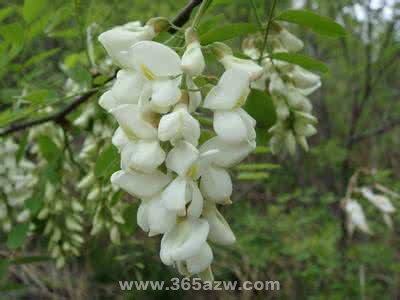
Detailed Introduction to the Growth Habits and Morphological Characteristics of Black Locust Flowers
Branchlets grayish brown, ridged when young, slightly pubescent, later glabrous; stipular spines present, up to 2 cm long; winter buds small, pubescent. Pinnate compound leaves 10-25 (-40) cm long; rachis grooved on the upper side; leaflets 2-12 pairs, usually opposite, elliptic, oblong-elliptic, or ovate, 2-5 cm long, 1.5-2.2 cm wide, apex rounded, slightly emarginate, with a small mucro, base rounded to broadly cuneate, margin entire, upper surface green, lower surface grayish green, sparsely pubescent when young, later becoming glabrous; petiolules 1-3 mm long; stipels needle-like. Racemes axillary, 10-20 cm long, pendulous, flowers numerous, fragrant; bracts caducous; pedicels 7-8 mm long; calyx obliquely campanulate, 7-9 mm long, calyx teeth 5, triangular to ovate-triangular, densely pubescent.
Corolla white, all petals clawed, standard nearly circular, 16 mm long, about 19 mm wide, apex emarginate, base rounded, reflexed, with a yellow blotch inside, wings obliquely obovate, nearly as long as the standard, about 16 mm long, with a rounded auricle on one side at the base, keel falcate, triangular, as long as or slightly shorter than the wings, connate along the anterior margin, apex obtuse-acuminate; stamens diadelphous, the one opposite the standard free; ovary linear, about 1.2 cm long, glabrous, stipe 2-3 mm long, style subulate, about 8 mm long, curved upward, hairy at the apex, stigma terminal. Legume brown, or with reddish brown markings, linear-oblong, 5-12 cm long, 1-1.3 (-1.7) cm wide, flat, apex curved upward, with a mucro, stipe short, with a narrow wing along the ventral suture; calyx persistent, seeds 2-15; seeds brown to blackish brown, slightly glossy, sometimes with markings, nearly reniform, 5-6 mm long, about 3 mm wide, hilum circular, toward one end. Flowering period April-June, fruiting period August-September.
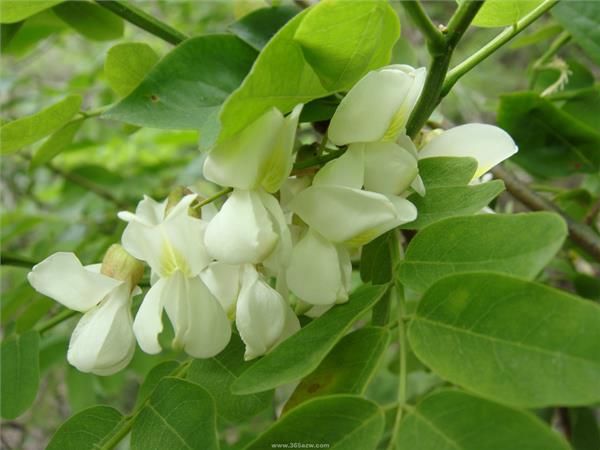
Water-tolerant plant, light-loving plant. Black locust loves light and prefers a warm, humid climate; it grows well in areas with an annual average temperature of 8-14°C and annual precipitation of 500-900 mm. Black locust has no strict requirements for soil and is highly adaptable. It most prefers deep, fertile, loose, moist silt soil, sandy loam, and loam. It is insensitive to soil pH. It grows poorly on clay and coarse sandy soils where the subsoil is too sticky, hard, and poorly drained. Although it has a certain drought tolerance, in severe drought seasons with long periods without rain, the shoot tips often die back. It is not water-tolerant. It fears wind. It grows fast and is an important fast-growing tree species in the world. Roots shallow, crown dense.
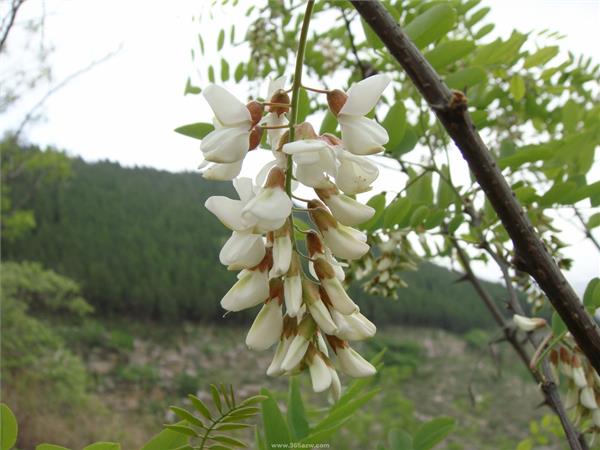
Flowers contain canavanine, tannins, flavonoids, and ricin.
Nectar contains 0.37% sugar and various amino acids including aspartic acid, glutamic acid, histidine, arginine, lysine, ornithine, leucine, phenylalanine, valine, tyrosine, proline, and threonine, with a content of 0.002-4.786 mg% of the dry weight of the nectar.
Leaves contain robinin, i.e. acaciin's ? glucoside, acaciin trisaccharide, i.e. acaciin's rhamnose-xylose-glucoside, apigenin disaccharide, i.e. apigenin's rhamnose-xyloside, apigenin trisaccharide, i.e. apigenin's rhamnose-xylose-glucoside, and a large amount of n-hexacosanol, and also contain canavanine. Fresh leaves contain vitamin C 119.3 mg%.
Immature seeds and their outer hard coat contain canavanine. Seeds contain phytohemagglutinin. The fatty acid composition of seed oil is: linoleic acid 53.18%, oleic acid 24.26%, linolenic acid 12.04%, palmitic acid 4.72%, arachidic acid 3.31%, stearic acid 2.35%, and trace amounts of docosanoic acid and tetracosanoic acid.
The bark is toxic, containing toxic proteins and toxic glycoside components. The heartwood contains robinetin, dihydrorobinetin, β-dihydroxybenzoic acid, methyl β-dihydroxybenzoate, 4,2',4'-trihydroxychalcone, liquiritigenin, butein, butin, and 3,4,5,2',4'-pentahydroxychalcone.
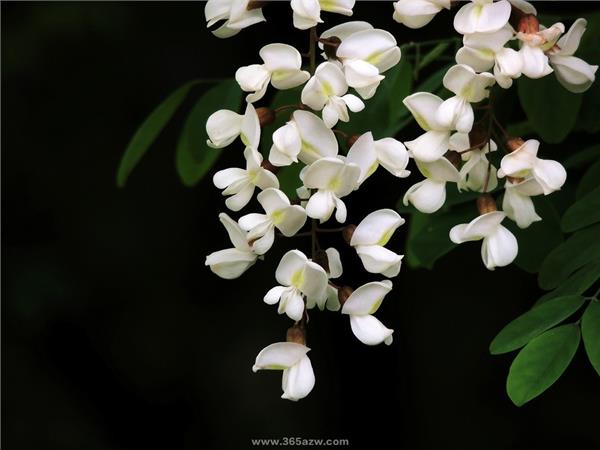
Black locust is a deciduous tree, usually about 15 m tall. Bark grayish brown, deeply longitudinally fissured; branchlets dark brown, with spines, glabrous; winter buds small, hidden within the leaf base before leaf fall. Odd-pinnate compound leaves, rachis with a shallow groove, enlarged at the base; leaflets 7-19, elliptic, oblong, or ovate, 2-5.5 cm long, 1-2 cm wide, apex rounded or slightly emarginate, sometimes with a small mucro, base rounded or broadly cuneate, margin entire, upper surface glabrous or lower surface slightly finely hairy when young; petiolules about 2 mm long, with spiny stipels. Racemes axillary, pendulous, 10-20 cm long, rachis hairy, pedicels 7 mm long, densely hairy; calyx campanulate, apex shallowly divided into 5 teeth, slightly bilabiate, pubescent; corolla white, fragrant, standard nearly circular, clawed, base with 2 yellow spots, wings curved, keel curved inward, connate below; stamens 10, diadelphous, upper part free or semi-free; stigma capitate, apex pubescent. Legume linear-oblong, flat, 5-10 cm long, 1-1.5 cm wide, reddish brown, with a narrow wing along the ventral suture, without transverse septa between seeds. Seeds 3-10, reniform, blackish brown, with tiny dark spots. Flowering period April-June, fruiting period July-August.
Apex pubescent. Legume linear-oblong, flat, 5-10 cm long, 1-1.5 cm wide, reddish brown, with a narrow wing along the ventral suture, without transverse septa between seeds. Seeds 3-10, reniform, blackish brown, with tiny dark spots. Flowering period April-June, fruiting period July-August.