What are the benefits and effects of elderflower?
Elder is regarded as a dwelling place of souls, because it gives rise to negative associations with witches and bad luck. Below, let us take a look at the detailed introduction to the benefits and effects of elderflower.
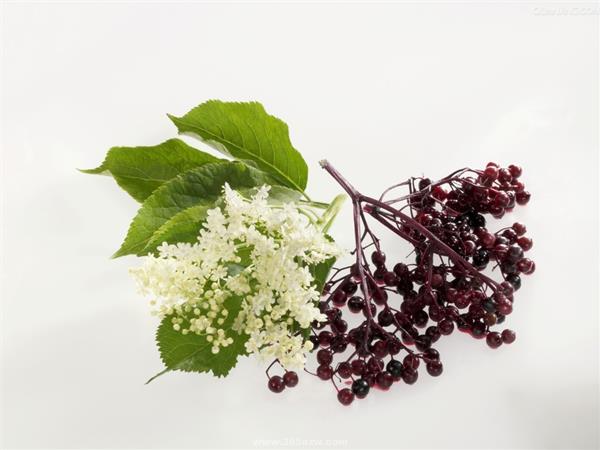
Detailed introduction to the benefits and effects of elderflower
Elderflower is a small yellow flower harvested from the Caprifoliaceae family, with its place of origin across the north and south, carrying an elegant, sweet muscat grape-like fragrance. It is the flower that grows on the tall avenue trees commonly seen in Europe. Its benefits and range of uses are treasures to Europeans, and it is also a childhood memory for many Europeans. The part of elder that can be made into herbal tea is the yellow-white flowers that bloom every June and July.
Elderflower has a peduncle, and the inflorescence branches spread mostly at right angles. The flowers are small and dense. The calyx tube is cup-shaped, about 1mm long, and the calyx teeth are triangular-lanceolate, slightly shorter than the calyx tube. The flower buds are pinkish, and after opening they are white or pale yellow. The corolla is rotate, with 5 lobes, about 2mm long. The stamens are equal in length to the corolla lobes, and the anthers are yellow. The ovary has 3 chambers, the style is short, and the stigma is 3-lobed. The flowering period is April-May.
Since ancient times, elderflower has had the reputation of being a "panacea." The ancient Egyptians believed it had the power to ward off evil and misfortune, preventing illness and evil spirits from afflicting the body. For centuries, the Romani people have used elder to treat wind-cold, influenza, and bronchial discomfort. Even today, Europeans still add brown sugar to elderflower tea to make a traditional cordial, a cold-prevention remedy much loved by children.
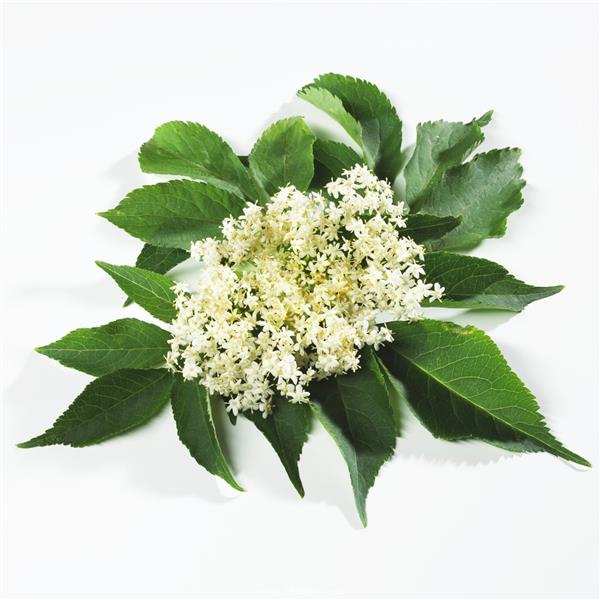
Elder can grow up to ten meters tall, and in May and June it blooms with small white flowers tinged with cream yellow. Its fresh and pleasant sweet fragrance is very similar to that of muscat grapes. The lotion obtained by distilling elderflower is a very good daily skincare product. Steaming the face with the floral water can nourish the complexion and preserve youthful looks. It can help adjust one's constitution and maintain health. Drunk on its own with honey added, it has an excellent flavor and is suitable both cold and hot.
Elderflower added to blended herbal tea can be drunk as a beverage; a strong infusion used as mouthwash can help prevent inflammation of the oral cavity and gums as well as bad breath. A strong infusion or extract added to external medicinal cloths can exert an anti-inflammatory effect. To prevent allergies and hay fever, blend elderflower, European mint, and thyme in a 3:2:1 ratio and drink warm; this can help prevent and alleviate discomfort in the nasal and respiratory systems. The fragrant, delicious elderflower tea can be enhanced with one or two fresh mint leaves, and the refreshing sensation can lift one's spirits.
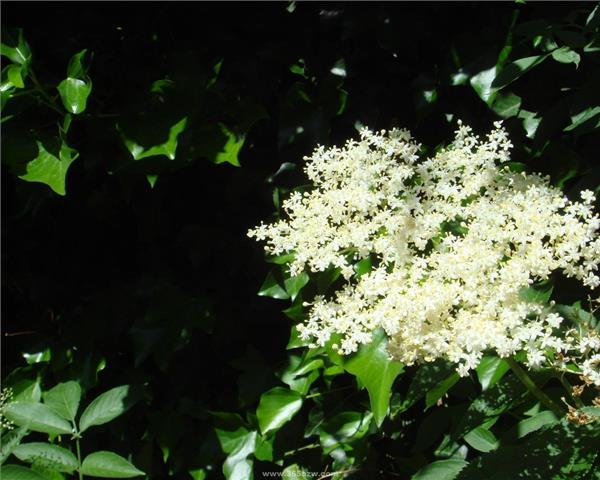
[Morphology of animals and plants]
1. Elder is a thin-leaved shrub or small tree, up to 6m tall. Old branches have lenticels and are pale yellow-brown. The odd-pinnate compound leaves are opposite, with 2-3 pairs of leaflets, sometimes only 1 pair or as many as 5 pairs; the stipules are narrowly band-shaped or reduced to bluish protrusions. The lateral leaflets are ovate, narrowly elliptic to obovate-oblong-lanceolate, 5-15cm long and 1.2-7cm wide, with acute, acuminate to caudate-acuminate apexes, cuneate or rounded bases, irregularly serrate margins, and 1 to several glandular teeth at the base or below the middle. The lowest pair of leaflets sometimes has a 0.5cm-long petiole. The terminal leaflet is ovate or obovate, with an acuminate or caudate-acuminate apex and a cuneate base, and has a petiole about 2cm long. When crushed, it has a foul odor.
Emerging together with the leaves, the paniculate cyme is terminal, 5-11cm long and 4-14cm wide; it has a peduncle, and the inflorescence branches spread mostly at right angles; the flowers are small and dense; the calyx tube is cup-shaped, about 1mm long, and the calyx teeth are triangular-lanceolate, slightly shorter than the calyx tube; the flower buds are pinkish, and after opening they are white or pale yellow; the corolla is rotate, with 5 lobes, about 2mm long; the stamens are equal in length to the corolla lobes, and the anthers are yellow; the ovary has 3 chambers, the style is short, and the stigma is 3-lobed. The berry-like drupe is nearly spherical, 3-5mm in diameter, black-purple or red; it has 2-3 pyrenes, ovate to elliptic, 2.5-3.5mm long, slightly wrinkled. The flowering period is April-May, and the fruiting period is September-October.
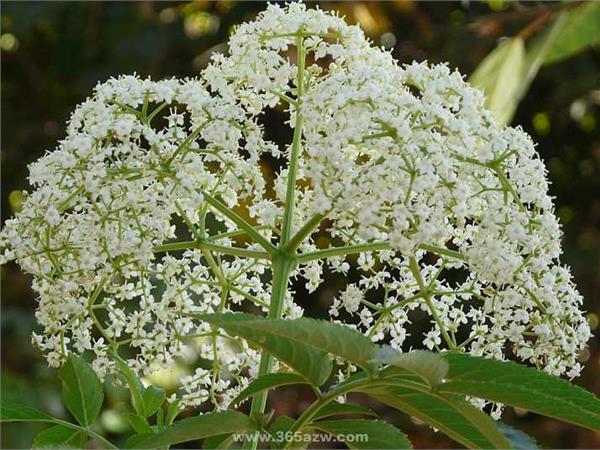
2. Hairy elder differs from elder in that its odd-pinnate compound leaves have 2-3 pairs of leaflets; the main veins and bases of the lateral veins of the leaflets are covered with obvious long stiff hairs, and the leaflet petioles, leaf rachis, and young branches are covered with yellow long stiff hairs; the inflorescence axis, in addition to being covered with short soft hairs, is also mixed with long stiff hairs.
3. European elder differs from elder in that its branches have obvious raised circular lenticels; the pith is well developed and white. Its odd-pinnate compound leaves have 1-3 pairs, usually 2 pairs. The fruit is glossy black.