The Origin of the Bellflower's Name and the Meaning of Its Flower Language
Campanula, also called bellflower, is very popular in Europe and is a common herbaceous flower in small gardens in late spring and early summer. Its flowers are bright and elegantly simple, very warm and lovely. Every flower has its own unique flower language, and the bellflower has its own too. Though the bellflower is a rather unassuming flower, it also has its own warm message. The bellflower has a beautiful legend; behind the poignant tale, the bellflower represents an eternal waiting and a promise to love only you for a lifetime. Whoever receives a "bellflower" from a loved one will be happy for a lifetime. The bellflower has many other meanings in its flower language as well; in the following article, we introduce the various messages of the bellflower.
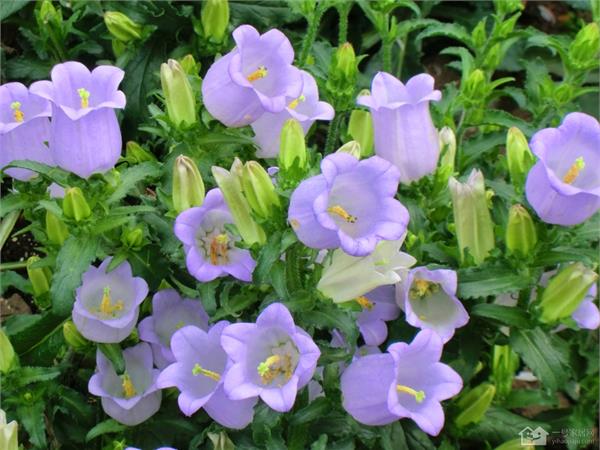
I. Basic Information About the Bellflower
Campanula, also known as bellflower, is native to southern Europe. The plant is stout in form, with bell-shaped flowers resembling wind chimes, and the flower colors are bright and elegantly simple. It is a biennial herb. The plant grows about 1 m tall and is very hairy. The rosette leaves are ovate to obovate, with rounded-toothed, wavy, rough leaf margins. The leaf stalks are winged. The stem leaves are small and stalkless. It bears a raceme, with 1 or 2 small flowers on the stem. The corolla is bell-shaped with 5 shallow lobes and a slightly swollen base; the flower colors include white, blue, purple, and pale peach pink. The flowering period is from April to June. Garden varieties of campanula include: dwarf types and double-layered types, whose calyx and corolla are the same color and shape, forming an inner and outer layer. The cup-and-saucer type has a petal-like calyx, the same color as the petals, spreading like a saucer up to 7.5 cm in diameter, with a cup-shaped corolla. Common varieties include the blue "Blue Bell," the purple "Amethyst," the white "Bell," and the pink "Spike," among others.
II. The Origin of the Bellflower's Name
The bellflower appears in Greek mythology, where it was loved by the sun god Apollo. The jealous west wind threw a disc at the bellflower's head, and the blood that flowed out splashed onto the ground and bloomed into bellflowers. Therefore, its flower language is jealousy.
Anyone born under the blessing of this flower tends to be quite possessive, wanting their lover to belong to them twenty-four hours a day. However, this often backfires!
III. The Bellflower's Flower Language
1. Gratitude
If you like this flower, you are a person who repays kindness with gratitude; you remember the favors others do for you. But you are extremely self-centered, trusting your own feelings, somewhat cold toward others, and very mindful of others' faults, which makes the friends around you hesitant to approach you easily, and you gradually become isolated.
2. Jealousy
The bellflower appears in Greek mythology, where it was loved by the sun god Apollo. The jealous west wind threw a disc at the bellflower's head, and the blood that flowed out splashed onto the ground and bloomed into bellflowers. Therefore, its flower language is jealousy. Anyone born under the blessing of this flower tends to be quite possessive, wanting their lover to belong to them twenty-four hours a day. However, this often backfires!
3. Creativity
Anyone born under the blessing of this flower possesses exceptionally outstanding creativity, and for this reason has an appealing artistic temperament; they are independent and self-reliant, and dislike depending on others.
4. Health and Gentle Loveliness
Because most bellflowers bloom in late spring and early summer, and their flowers and stamens are very delicate, with colors mainly in warm tones, they are mostly used to express health and gentle loveliness as symbols.
The bellflower's flower language also includes tender love. Every flower has its own meaning, and understanding a flower's language makes you like it even more. When some flowers are given as gifts, the flower language can cause the recipient to misunderstand the giver's meaning. So you must understand a flower's language to express your feelings better.
That is the relevant introduction in this article. We believe that after reading it, you now have a simple understanding of this topic. If you need more, you can keep following No. 1 Home Network for more information.