Clivia Miniata Morphological Characteristics and Detailed Care Methods
Clivia miniata's flowers and leaves are both beautiful and elegant, and it is shade-tolerant, suitable for potted indoor display, for both foliage and flowers. Clivia miniata has relatively demanding requirements for its growing environment. To better care for Clivia miniata, you need to understand its ecological habits, for example, understanding that Clivia miniata prefers a semi-shaded and humid environment, fears strong direct sunlight, and its optimal growing temperature is between 18 and 28°C. Let's take a look at the introduction to Clivia miniata care methods below.
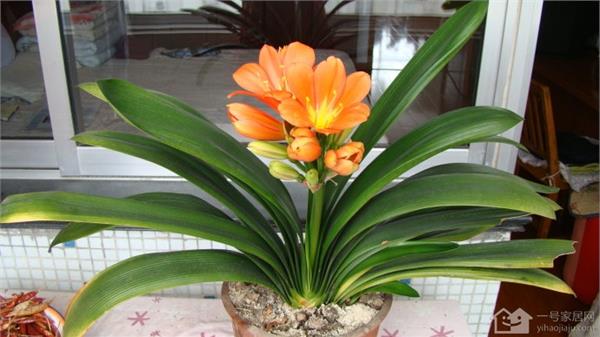
I. Morphological Characteristics of Clivia Miniata
Clivia miniata's roots are fleshy and fibrous, milky white, and very thick and sturdy. The root system is thick and large, with a very fleshy texture. The persistent leaf bases at the stem base of Clivia miniata expand and clasp each other to form a pseudobulb-like structure. The leaves emerge in two ranks from the shortened stem at the base, neatly arranged, broad and strap-shaped, with rounded tips, hard and thick texture, and with luster and vein patterns. The basal leaves are thick, sword-shaped, leathery, dark green, glossy, strap-like, 30-50 cm long, with the longest reaching up to 85 cm, 3-5 cm wide, gradually narrowing toward the base, alternately arranged, with entire margins.
Clivia miniata's flower scape emerges from the leaf axils. If grown from seed, it generally blooms when it reaches 15 leaves. The flower stem is about 2 cm wide; the small flowers have stalks, arranged in an umbel at the top of the flower, funnel-shaped, upright, yellow or orange-yellow, orange-red. The umbel is terminal, flowers upright, with several imbricate bracts, each inflorescence has 7-30 small flowers, and some can reach over 40. The perianth has 6 fused segments.
The nodding clivia has slightly drooping flowers, with a narrowly funnel-shaped perianth. The pedicel is 2.5-5 cm long; the flower is upright and upward-facing, with a broadly funnel-shaped perianth, bright red, slightly yellow on the inside; the perianth tube is about 5 mm long, the outer perianth segment tips have a slight protrusion, the inner ones are slightly concave at the tip, slightly longer than the stamens; the style is long, slightly extending beyond the perianth. The berry is purplish-red, broadly ovate.
Clivia miniata's peak flowering period is from New Year's Day to Spring Festival, mainly in spring and summer, and it can bloom year-round. Sometimes it can also bloom in winter, and there are also cases of blooming in summer between June and July. The fruit ripening period is around October, and it is a berry, purplish-red. Clivia miniata's flowers and leaves are both beautiful.
II. Care of Clivia Miniata
1. Soil requirements. Clivia miniata is suitable for soil rich in humus. This kind of soil has good aeration, good water permeability, and is fertile, with slight acidity (pH 6.5). In humus soil, mixing in about 20% sand grains is beneficial for root development. When planting, the pot size should gradually increase as the plant grows. When cultivating one-year-old seedlings, a 3-inch pot is suitable. In the second year, switch to a 5-inch pot, and afterward, every 1-2 years, repot into a pot one size larger. Repotting can be done in spring and autumn.
2. Watering should be reasonable. Clivia miniata has well-developed fleshy roots that can store a fair amount of water and has a certain drought tolerance. General experience suggests that a soil moisture content of about 30% is suitable. The rule is to water again when the surface of the potting soil looks dry. In winter, water once every 3-5 days; in spring and autumn, water once every 1-2 days; in summer, appropriately increase the frequency of watering. Seedlings need less water, and the flowering period requires more water. When watering, do not pour water on the leaves to prevent leaf rot. If you notice dust on the leaves, you can gently wipe the leaf surface with a soft cloth, or brush it with a soft-bristled brush. Do not wash it with large amounts of water.
3. Fertilize more. Clivia miniata likes fertilizer, but too much fertilizer can cause root rot. In addition to applying base fertilizer, topdressing should follow the method of "light fertilizer, frequent application." Apply base fertilizer when repotting. In spring and autumn, apply fermented solid fertilizer once a month, and also apply liquid fertilizer once a week. It is best not to topdress, and the whole plant can rely on nutrients accumulated in spring and autumn to grow slowly. When applying solid fertilizer, pull open the potting soil and bury it 2 cm deep into the soil. Do not let it directly touch the roots to avoid burning them. When applying liquid fertilizer, for small seedlings a fertilizer-to-water ratio of 1:40 is better, and for large and medium plants 1:20 is better. The best time to fertilize is early morning. Avoid splashing it onto the leaves. After applying liquid fertilizer, water once promptly, but the amount of water does not need to be too much. On one hand, it dissolves the fertilizer; on the other hand, it can rinse the newly grown fleshy roots to prevent damage to the new roots. The type of fertilizer varies by season. In winter and spring, apply more phosphorus and potassium fertilizers, such as bone meal; in autumn, apply more nitrogen fertilizer, such as bean cake water; in summer, foliar feeding is commonly used, spraying the leaf surface with 0.1% monopotassium phosphate or superphosphate. Foliar feeding can be done in all four seasons.
4. Clivia miniata likes semi-shade. When growing Clivia miniata indoors, manual adjustment is needed for the effect of light on it. Clivia miniata's leaves are phototropic. If it is kept in one place indoors for a long time, the leaves will definitely turn toward the direction of the sun. As far as its plant shape is concerned, it will be difficult to achieve the ornamental effect of forming a line when viewed from the side and looking like a fan when viewed from the front. Usually, during the day, my mom would put the flower pot in a sunny place. In order for Clivia miniata to grow beautifully and have ornamental value, you must not be lazy. Every week, change the direction of the leaf surface facing the sun, so that Clivia miniata can grow with an attractive staggered arrangement. Because Clivia miniata's leaves are opposite, if the light is too one-sided for a long time, it will cause uneven growth. Ha, my mom said that when Clivia miniata is in bud, she learned a trick from an old flower enthusiast: place Clivia miniata under sunlight at night to supplement light. Haha, such a flower fanatic! PS: Methods for placing the flower pot indoors: a. Let the leaves be parallel to the sunny window, and adjust to the opposite direction once a week. b. Let the leaves be perpendicular to the sunny window. My mom said method b is quite good. Clivia miniata must be placed in a north-south direction; if not in a north-south direction, the leaves will grow crooked. What should you do if the leaves grow crooked? You can align the two leaves and clip them together. You can surround them with a playing card so the leaves are not damaged. Normally, the leaves will be corrected in 15-20 days.
5. Clivia miniata requires special attention to the prevention and control of two diseases, root rot and sunscald. If these conditions appear, timely and effective control will make Clivia miniata become delicate and charming.
Since ancient times, Clivia miniata has been a flower praised by literati and writers, often used as a metaphor for a gentleman. The care of Clivia miniata requires flower lovers to put in more thought in order to care for it better.
The above is the related introduction in this article. I believe after reading it you also have a simple understanding of this. If needed, you can continue to follow No.1 Home Network to learn more information.