How to Grow Pomegranate Flowers: Tips for Keeping Pomegranate Flowers Alive
The pomegranate flower is a deciduous tree with small, orange-red flowers that grow at the tips of the branches. Pomegranate flowers are not only beautiful but can also be used as medicine. Nowadays, many people like to grow them at home for ornamental purposes. It is also a very distinctive flowering plant, beautiful and elegant, and a nice choice to keep at home for enjoyment. Below we will explain how to grow pomegranate flowers. What are the tips for growing them?
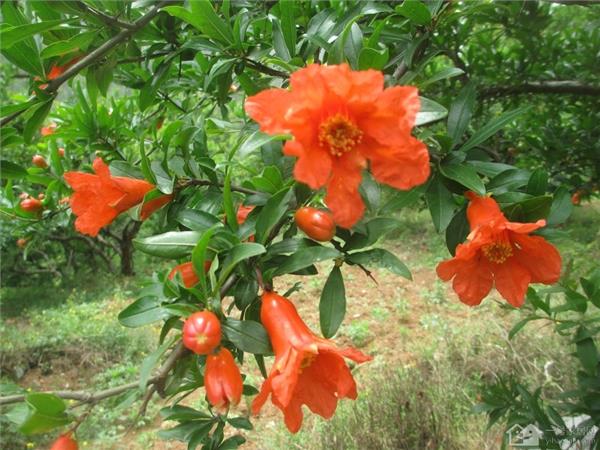
How to Grow Pomegranate Flowers
1. Light: The pomegranate flower is a sun-loving plant, and the daily light period should ideally reach 12 hours, because the pomegranate tree needs sufficient light to grow. Generally, the strong summer sun is its best storage period for fruiting in autumn. The better the sunlight, the larger the flowers bloom and the better the fruit sets.
2. Water: Pomegranate is found in many parts of the country, and it can survive even in some relatively dry places, so pomegranate is a drought-tolerant variety. However, pomegranate trees grown in such places generally do not bloom brightly, and the fruit is not tasty either. This also proves that if you want to grow pomegranate trees well, it is still advisable to provide sufficient water.
3. Soil: Pomegranate trees have the lowest requirements for soil, and generally any natural soil can be used for planting. However, for potted pomegranates, it is advisable for the soil to be somewhat fertile.
4. Temperature: Pomegranate flowers like warmth, so they grow fastest in late spring and early summer. However, in general, the temperature during winter should not be lower than 10°C, otherwise the pomegranate tree will suffer frost damage, causing it to stop growing and enter dormancy.
Tips for Keeping Pomegranate Flowers Alive
1. Choosing varieties: Choosing varieties that are beautiful in both flowers and fruit has greater ornamental value: pink sweet pomegranate, agate pomegranate, white-flowered pomegranate, red-shell pomegranate, four-season pomegranate, soft-seeded pomegranate.
2. Choosing pots and preparing soil: For flower pots, choose clay pots, wooden buckets, or wooden boxes, with a pot mouth diameter of 30-40 cm and a depth of 30-35 cm. Nutrient soil preparation: 7 parts leaf mold or humus soil, 2 parts turf soil, 1 part sandy soil. Break up and sieve the various soils, mix them evenly, pile them up, lay branches or other flammable materials on top, and light them. This both increases the plant ash content and also serves to treat the soil at high temperature.
3. Seedling cultivation: Pomegranate seedlings can be propagated by methods such as cuttings and layering. For cuttings, it is required to cut from the mother tree 1-year-old branches that are robust in growth, full and strong, with plump buds, and a diameter of 0.5 cm. Cut them into lengths of about 20 cm, insert them into sandy soil or another loose medium, and keep it moist. At 20-25°C, they can take root and sprout in about 20 days.
4. Transplanting seedlings into pots: Transplant seedlings in mid-to-late March. Before planting, cover the drainage hole at the bottom of the pot with a tile, fill part of the nutrient soil into the bottom of the pot, place the seedling into the pot, cover with soil and firm it, lift the seedling upward slightly a few times with your hand, and water thoroughly. After the water seeps in, cover with soil again. The soil filled in the pot should be 5 cm lower than the pot rim. Then place the pot in a sunny place to increase humidity and promote root growth.
5. Post-planting management: Pomegranate likes fertilizer. When planting, more base fertilizer should be applied. After the leaves fall in autumn and winter, apply some organic fertilizer again. Apply quick-acting fertilizer once each when leaves emerge, before flowering, and after flowers fall. For potted pomegranates, because the pot soil is limited, the amount of fertilizer applied each time cannot be too much. You should "eat small meals often." The commonly used fertilizers are mainly organic fertilizers such as cake fertilizer, which are fermented and applied as liquid fertilizer.
6. Shaping and pruning: Potted pomegranates have the characteristic of compact branches and dense leaves. During the dormant period, one thinning and pruning can be carried out. They can be shaped into a single-trunk round-headed form, or into a multi-trunk clustered form or a flat-topped form.
7. Winter protection against cold: In winter, place potted pomegranates in a sunny shed or indoor room, and the room temperature must not exceed 5°C, so as to maintain normal dormancy.
Finally, what I want to say is that because the pomegranate flower can adapt to many growing environments, and although it seems ordinary, it can produce beautiful and brightly colored flowers.
The above is the relevant introduction in this article. I believe that after reading it, you also have a simple understanding of this. If needed, you can continue to follow No.1 Home Network to learn more information.