What are the benefits and effects of Dendrobium flowers?
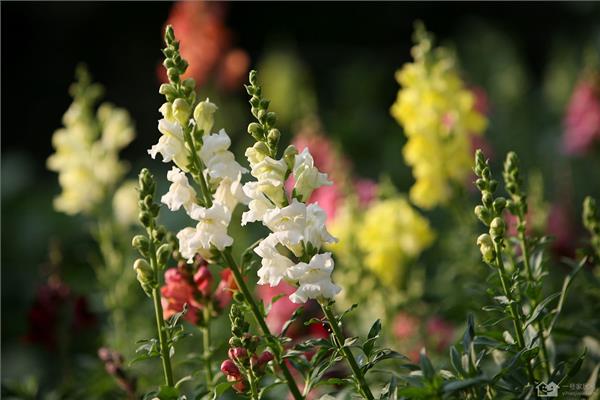
Nowadays, whether in courtyards or indoors, people like to choose plants for decoration and embellishment, and the interesting appearance of snapdragon has won praise from many flower lovers. Snapdragon has a raceme, a tubular labiate corolla, and a saccate swollen base; the upper lip is upright. The flower colors include white, light red, deep red, flesh color, deep yellow, light yellow, yellow-orange and other colors, with extremely high ornamental value. Now let's take a look at how snapdragon is cultivated.
I. Introduction to snapdragon
Snapdragon likes sunlight and can also tolerate semi-shade. It is relatively cold-tolerant and not tolerant of intense heat. It is suitable for growing in loose, fertile, well-drained soil, and can also grow normally in calcareous soil. The plant height is 20-70 cm, and the leaves are oblong-lanceolate. Raceme, tubular labiate corolla, base swollen into a sac, upper lip upright, 2-lobed, lower lip 3-lobed, spreading and recurved. There are white, light red, deep red, flesh color, deep yellow, light yellow, yellow-orange and other colors.
Snapdragon can be potted, and because its flower colors are gorgeous, it is very suitable for ornamental use. It is native to the Mediterranean region, with a distribution range extending north to Morocco and Portugal, south to France, and east to Turkey and Syria. Snapdragon is named because its flowers resemble goldfish. Snapdragon is named because its flowers resemble goldfish. At the same time, it is also a traditional Chinese medicine, with the effects of clearing heat and detoxifying, cooling blood and reducing swelling. It can also be pressed for oil for consumption, and is nutritious and healthy.
II. How to grow snapdragon
1. Sow at the right time
Snapdragon can be propagated by sowing and cuttings, but sowing propagation is mainly used. Sowing is usually best in mid-September. The sowing substrate is sterilized humus soil or peat soil. Generally, a shallow pot with a diameter of 30 cm is used. Fill the pot with soil for sowing, leave 1-2 cm at the rim of the pot, then gently press the pot soil flat before sowing. After sowing, cover with a thin layer of fine soil, then gently compact it with a wooden board so that the seeds and soil are closely combined. After sowing, place the pot in a water basin so that moisture can seep upward from the bottom until the entire soil surface is moist. Then cover the pot surface with glass to reduce water evaporation, and finally place the pot in a cool place.
2. Management after sowing
After sowing, water management is the main task. Watering should be even, and the pot surface should not be too dry or too wet. Remove the glass at night to allow ventilation, and cover it again during the day to prevent water evaporation. The seeds can sprout and emerge 7-8 days after sowing. After the seedlings emerge, the glass can be removed to receive light.
3. Transplanting
When the seedlings grow 4-5 leaves and branches, they can be moved into flower pots with a diameter of 8-12 cm. The pot soil should preferably be a mixture of 7 parts humus soil and 3 parts garden soil. When watering the seedlings, it is best to use a watering can and spray thoroughly. As the seedlings gradually grow, change the pot once more and plant them in pots with a diameter of 20-24 cm.
Cultivation methods of snapdragon
4. Temperature and humidity
Snapdragon is relatively cold-tolerant and also tolerates semi-shade. It can withstand low temperatures above -5°C, and is prone to freezing to death below -5°C. Snapdragon is moisture-tolerant and afraid of drought. During maintenance and management, watering must follow the principle of "water when dry, stop when wet," and spray water once about every 2 days.
5. Reasonable fertilization
Fertilization should pay attention to the combination of nitrogen, phosphorus, and potassium. Snapdragon has root nodule bacteria and has its own nitrogen-fixing effect. Under normal circumstances, there is no need to apply nitrogen fertilizer; appropriately increasing phosphorus and potassium fertilizer is sufficient. During the growth period, apply fermented oil residue water once every half month along with watering. When flower buds appear, spraying with a 12% potassium dihydrogen phosphate solution is better. Before each fertilization, loosen the soil and remove weeds.
6. Suitable pruning
When snapdragon seedlings reach about 10 cm, pinching can be done to shorten plant height, increase the number of side branches, and increase flowers. When pruning, cut off diseased and weak branches, dead and old branches, and excessively dense branches. After each flowering, cut off the branches that have already bloomed to encourage new branches to sprout and continue blooming.
The above is the relevant introduction in this article. I believe that after reading it, you also have a simple understanding of this. If needed, you can continue to follow No. 1 Home Network to learn more information.