What Flower Is the Yesterday-Today-and-Tomorrow? Key Points of Its Cultivation Methods Explained
What flower is the yesterday-today-and-tomorrow? The yesterday-today-and-tomorrow (Brunfelsia pauciflora) is a plant whose flowers open in succession, so different colors of flowers can be seen on the same plant at the same time, hence the name "two-colored jasmine." Below, follow the editor to see the key points of its cultivation methods.
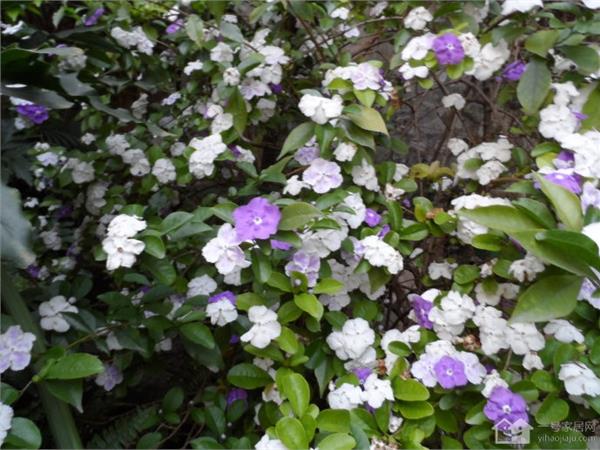
The yesterday-today-and-tomorrow is a perennial evergreen small shrub, with a plant height of up to 1 m. The yesterday-today-and-tomorrow belongs to the Solanaceae family and the genus Brunfelsia; it is an evergreen shrub with a plant height of 30-100 cm, and its leaves are long-ovate and dark green. The flowers are solitary or several densely clustered; the perianth has 5 shallow lobes, resembling a 5-petaled plum blossom; the corolla diameter is 3-4 cm; the flower is light purple when it first opens, gradually turns blue, and finally turns white.
The key points of the cultivation methods for the yesterday-today-and-tomorrow are as follows:
① How to grow the yesterday-today-and-tomorrow at home: Brunfelsia likes a warm, humid climate and is not cold-tolerant. It requires full sunlight and well-drained acidic soil. In winter it needs to overwinter indoors, and in spring it should be moved outdoors.
② The growing medium can be prepared with garden soil: leaf mold: rice husk ash (1.5:1:0.5), with an appropriate addition of barnyard manure. When repotting in spring, prune and shape the branches appropriately, removing old roots, dead branches, dense branches, and leggy branches. In summer it needs to be moved under large trees for cultivation.
③ After spring, the amount of watering can gradually be increased; in summer, water thoroughly once every 2 days. Spray water appropriately on the leaves and the surrounding environment. In autumn, reduce the frequency of watering. In winter, generally water once every 10 days; excessive watering or an indoor environment that is too humid will cause leaf drop or root rot.
④ In spring and summer, apply a thin cake fertilizer solution (20%) once every 10-15 days; from autumn, stop fertilizing to prevent new shoots from growing and suffering cold damage.
⑤ Propagation: a. Cuttings can be taken from April to August by cutting 1-year-old branches 8-10 cm long; after insertion, roots can form in 1 month. In summer, using the full-light misting method gives a high survival rate. b. Layering can also be used for propagation; make a notch in the branch at 15 cm, bury it in soil, and roots can form after 3 weeks; after 50 days it can be separated as a seedling for transplanting.
The above is the relevant introduction in this article. I believe that after reading it, you also have a simple understanding of this. If needed, you can continue to follow No.1 Home Network to learn more information.