Detailed Guide to Peacock Calathea Cultivation Methods and Precautions
The Peacock Calathea (Calathea makoyana) is a plant with dark green spotted leaves, and the undersides have brownish-red spots of the same shape. It can effectively remove ammonia pollution from the air. Below we look at the Peacock Calathea cultivation methods and Peacock Calathea cultivation precautions.
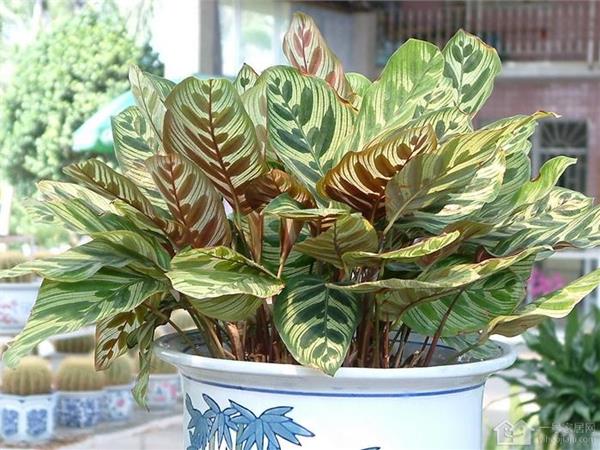
I. Peacock Calathea Cultivation Methods
1. Cultivation environment. The Peacock Calathea likes a high-temperature, high-humidity environment and is highly shade-tolerant, with an optimal light intensity of 30%-40%. It grows well under indoor diffused light and is best cultivated in loose, fertile, well-drained soil. In spring and autumn, it can be placed in a bright indoor spot for care; in summer, it should be kept in partial shade, as overly strong light will turn the leaves yellow and scorched, affecting its ornamental value. In winter, when light intensity declines, the pot can be moved near a south-facing window for cultivation, and the growing environment at this time should not be too shady. If placed in a dim spot for a long time, the Peacock Calathea's leaves will lose their distinctive luster.
2. Growing temperature and humidity
① Temperature. The optimal growing temperature for the Peacock Calathea is around 22°C. When the summer temperature is above 35°C, not only does the plant's growth stall, but the leaf color also turns yellow and loses its ornamental value. When the winter temperature is below 15°C, the plant's growth slows; below 10°C the leaves easily curl; below 5°C it is prone to cold damage, and in severe cases the entire plant may die. Therefore, in winter, attention must be paid to cold protection and insulation, and the room temperature should be kept above 13°C.
② Humidity. The suitable air humidity for the Peacock Calathea is 70%-75%, and when new leaves are emerging, the humidity requirement is even higher. Therefore, during the growing season it should be watered thoroughly to keep the soil moist, but not waterlogged. In summer, spray water on the leaf surfaces 2-3 times a day, and also sprinkle water on the surrounding ground to increase humidity and lower temperature, which benefits its growth. In winter, watering should be controlled, and the potting soil only needs to be slightly moist. In northern China, where indoor air is dry in winter, besides using clean water close to room temperature to spray and wash the leaf surfaces around midday during the day, it is best to cover the plant with a plastic film hood at night to keep it warm and moist. To keep the leaves fresh, neat, and radiant, the leaves can be gently wiped and washed with clean water every half month.
3. Pot selection and fertilizing
① Pot selection. The Peacock Calathea is a shallow-rooted plant, so the cultivation container should preferably be a wide, shallow pot to facilitate root extension and spreading. The potting soil needs to be loose, fertile, and well-drained. You can use 6 parts peat soil (or leaf mold), 2 parts garden soil, and 2 parts sandy soil, mixed evenly. A soilless substrate can also be used, such as an even mix of perlite and vermiculite. Generally, repotting is done at the turn of spring and summer in combination with division propagation, repotting once every 2 years.
② Fertilizing. During the peak growing season, the Peacock Calathea should be given a diluted liquid fertilizer once every half month. When fertilizing, be careful not to apply too much nitrogen fertilizer, to avoid undesirable growth such as fading of leaf markings, thickening of leaves, and softening of leaf stalks. Generally, the application ratio of the three fertilizers nitrogen, phosphorus, and potassium should be 1:1:1. For soilless cultivation, simply apply a complete-element inorganic nutrient solution 1-2 times a month during the growing period.
4. Propagation. The Peacock Calathea is mostly propagated by division, carried out in spring from April to May in combination with repotting and soil changing. If division is done too early and the temperature is too low, the wounds heal slowly and are prone to rot, reducing the survival rate. When dividing, tip the mother plant out of the pot, remove the old soil, and use a sharp knife to cut every 3-4 buds into 1 plant; coat the cut surfaces with charcoal powder to prevent rot, pot them up immediately after cutting, water thoroughly, and place them in partial shade to recover; after 5-7 days they can be returned to normal care. When dividing, it is best to plant 3-5 plants per pot. If only one plant is planted per pot, more than 5 leaves must be retained and more roots carried along, otherwise it will affect the plant's survival and its growth and development after survival.
II. Peacock Calathea Cultivation Precautions
The Peacock Calathea likes high temperatures and moist air, and grows fastest above 20°C. During the low-temperature season from October each year to April of the following year, in northern China it should be moved into a greenhouse to overwinter, and the wintering temperature should not be lower than 15°C, otherwise the leaf color becomes dull, the leaves curl, and the leaf tips turn yellow. If the cold damage is slight, promptly changing the environmental conditions will still allow new leaves to emerge the following spring. If the cold damage is severe, the leaves will wither and die one after another, and even the entire plant may die.
When growing the Peacock Calathea, if the indoor day-night temperature difference is large, you can use a plastic film to wrap the pot or use a glass box to keep it warm and moist, and also wash the leaf surfaces with warm water once a month to maintain the leaf color. Every spring, after the temperature steadily rises to 20°C, it can be repotted once; when repotting, add new potting soil, cut off residual roots and withered leaves, and replant to promote growth.
The above is the relevant introduction in this article. I believe that after reading it you now have a simple understanding of this. If needed, you can continue to follow No. 1 Home Network to learn more information.