What are the cultivation methods and precautions for maidenhair fern?
Maidenhair fern is a wild herbaceous plant. Many people encounter various problems when cultivating maidenhair fern because they do not understand the cultivation methods. Today, follow the editor to take a look at the cultivation methods for maidenhair fern and the precautions for cultivating maidenhair fern.
Maidenhair fern
Maidenhair fern (scientific name: Adiantum capillus-veneris Linn.) is a perennial evergreen herbaceous plant, also known as wire grass, maiden's hair, iron-wire grass, and water pig bristle soil. Its pale green thin-textured leaves paired with shiny black leaf stalks make it look especially elegant and graceful. It grows 0.1-0.5 m tall. Because its stems are slender and resemble iron wire in color, it is named maidenhair fern. Maidenhair fern is also an indicator of calcareous soil. Because it fears dryness and strong light, it must be placed in a spot without direct sunlight for care. Maidenhair fern also has many varieties, such as lotus-leaf maidenhair fern and kidney-leaf maidenhair fern. It is a cosmopolitan species, growing wild in all regions.
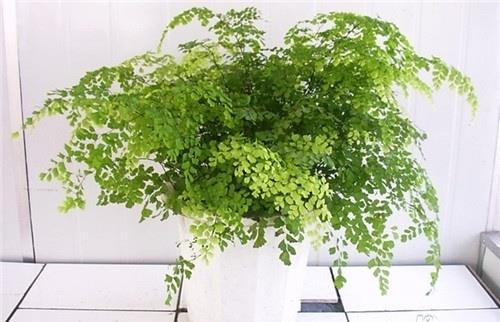
Cultivation methods for maidenhair fern
1. Soil
When preparing to cultivate maidenhair fern, the first thing is to prepare a good pot of soil for it. If you pay attention, you will find that wild maidenhair ferns mostly grow in places with soft soil. Therefore, when cultivating maidenhair fern, it is essential to prepare a pot of soft, well-draining, fertile calcareous soil or sandy loam.
2. Light
Maidenhair fern likes to grow in an environment with sufficient sunlight, so it is best to place it in an environment with good ventilation and sufficient sunlight. However, it should be noted that maidenhair fern likes diffused light and must not be placed in direct sunlight. If it is exposed to strong direct light for a long time, the leaves of the maidenhair fern will turn yellow and may even die.
3. Watering
Maidenhair fern likes to grow in a moist environment. During its growing season, sufficient water must be ensured. If it is in the hot summer, when the air is especially dry, water should be sprinkled around the maidenhair fern in time so that there is some moisture in the space, maintaining air humidity, and it should be watered once or twice a day. Otherwise, lack of water will cause the leaves of the maidenhair fern to shrivel and prevent normal growth.
4. Fertilizing
Maidenhair fern is not particularly fond of fertilizer, so it is enough to apply some diluted liquid fertilizer every two to three months. It should be noted that during fertilizing, liquid fertilizer must not be sprinkled on the leaves, otherwise it will cause leaf rot in the maidenhair fern.
5. Temperature
Maidenhair fern is a plant that likes warmth and tolerates cold. During the day, it grows suitably in an environment of 21-25 degrees, and at night 12-15 degrees. In the cold winter, the maidenhair fern should be moved indoors and its growing environment kept above 5 degrees, otherwise it will cause leaf frost damage.
6. Pests and diseases
Potted maidenhair fern often suffers from leaf blight. In the early stage, Bordeaux mixture can be used for control. In severe cases, a 1000-1500 times solution of 70% thiophanate-methyl can be used for control. If scale insects harm the plant, a 1000 times solution of 40% omethoate can be used for control.
7. Pruning
After autumn begins, as the temperature drops, the maidenhair fern enters a stage of slow growth, and old leaves gradually turn yellow. At this time, they should be cut off.
Precautions for the cultivation methods of maidenhair fern
1. Maidenhair fern by nature likes warm, humid, and semi-shaded cool environments, and greatly dislikes direct sunlight.
2. Ferns all grow in humid environments, and for maidenhair fern, this is naturally no exception.
3. It needs to be repotted once every spring, and at the same time dry leaves and old roots should be pruned away.
The above is the related introduction in this article. I believe that after reading it, you also have a simple understanding of this. If needed, you can continue to follow No. 1 Home Network to learn more information.