How to Care for the Peacock Plant and Tips for Disease Prevention and Control
As air pollution becomes more and more serious, more and more people are choosing to grow plants at home to keep the indoor air fresh. Among the many plants, the peacock plant is very popular, but because of its unique growing conditions, many people worry about how to grow it. Below, let us take a detailed look at how to grow the peacock plant well and how to prevent and control its diseases.
How to Grow the Peacock Plant: Fertilizing
During the peak growing season, apply a thin liquid fertilizer once every half month. When fertilizing, be careful not to apply too much nitrogen fertilizer, so as to avoid poor growth such as fading of the leaf markings, thickening of the leaves, and softening of the leaf stalks. Generally, the application ratio of the three fertilizers nitrogen, phosphorus and potassium should be 1:1:1. For soilless cultivation, simply water with a full-element inorganic nutrient solution 1 to 2 times a month during the growing period.
When fertilizer is lacking, the plant is noticeably short, the leaf color is dull, and the golden sheen is not vivid. During the growing period, apply a thin liquid fertilizer once every 20 days, with a nitrogen-phosphorus-potassium ratio of 2:1:1, which can make the leaf color glossy and vivid. Never use too high a proportion of nitrogen fertilizer. For example, spraying a 0.2% liquid fertilizer directly on the leaf surface every 10 days is extremely beneficial for sprouting and growth. Stop fertilizing in winter and summer.
How to Grow the Peacock Plant: Temperature
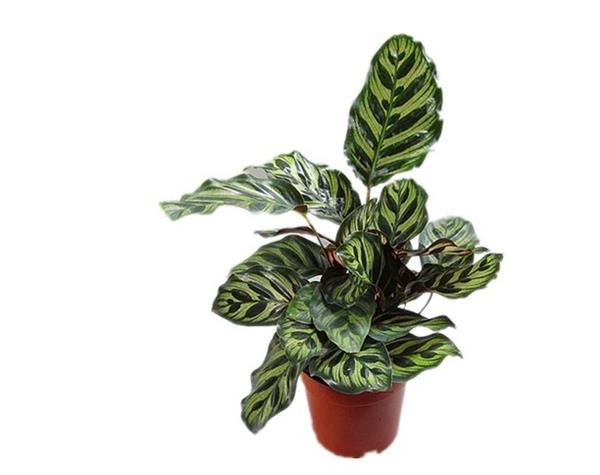
The optimal growing temperature for the peacock plant (Calathea makoyana) is about 22°C. When the summer temperature is above 35°C, not only does the plant stop growing, but the leaf color also turns yellow and loses its ornamental value. When the winter temperature is below 15°C, the plant grows more slowly; below 10°C the leaves tend to curl; below 5°C it is prone to cold damage, which in severe cases can cause the whole plant to die. Therefore, in winter, be sure to protect it from the cold and keep it warm, and the room temperature should be kept above 13°C.
How to Grow the Peacock Plant: Light
During the growing season from May to September, place it in a shaded or semi-shaded spot, maintaining a light transmission rate of 40%-60%, and avoid direct scorching sunlight. Too strong light or dry air can easily cause the leaf margins and leaf tips to scorch and the leaf markings to become dull and lusterless; but the light should not be too weak either. If it is kept in a dark room for a long time, with low temperature and insufficient light, it will also grow weakly, which is unfavorable for the formation of leaf color, and it will lose the unique metallic sheen of the leaf surface. In winter, it can receive direct sunlight through glass.
How to Grow the Peacock Plant: Soil
For potted plants, it is best to use a loose, fertile, well-drained, humus-rich, slightly acidic loam. Generally, it can be mixed from 3 parts leaf mold, 1 part peat or sawdust, and 1 part sand, with a small amount of bean cake added as a base fertilizer. Avoid using heavy clay garden soil. When potting, first place a 3 cm thick layer of coarse sand at the bottom of the pot as a drainage layer to facilitate drainage.
How to Grow the Peacock Plant: Water
During the growing period, give sufficient water. Especially in summer and autumn, in addition to often keeping the potting soil moist, you must also frequently spray water on the leaves to lower the temperature and maintain humidity; it requires relatively high air humidity, ideally reaching 70% to 80%; avoid dry air and dry potting soil, but it must not become waterlogged. After late autumn, water should be controlled to help it resist the cold and survive the winter. In winter, maintain a dry environment; if it is too wet, the basal leaves will turn yellow and scorch, affecting its ornamental value.
During the growing period, the potting soil must be kept fully moist. Water before the potting soil dries out completely, otherwise the leaves are prone to curling and scorched edges. In summer, frequently sprinkle water on the plant's leaf surface. Note that the potting soil must not be too wet, otherwise it will cause root rot and even death.
How to Grow the Peacock Plant: Humidity
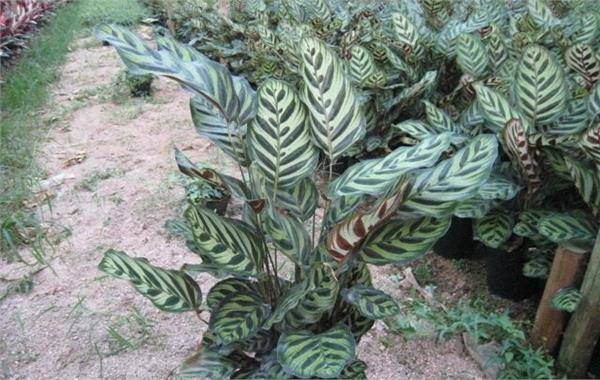
The suitable air humidity is 70%-75%, and when new leaves are emerging, the humidity requirement is even higher. Therefore, during the growing season, water fully to keep the soil moist, but it must not become waterlogged. In summer, spray water on the leaf surface 2 to 3 times a day, and also sprinkle water on the surrounding ground to increase humidity and lower temperature, which benefits its growth. In winter, watering should be controlled, and the potting soil only needs to be slightly moist. In the dry indoor air of northern winters, besides using clean water close to room temperature to spray and wash the leaves around noon during the day, it is best to cover it with a plastic film cover at night to keep it warm and moist. To keep the leaf color fresh, neat and radiant, gently wipe the leaves with clean water every half month.
How to Grow the Peacock Plant: Disease Prevention and Control
There are relatively few pests and diseases, but if ventilation is poor and the air is dry, scale insects may also cause damage, which should be controlled by spraying with 1500-fold dimethoate.
Leaf spot disease spots are yellow-brown. In the early stage of the disease, small yellow granules form near the leaf edges or in the center of the leaf, and gradually expand, with the color deepening and turning yellow-brown. There is a relatively obvious halo around the spots. As the spots spread, the leaves gradually dry up, shrivel, and eventually fall off and die. The pathogen is the conidium of the imperfect fungus Drechslera. The causes of the disease are high temperature and high humidity, poor air circulation, plants placed too densely, many weeds and rotten leaves in the growing environment, excessive nitrogen fertilizer application, and leggy plant growth. Tissues that are young and tender are susceptible to the disease.
The control method is to strengthen fertilizer and water management, appropriately increase the application of phosphorus and potassium fertilizers, and apply less nitrogen fertilizer, to promote full, sturdy plant growth and enhance its own resistance. Remove diseased and disabled leaves as well as weeds in time to reduce sources of infection. Plants should not be placed too densely, and appropriate ventilation and light transmission should be provided to reduce the humidity of the environment, which can reduce the incidence of the disease. When the disease occurs, spray for protection. The agents include: 50% carbendazim 600-fold to 800-fold solution; or 75% chlorothalonil 600-fold to 800-fold solution; 50% mancozeb 500-fold to 600-fold solution, once every 7 to 10 days. Various agents should be used alternately to prevent the pathogen from developing resistance.
The above is the relevant introduction in this article. I hope it is helpful to those of you who need it. If you have other questions, you can follow Yihao Home Network to learn more.
The above is the relevant introduction in this article. I hope it is helpful to those of you who need it. If you have other questions, you can follow Yihao Home Network to learn more.