How to grow the succulent Haworthia cooperi? Little cultivation tips to make you an expert
Many people today are very fond of succulents. These plants are pretty and easy to grow, but they have very high environmental requirements. Below, let's learn some little tips for growing the succulent Haworthia cooperi to make you a succulent expert.
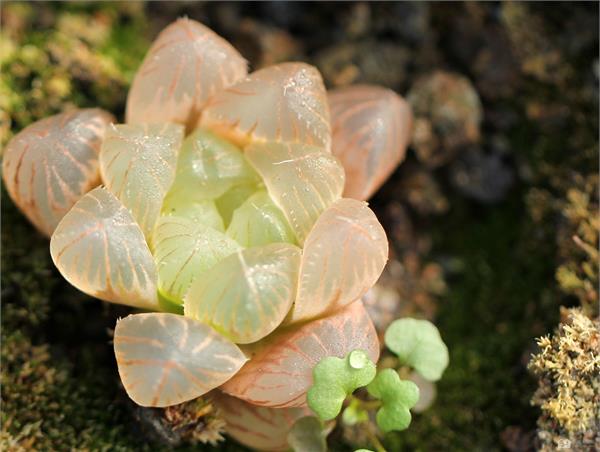
I. How Haworthia cooperi changes with the four seasons
The suitable temperature for Haworthia cooperi growth is 15-25 degrees, with humidity controlled between 70-90. Take the Yangtze River Delta region as an example.
The temperatures in spring and autumn are the most suitable. Haworthia cooperi grows rapidly, and usually the fluid inside cannot fill up in time, so it looks like a balloon without enough air, with a surface like a coating of white powder and slightly lower gloss.
After the temperature rises in summer, Haworthia cooperi stops growing and enters dormancy, with the surface turning white and transparency decreasing.
In winter, the indoor temperature should be kept above 5 degrees. Growth is slow and a semi-dormant state appears. The fluid inside is full, like a balloon with enough air, and the window surface has the highest gloss and the best transparency.
II. Watering Haworthia cooperi in different seasons
The temperatures in spring and autumn are suitable. If you observe that Haworthia cooperi has begun vigorous growth, it means the roots are strong at this time. After the potting soil dries, water the potting soil thoroughly, place it in a ventilated spot for a few days to remove excess water from the potting soil, and then grow it covered.
In summer, the temperature is relatively high, Haworthia cooperi stops growing, and the transparency of the window surface decreases. At this time, the root hairs are dry and have no water-absorbing ability, so watering should be stopped. You can mist in the evening to increase humidity and ease leaf shrinkage.
In winter, if the temperature is above 10 degrees, Haworthia cooperi will still grow slowly; keep the potting soil slightly moist. At this time, covered cultivation is most suitable, improving the transparency of the window surface and increasing ornamental value. When the lowest temperature drops to 5 degrees, protection against freezing is needed. After frost damage, the window surface of Haworthia cooperi turns white, affecting its ornamental value.
III. Create a suitable micro-environment
The suitable environmental humidity for Haworthia cooperi mentioned earlier is between 70-90, so it is clear that a small covered growing environment needs to be created.
Specific methods include: placing a plastic cup over the flower pot; covering a storage box with plastic film or pressing on a glass pane; using glass or sunlight panels to build a small cabinet or small shed; on a security window, using stainless steel to separate it, pressing glass on top to prevent rain, and blocking the outer three sides with sunlight panels or thick transparent plastic sheeting, and so on. Note that the smaller the space, the more easily the temperature and humidity inside change abruptly, which is bad for the plants.
In spring and autumn, the temperature from 12:00-15:00 will rise very high, reaching 40-50 degrees, so before going to work in the daytime you should open it for ventilation, and only cover it in the evening to add humidity. Remember that covered cultivation during this period must mean ventilation during the day and covering only at night. Many friends do it the opposite way, and the plants then have problems.
The high temperature and high humidity of summer are fatal to Haworthia cooperi. During this period, ventilation and cooling must be the main focus. Remember that it must not be grown covered. On clear evenings, you can mist above and around the plants to increase humidity.
Winter is the most suitable time for covered cultivation;
1. It can keep warmth.
2. It can improve the transparency of the window surface and increase ornamental value. In northern regions, foam insulation boxes are needed to cope with colder climates.
IV. Planting, soil mixing, and potting
First place larger granules of orchid stone at the bottom of the pot, put in the Haworthia cooperi so the roots spread out, hold the Haworthia cooperi with one hand and with the other pour along the inner walls a granular akadama soil mixed with a small amount of peat and vermiculite. Some people think akadama will break down into powder over time; I use Nihon Line hard akadama soil, and in practice the hardness is fine. Spread the soil to two-thirds of the pot. Here, note that the soil covering the roots is best kept slightly moist, as this helps root growth. Next comes a pure granular soil top dressing, spread to 0.5 cm from the pot rim, completing the top dressing. After potting, spray some water with a spray bottle; the soil surface just needs to be slightly moist.
The above is the relevant introduction in this article. I believe after reading it you also have a simple understanding of this. If needed, you can continue to follow No.1 Home Network to learn more information.