How to handle root rot in succulents is an essential skill for growing succulents
Succulents are loved by many people for their plump, fleshy look. Growing succulents is simple, yet also very difficult, because succulents are actually quite delicate. Some succulent enthusiasts have encountered root rot while growing them, so what should be done? Below, let's look at how to handle root rot in succulents.
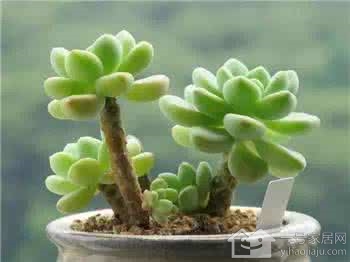
Methods for handling root rot:
Step one: Pull the succulent out, wash the roots clean, and cut off all the moldy parts.
Step two: Apply carbendazim to the cuts and moldy areas, then let them dry, for about three days.
Step three: Re-root the treated succulent. You can let it sit at the mouth of a bottle, with water below but not touching the roots, to encourage rooting; you can also replant it in granular soil, such as akadama soil or kanuma soil.
Step four: Place the planted succulent, or the one at the bottle mouth, in a bright indoor spot, avoiding direct sunlight and scorching exposure, and make sure there is good ventilation. Right after planting, do not water immediately; wait until it has rooted and gradually stabilized before watering. Next, just observe carefully. If nothing goes wrong, it will re-root and grow in about one to three weeks.
Rescue methods for mild root rot:
First, what you need to do is quickly control water and use airflow. Place the flower pot on a flower stand with good ventilation at the bottom so excess water can drain out, and use an electric fan to strengthen air circulation, blowing continuously for 24 hours. If the weather is bad and the air humidity is too high, friends who have a heater fan at home can use the heater fan together with the electric fan. However, when using a heater fan, remember to keep it at least 3 m away and never point it directly at the plant; use indirect, deflected airflow. The fan can be pointed directly at the plant. Also note that the heater fan should be turned on and off intermittently, otherwise the plant's moisture will quickly be lost and it will turn into a specimen.
Step two, wait until the surface of the soil in the pot looks dry, and when a flower trowel can dig into the soil without soil sticking to the trowel, carry out deep loosening of the soil. At this time, you will find that the turned-up soil is still very wet. If the weather improves, you can let it get some sun, but if the sunlight is too strong, appropriate shading is also needed. If the weather is still bad, continue using the fan to blow air. When the surface soil looks dry again, continue loosening the soil. After repeating this cycle several times, when the humidity in the pot has basically dropped to an acceptable range, turn over some of the soil around the base of the plant's main stem to strengthen air circulation around the roots, and backfill after the plant has recovered.
There is also a simplest method: take the plant out of the pot and let it dry for a few days, and at the same time spread out the potting soil to air-dry, shade-dry, or heat-dry it. No matter what method is used, as long as it is dried, then replant it. It should be noted that succulents that have been rained on for more than three days will almost certainly develop root rot, and those that show wilting after too much watering are also showing signs of initial root rot. This needs to be handled immediately. Never wait until the rot reaches the stem before trying to rescue it, as by then there is no way to save it.
The above is the relevant introduction in this article. I believe that after reading it, you also have a simple understanding of this. If needed, you can continue to follow No.1 Home Network to learn more information.