Potted Grape Repotting and Soil Changing with Fertilizer and Water Management Tips
Potted grapes are simply grapes grown in containers such as pots, boxes, barrels and planting troughs. This growing method is very clever, and many people want to try it. Below we will learn about potted grape repotting and soil changing tips, and potted grape fertilizer and water management.
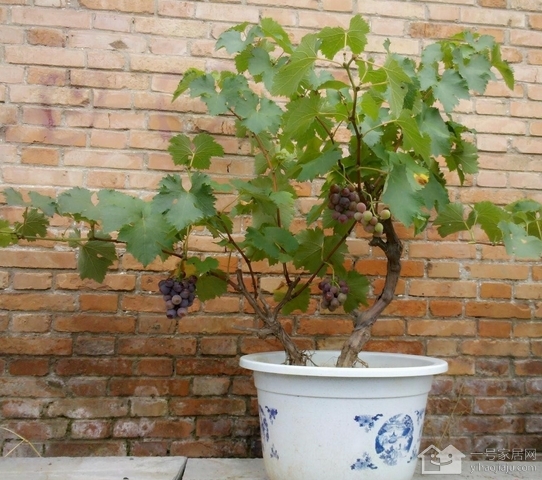
I. Containers and Potting Soil Preparation
1. Containers
Available containers include clay pots, ceramic pots, purple clay pots, wooden pots, plastic flower pots, etc., which can be selected according to conditions. In the first year, potted grapes can use containers with a pot mouth diameter of about 20-25cm, and after 2-3 years, containers with a pot mouth diameter of 30-40cm can be used. This can be determined according to production volume and site space.
2. Potting Soil Preparation
1. Potting Soil Requirements
Loamy soil that is loose, fertile, and rich in organic matter and calcium is required. You can also use local materials according to the specific conditions of each place, choosing cultivation materials with wide sources, low cost, no pests or diseases, and no pollution. Commonly used materials include leaf mold, peat soil, garden soil, sand and gravel, bone meal, puffed chicken manure, etc.
2. Potting Soil Preparation and Disinfection
Commonly used formulas include: ① 4 parts leaf mold, 3 parts garden soil, 3 parts coarse sand, 0.5 part bone meal; ② 7 parts garden soil, 2 parts coarse sand (or furnace slag), 1 part puffed chicken manure, 0.5 part bone meal. After the potting soil is mixed evenly, spray it evenly with a 0.1% formalin solution (use 500 ml of the agent per cubic meter of potting soil). Then seal it with plastic film, fumigate for a whole day and night, remove the film, and after drying in the sun for 3-4 days, it can be put into pots for use.
II. Suitable Varieties for Planting
Grape varieties that can be used for potting include Kyoho, Jingya, Jingchao, Izu, Black Olympia, Jingyu, Phoenix No. 51, Delaware, 8611, 8612, Zizhenxiang, American Black, etc.
III. Potting and Soil Changing
After the flower pots are selected, it is best to soak them in 1% bleaching powder water for 5 minutes, take them out and dry them, then fill them with disinfected culture soil. The seedlings used for potted grapes can be directly cut in flower pots from cuttings and grown into seedlings. When cutting, it is best to insert 2 cuttings per pot so that the best one can be kept, and keep the potting soil moist at all times. It is also possible to use 1-3 year old grape plants and transplant them into the pot with a soil ball before budding. When transplanting, the branches and vines of the plant should be heavily pruned, generally keeping 1-3 strong branches and vines. In the year of transplanting, the focus should be on restoring tree vigor, cultivating the tree shape, and laying a good foundation, and it should not bear fruit first.
After the plant grows in the pot for 1-2 years, the original container space can no longer meet the requirements of root growth and development, and the nutrients in the potting soil gradually decrease. Therefore, the container needs to be changed from small to large, or the potting soil needs to be replaced. This work is generally carried out when the dormant period is about to end and before growth begins. When changing pots or soil, part of the dead roots should be cut off, and water should be applied immediately after changing to help the plant recover growth.
IV. Shaping
Generally, there are the following two shaping methods for potted grapes:
1. Single-trunk form
Suitable for small and medium-sized pots. In the year of planting, set up a bamboo pole or No. 8 iron wire in the center of the pot, about 1m high. After the new shoots sprout, select and keep one strong shoot as the main vine, tie it to the bamboo pole, and pinch the tip when it grows to 80-90cm. Of the secondary shoots that later emerge, except for the top one which is allowed to grow, all the rest are repeatedly pinched with 1-2 leaves kept. During winter pruning, well-matured branches and vines can be cut and kept at 50cm. After sprouting in the second year, keep 3-5 strong new shoots on the main vine, and the remaining buds should be removed in time. During winter pruning, each new shoot is pruned with 2-3 buds kept as a fruiting mother branch. After sprouting in the third year, each fruiting mother branch keeps 1-2 new shoots, and short pruning is carried out every year thereafter.
2. Fan-shaped form
In the winter of the planting year, new shoots above 60cm are cut short and kept as the trunk. In the following year, a new shoot is kept every 10-15cm and tied obliquely. During winter pruning, they are cut short into fruiting mother branches with 1-3 buds. In the third year, each fruiting mother branch keeps 1-2 fruiting branches to bear fruit. The new shoots and fruit clusters are evenly distributed on one plane, and as the tree body grows larger, the flower pot is enlarged and the fan surface is expanded.
V. Fertilizer and Water Management
1. Fertilization
The principle of fertilizing potted grapes is to apply dilute fertilizer frequently. For potted seedlings that have not yet borne fruit, generally start when the seedlings are about 20cm high (that is, 6-7 leaves), apply cake fertilizer water once every 7-10 days, until the end of September. For potted grapes that have already borne fruit, in order to ensure the requirements of fruit development, it is best to apply once every 5 days. After the fruit is harvested, apply according to the potted seedling method. Note that after each application of liquid fertilizer, water should be applied immediately. Foliar feeding can also be carried out. The method is that in the early growth stage of potted grapes, a 0.1%-0.3% urea solution can be sprayed 2-3 times; starting from the fruit enlargement stage, a 0.3% potassium dihydrogen phosphate solution can be sprayed 3-4 times every 7-10 days.
Application is divided into two types: base fertilizer and topdressing. (1) Base fertilizer is suitable for application around National Day, mainly using decomposed farmyard manure. (2) For topdressing, human excrement and urine are most suitable, and urea, ammonium sulfate, ammonium bicarbonate, potassium sulfate and superphosphate can also be applied, generally in three applications. 1. Sprouting fertilizer. For plants with many fruits and weak tree vigor, apply when the buds swell, which is beneficial to flower development. Mainly use human excrement and urine, and it should not be applied too late; it should be applied 30-40 days before flowering. 2. Post-flowering fertilizer. Apply from after flowering to the young fruit enlargement stage, which can promote fruit enlargement and is beneficial to the flower bud differentiation of new shoots. It is a fertilizer that must be applied. Mainly nitrogen, appropriately combined with phosphorus and potassium fertilizers. Use 250 grams of mixed superphosphate and 50-100 grams of potassium sulfate per plant. 3. Fruit-promoting fertilizer. Apply 20 days before fruit harvest, in early July, mainly phosphorus and potassium, combined with a small amount of nitrogen fertilizer. Use 250 grams of superphosphate and 50-100 grams of potassium sulfate per plant, and add an appropriate amount of ammonium sulfate and urea as needed; after application, irrigate or dissolve in water and apply.
2. Watering
When watering, the water temperature is best close to the potting soil temperature, and it is preferable to water before 10 a.m. and after 4 p.m.; the water quality should be good, and the watering frequency should depend on the season. Generally, in early spring when the temperature is low, water once every 2-3 days. As the temperature rises and evaporation increases, water once every 1-2 days. After the temperature gradually decreases in autumn, the watering frequency gradually decreases again, and it is preferable to keep the potting soil moist.
VI. Pest and Disease Control
Potted grapes have fewer insect pests, and the focus is on diseases. Common diseases include downy mildew, white rot, anthracnose, black pox, etc.
During the dormant period of grapes, spray lime sulfur mixture at 3-5 degrees Baume. After sprouting, spray a 1:0.5:200 Bordeaux mixture or 500 times compound carbendazim solution once every 10-15 days, and general diseases can be controlled.
The above is the relevant introduction in this article. I believe that after reading it, you also have a simple understanding of this. If needed, you can continue to follow No. 1 Home Network to learn more information.