A Detailed Guide to the Propagation Methods and Growth Habits of the Succulent "Light Bulb"
The succulent Light Bulb is a plant that is utterly adorable, from its name to its appearance, and just looking at it puts you in a great mood. Below, let's take a look at how to propagate the succulent Light Bulb and its growth habits.
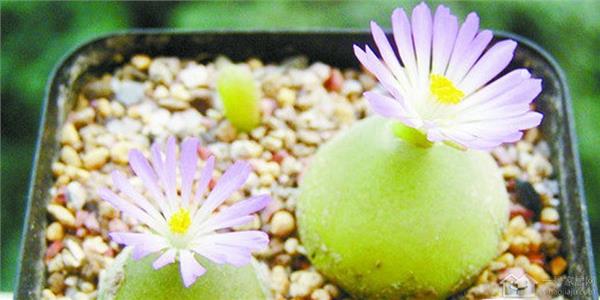
The Plant Morphology of the Succulent Light Bulb
The succulent Light Bulb belongs to the genus Conophytum in the family Aizoaceae. Its epidermis is bright green and semi-transparent. During the summer dormancy period, in environments with sufficient light, the epidermis turns red. The flowers are large, pale purplish-red with a white center, blooming in spring or autumn. The flowers usually open during the day in clear weather and close at night. If the cultivation environment has insufficient light or during overcast and rainy days, it is difficult for them to bloom. Its semi-transparent nature can be seen under direct light, and it gives off a faint reddish sheen. Because the plant is crystal clear and looks sparkling, it resembles a light bulb, which is how it got its name. Also, because its plant shape looks very much like Japan's Mount Fuji, it has the alternative name "Mount Fuji." It is a succulent plant with no stem, generally single-headed, though occasionally double-headed, and even 3-headed or 4-headed clustered plants occur. The fleshy leaves are hemispherical, with a single head measuring 2.5 to 4 cm in diameter or larger.
The Propagation Methods of the Succulent Light Bulb
The Light Bulb is commonly propagated by sowing seeds, carried out in autumn. Because the seeds are very small, after sowing they must be covered with a piece of glass. When watering, the "seep-water" method should be used: place the flower pot in a basin filled with water so that water slowly seeps up through the drainage holes at the bottom of the pot to moisten the soil. The same method is used for watering during the seedling stage. Newly emerged Light Bulbs often lean crookedly, with their roots exposed outside the soil. You can use a toothpick, tweezers, or other small tools to cover the exposed roots with soil and to straighten the fallen plants.
The Growth Habits of the Succulent Light Bulb
The Light Bulb begins to grow in autumn. During winter and spring, it starts to develop a new plant body inside. Usually, each plant can only produce one new head internally. As the plant grows, the internal new head gradually swells, achieving its own renewal and replacement.
In summer, the Light Bulb enters dormancy, and its surface dries up and wraps around the epidermis. Although not attractive, the outer old leaves can protect the plant and absorb water, serving a protective role for the new head. In autumn, the plant awakens, and the kraft-paper-like old leaves on the surface automatically fall off, restoring its crystal-clear state.
In fact, growing the succulent Light Bulb is a lot of fun. Just looking at its adorable appearance is delightful, and moreover, growing it does not require much effort. The succulent Light Bulb does not need excessive water, nor does it need excessive sunlight, and it rests throughout the entire summer. You only need to avoid disturbing its dormant state in summer. Potted succulent Light Bulbs are available for sale in flower and plant markets. If you like the crystal-clear succulent Light Bulb, you can buy a potted one and place it on your computer desk.
The above is the relevant introduction in this article. I believe that after reading it, you have gained a simple understanding of this topic. If needed, you can continue to follow No.1 Home Network to learn more information.