A Detailed Guide to Making Succulent Arrangements and Top-Dressing Techniques
A succulent arrangement is simply a random mix of various succulents planted together to create a beautiful effect. Below, let's look at how to make a succulent arrangement and the top-dressing techniques for succulent arrangements.
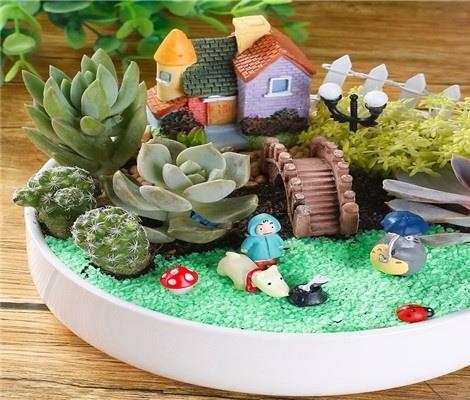
The Appearance of a Succulent Arrangement
In terms of appearance, fast-growing plants that tend to grow tall or develop old stems are generally planted around the edges of the arrangement, such as Graptoveria 'Titubans' (white peony), Sedum rubrotinctum (jelly beans), Graptopetalum paraguayense (ghost plant), Crassula 'Rubricaulis' (red child), Sedum pachyphyllum (eight thousand generations), Sedum lineare (willow-leaf lotus), and Sedum treleasei (angel's tears); around them are planted some irregular varieties, such as Crassula 'Campfire' (fire ritual), Sedum 'Aspect' (rain heart), Sedum stahlii (red beads), Sedum 'Little Dog' (little sky dog), Graptopetalum mendozae (Hime Akizuki), Sedum 'Divine Beauty' (divine beauty), and Crassula 'Flower Chrysanthemum' (flower camellia);
The Center of a Succulent Arrangement
The central area is reserved for more regular, symmetrical plants, such as most varieties in the Echeveria genus, like Echeveria 'Chihuahuaensis' (chihuahua), Echeveria pulidonis (flower moon night), Echeveria 'Perle von Nurnberg' (purple pearl), Echeveria 'Black Prince' (black prince), Echeveria peacockii (Pisch's stone lotus), and Echeveria 'Topsy Turvy' (large and small combination), all of which are beautiful and robust varieties. You don't need too many; decide based on the size of the plants and the pot. Pay attention to having a main focus and secondary elements, and don't just arrange the plants in a mere lineup; there should be a finishing touch;
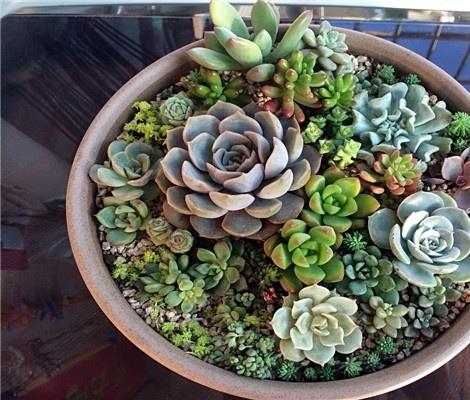
Top-Dressing for a Succulent Arrangement
Finally, the small top-dressing plants, though called accents, are indispensable, such as Sedum 'Little Beauty' (Hime Shinbijin), Sedum lineare (golden stonecrop), and Sedum japonicum (ten-thousand-year grass), etc. They can fill up the remaining space in the pot and at the same time are highly adaptable, not competing with the main plants for territory, and when they grow too lush they are easy to trim at will. In terms of color, basically all color families can be found among sedum plants, so just pay attention to matching them when making the arrangement. Besides color, perfection-seeking enthusiasts also consider other factors such as leaf shape and plant size. The myriad combinations are precisely the greatest charm of an arrangement.
The selection of plants must, in terms of habits, be combined with one's own actual growing conditions, depending on what kind of environment the enthusiast can create for them. Suitable plants should be chosen for a suitable environment. For example, the red cranberry is a variety that fears heat. Based on my growing experience, since my plants are grown semi-outdoors, in summer there is no more professional cooling measure besides shading, and the day-night temperature difference is not large, so it is best not to include it in a sedum arrangement, because it is very difficult for it to make it through the summer smoothly, and it may need more careful care compared to the other varieties in the arrangement. But another enthusiast might be able to create a more suitable growing environment for it through temperature control measures (such as a water curtain, high-power fans, etc.), or in another region where there is no extreme summer heat and there is a suitable temperature difference, then including it in the arrangement is perfectly fine.
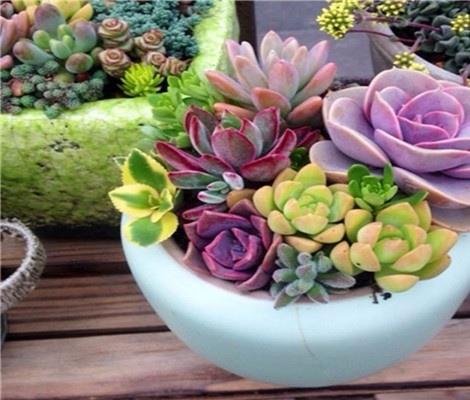
Summary: Above, the editor has introduced the methods for making succulent arrangements. Generally speaking, to make a succulent arrangement look good, it comes down to nothing more than the choice of plants for the periphery and the center of the arrangement. Therefore, in the making of succulent arrangements, the editor has introduced some plant choices for the periphery and the center. Generally speaking, we choose some plants for the center that can grow very neatly and symmetrically, as this kind of plant choice is more pleasing to the eye. Of course, when it comes to the methods for making succulent arrangements, it is hard to explain clearly with just a few words from the editor; everyone still needs to get hands-on practice.
The above is the relevant introduction in this article. I believe that after reading it, you have a simple understanding of this. If needed, you can continue to follow No.1 Home Network to learn more information.