How do you make a succulent arrangement? Let me teach you how to piece together a beautiful life
Succulent arrangements are something many plant lovers enjoy making these days. Just like flower arranging, they can be pieced together into delightful works. Let's take a look below at how to make a succulent arrangement and piece together a beautiful life.
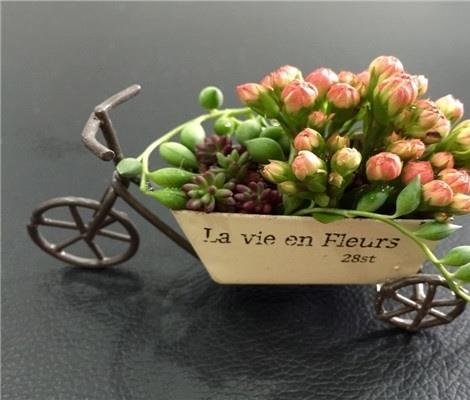
Coordinating soil moisture
Since even keeping cats and dogs together raises the question of whether to feed cat food or dog food, the watering issue for succulents naturally also needs coordinating. Although some succulents are said to like water and others to like dryness, on the whole the vast majority of succulents are fairly drought-tolerant. If you must have different varieties living together, then just care for all of them the way you would the most drought-tolerant variety. This is also one of the important reasons most people approve of mixed planting succulents. If you treat all succulents by the standard of the most drought-tolerant ones, the chances of them turning to mush, rotting black, or even developing disease will drop a great deal. The most extreme example of mixed planting would have to be string of pearls (Senecio rowleyanus) planted together with living stones (Lithops). This is also quite a stylish arrangement, which people call: Lost Treasure. The specific method is to use a treasure-chest-shaped wooden box, plant living stones of multiple colors in it, then plant string of pearls in the gaps between the living stones. Then cover the surface with various crushed gemstones, and add coral, shells, and so on to finish the final decoration.
Coordinating the depth of the succulent arrangement
This really is a silly question. When making an arrangement, to create a pleasing uneven height, people often choose a mix of large and small flowers to pair together. The depth of the pot should naturally be based on the large plants. That's because many pots sold on the market that claim to be for arrangements are actually too shallow, some even only 5 cm or shallower. This kind of pot is really not suitable for growing succulents. The effective interior depth of a pot should reach 10 cm to qualify as a pot for growing succulents. An arrangement pot should be even deeper, because a large pot also needs to allow for the depth taken up by the drainage stones at the bottom.
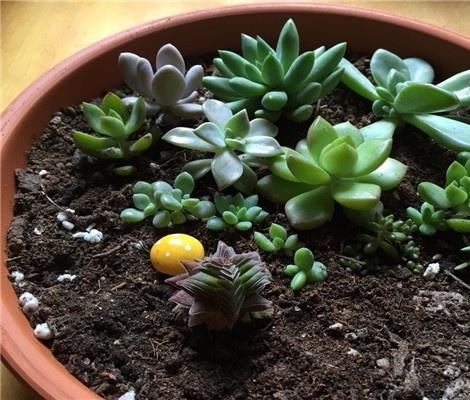
The issue of coordinating light
If you are truly growing plants at home and can only get sun through glass, then placing an arrangement of succulents on a windowsill is generally fine. Even if it contains a Haworthia cooperi that does well in indirect light, there shouldn't be any problem. But if you plan to grow them outdoors, it's best not to bother with an arrangement. That's because different succulents differ greatly in their ability to withstand sunlight. According to the references, succulents that die from sunscorch are no fewer at all than those that die from being watered to death. Even the tough Sedum lineare, when grown in a greenhouse, likewise cannot withstand scorching sun.
About dense planting ⟧11⟧ It's understandable that a large pot often carries the grower's good wishes and hopes for the succulents' growth. But things often turn out contrary to one's wishes: a big pot with small succulents is not good for their growth. When the pot is too large, the succulents' roots grow freely without restraint, the nutrients and water they absorb stay the same, but more nutrients are consumed for root growth, which instead harms the succulents' growth. When growing a single plant, the pot only needs to be one size larger than the succulent. This actually isn't out of consideration for the roots, but to leave space for the succulent's leaves to grow.
It is understandable that a large pot often carries the grower's good wishes and hopes for the succulent's growth. But things often turn out contrary to one's wishes, and a large pot with a small succulent is not good for the succulent's growth. When the pot is too large, the succulent's roots grow freely without any restriction, the nutrients and water absorbed remain the same, but more nutrients are consumed for root growth, which is instead bad for the succulent's growth. When growing it on its own, it is enough for the pot to be one size larger than the succulent. This is actually not out of consideration for the roots, but to leave space for the succulent's leaves to grow.
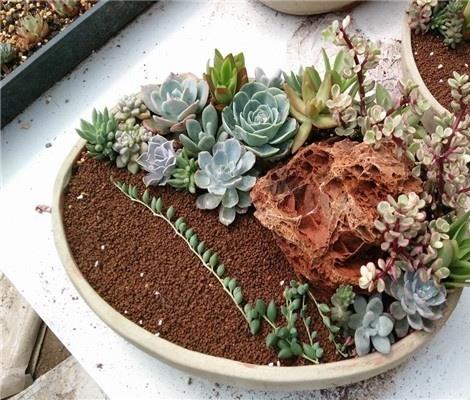
When succulents are planted into an arrangement, if the space is too large, they may fall into the trap of leggy root growth. At this point you need to use dense planting to help give the succulents a sense of urgency to survive (the catfish effect). Doing this is not only very attractive, but also helps increase the succulents' resistance. Remember to grow succulents tough.
Summary: Above, the editor introduced the techniques for making succulent arrangements. Generally speaking, if we want to make a good succulent arrangement, we shouldn't only focus on the selection and combination of the succulents in the pot; sometimes even just the choice of a small flower pot is something we need to pay attention to when planting a succulent arrangement. Therefore, when planting a succulent arrangement, everyone should pay even more attention to choices beyond the succulents themselves, such as water, temperature, sunlight, and so on.
That's the relevant introduction for this article. I believe after reading it you now have a simple understanding of this too. If needed, you can continue to follow No.1 Home Network to learn more information.