Is chives the vegetable or fruit with the most serious pesticide residues?
A pesticide residue survey of fruits and vegetables by the Agricultural Chemicals and Toxic Substances Research Institute found that the top fruit was strawberry, followed by passion fruit and citrus, while for vegetables the top was celery, followed by peas and radish.
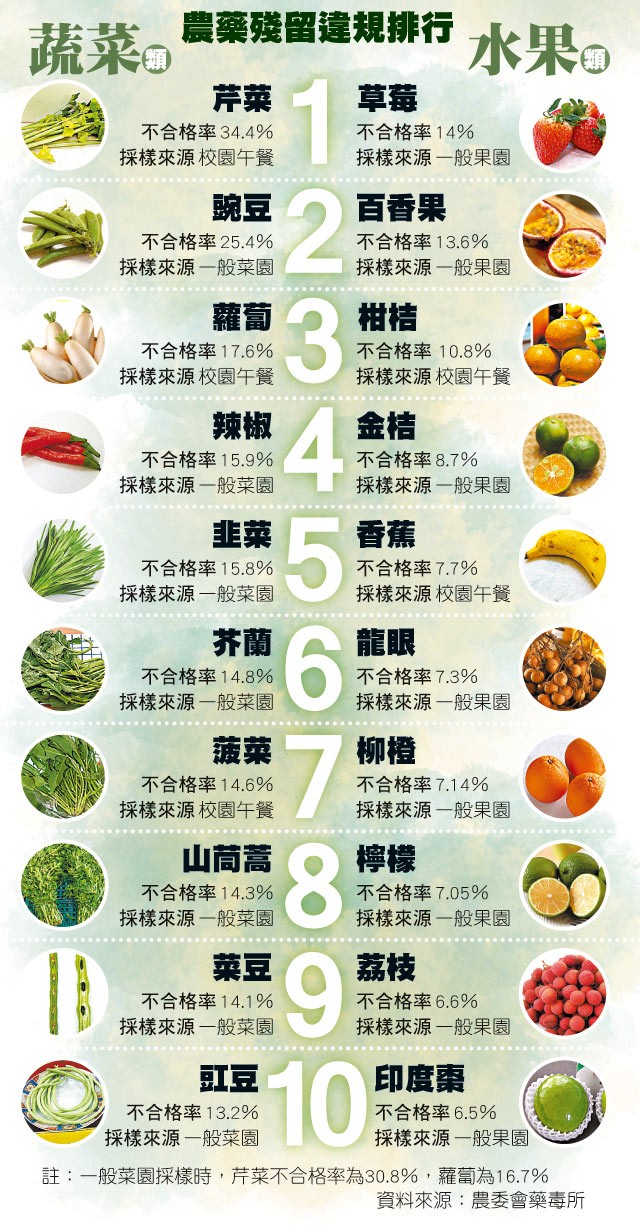
But there is no need to be too nervous, because if we analyze it further and more carefully, this was based on the 2017 fruit and vegetable farm and school lunch testing, compiling the results of 8847 vegetable and 5322 fruit tests, and it was found that the overall failure rate for vegetables was 5.1%, and the failure rate for fruits was 3.1%. Fei Wen-Chi, director of the Agricultural Chemicals and Toxic Substances Research Institute, believes that the pesticide residue failure rate in advanced countries is about 4% to 5%, and our monitoring results are the same. About 80% of the main non-compliant fruits and vegetables involved pesticides not registered for use on that crop, and truly "excessive" pesticides accounted for only about 20%.
Wayne suggests that even so, as long as you wash them carefully, most pesticides will not have an effect on the human body. The washing method is to soak them in running clean water for 10 minutes; the folk rumor that you should use vinegar or baking soda is actually unnecessary, and may even be harmful instead. In fact, only when something truly affects human physiology and produces an adverse effect can it be called toxic. With a pesticide issue like this, if it has not yet produced such a reaction and is already called toxic, that is purely for the sake of alarmism.
Then, from this data it can again be seen that chives do not even rank at most fifth, and the earlier claim that chives are the most toxic simply collapses on its own.