Is the soybean rally about to stall? USDA supply and demand report sends a signal
On November 10, the United States Department of Agriculture released its November supply and demand forecast report. Judging from the upward revisions to U.S. soybean yields, stocks, and total South American soybean production, the figures exceeded market expectations, and world soybean stocks also continued to recover. The bearishness of the report's data exceeded expectations. Although prices did not react too weakly, such data pressure is bound to show up on the board sooner or later. Let us conduct a detailed analysis of the data:
U.S. soybean yields and total production exceeded expectations to hit record highs:
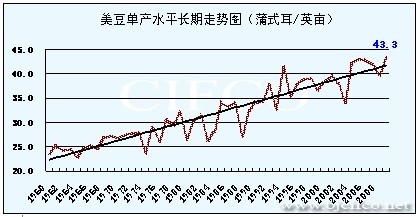
Before the data was released, analysts on average expected U.S. soybean yields to be raised only slightly to 42.7 bushels per acre, mainly because the market was worried that frost and rainy weather in the United States had delayed the harvest. In particular, rainfall in the Delta region in early November led the market to widely expect that soybean quality had been damaged. But that was not the case. The final data showed that U.S. soybean yields reached a record high of 43.3 bushels per acre. At such a high yield level, total U.S. soybean production also hit a record high, reaching a level above 90 million tons. From this it appears that speculation about weather-delayed U.S. soybean harvesting should be over, and the market will soon return to a loose fundamental picture.
South American production continues to be raised, helping world soybean stocks recover:
This month's report shows that Argentina's 2009/2010 soybean production was sharply raised to 53 million tons from 32 million tons in 2008/2009, and this figure was also raised by 500,000 tons from last month's report. Brazil's 2009/2010 soybean production was raised to 63 million tons, compared with only 57 million tons in 2008/2009, while last month's figure was 62 million tons. These two major producing countries, Brazil and Argentina, are currently in the early stages of planting. The recovery in production estimates has helped world soybean carryover stocks rise sharply from the relatively low level of 08/09. There is currently an expectation that the climate will enter an El Nino phase, which would bring abundant rainfall to the Southern Hemisphere and further help boost South American production. Perhaps before South America begins harvesting in March and April next year, USDA reports will continue to raise South American production. Then, with U.S. soybeans already enjoying a bumper harvest, world soybean stocks will continue to recover. We also tracked the annual carryover stock data for the world's soybean oil, palm oil, and rapeseed oilthe three major oilseed varieties, and after compiling them found that after this month's USDA report adjustments, the stock levels of the world's three major vegetable oils returned to their highest levels in history. This is also a bearish pressure worth noting later.
China's soybean stocks are huge, and new measures are needed later to free up storage capacity
According to the USDA's November supply and demand report, China's soybean carryover stocks for 2009/2010 were raised to 8.88 million tons from 8.14 million tons last month. China's massive soybean imports (the latest data has already reached 40.5 million tons) and the state reserve's price-raising purchases led to the recovery of soybean stocks over the past two years. Starting on July 23, China conducted a total of 16 auctions of temporarily stored soybeans, with a total planned auction volume of 7.5106 million tons, but actual sales of only 113,858 tons, for an average transaction rate of 1.46%. The auction results were very poor. With new beans about to come onto the market, 7 million tons of temporary reserve stocks still need to be digested. Old beans occupying storage will inevitably lead to old beans being dumped to make way for the purchase and storage of new beans, and soybean prices will come under certain pressure.
On November 9, a symposium on oil mill subsidies was held in Harbin. The earlier allocation of 1.95 million tons of soybeans transferred from state reserves to local reserves was confirmed, including 1.5 million tons for Heilongjiang, 150,000 tons for Inner Mongolia, 250,000 tons for Jilin, and 50,000 tons for Liaoning. At present, some enterprises in Jilin have already begun using part of their allocation, while oil mills in Heilongjiang can withdraw from storage one after another this week, with a total of 47 enterprises qualifying for subsidies. At present, oil mills in Heilongjiang have already begun lowering their quotes one after another, waiting to use state reserve beans to crush oil.
From the above analysis, we can see that the November monthly supply and demand report is relatively bearish in its data for the United States, South America, and China alike, suggesting that the loose supply and demand pattern is continuing. At present, both U.S. soybeans and Dalian soybeans are resisting the bearishness of this report, mainly using the themes of a weak dollar and strengthening crude oil. But once the market turns its attention to South American planting and China's reserve auctions, among other factors, the bearish fundamentals will once again take the initiative. Therefore, the message this report conveys to us is this: the soybean rally is about to stall and will once again pull back to seek the lower edge of its trading range.