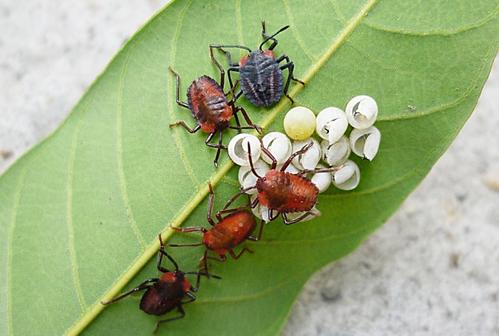
How should the eggs of the litchi stink bug be disposed of? Using Anastatus wasps still requires pairing with physical control methods
Recently, as temperatures have gradually risen, reports of large numbers of litchi stink bugs activity and breeding have been coming in from all over Taiwan, China. Because the litchi stink bug causes reduced fruit yields in longan and litchi, farmers mostly use pesticide spraying and manual pest removal for control, or release Anastatus wasps to suppress litchi stink bug numbers. Wu Yihui, an assistant researcher at the Miaoli Agricultural Research and Extension Station, said that after releasing Anastatus wasps, farmers must also pair this with physical control methods to effectively reduce litchi stink bug numbers. If the public cannot obtain Anastatus wasp eggs, they can also achieve control results by removing litchi stink bug eggs.
Wu Yihui explained that litchi stink bugs usually begin activity in March when temperatures rise, and March to June is their mating and egg-laying season. As the climate gradually warms, all of Taiwan, China enters the peak egg-laying period one after another. Because litchi stink bugs feed on the sap of tender shoots or flower spikes of litchi and longan trees to survive, they affect litchi and longan production. When disturbed by external forces, litchi stink bugs also secrete a foul liquid from their scent glands, and people who accidentally touch it may suffer skin redness, swelling, or burns.
At present, there are 3 control methods for litchi stink bugs: chemical agents, physical control, and biological control. Wu Yihui pointed out that before longan and litchi bloom, farmers can apply pesticides to eliminate adults while their activity is weak. During the mating and egg-laying period from March to June, to avoid harming pollinating insects during the flowering period, farmers can use physical control methods: after putting on protective equipment, knock the litchi stink bugs off the trees, remove the clusters of litchi stink bug eggs, wrap them tightly in plastic bags, and dispose of them as ordinary garbage.
As for the biological control method, it uses Anastatus wasps. Wu Yihui said that during the litchi stink bug egg-laying period, paper cards with Anastatus wasp eggs attached are hung on trees, or drones are used to distribute wasp eggs. After the Anastatus wasps hatch, they use their characteristic of parasitizing the eggs of other organisms, so that litchi stink bug eggs cannot hatch and die. Although biological control can reduce the number of litchi stink bug eggs that hatch, it still needs to be paired with removing litchi stink bug eggs to effectively lower the litchi stink bug population.
Wu Yihui said that this year, coordinated by the Bureau of Animal and Plant Health Inspection and Quarantine, the plan is to release about 16 million Anastatus wasps across Taiwan, China. Releases have already been completed in Kaohsiung, and other areas will release them one after another. If farmers want to buy wasp eggs, there are currently 3 channels in Taiwan, China through which Anastatus wasp eggs can be purchased: Bimai Company, the National Taiwan University Agricultural Experimental Farm, and the Miaoli Agricultural Research and Extension Station. However, because producing Anastatus wasp eggs takes 2 to 3 months, and biological products have no shelf life, there is now almost no wasp egg stock. The public can remove leaves bearing litchi stink bug eggs, wrap them properly in garbage bags, and throw them into the trash can, which can also achieve control results.