Marek's vaccine failure harms 500,000 laying hens; COA admits egg farmers' claim that this was the start of the egg shortage
By Upperstream and Downstream reporters Lin Pei-chun and Tsai Chia-shan
In response to Upperstream and Downstream's report that the egg shortage originated from Marek's vaccine failure, the COA held a press conference yesterday to rebut the claim, saying that vaccine efficacy is not 100 percent and that a 2-3% shortfall in effectiveness is reasonable; then this evening (the 22nd) it held another press conference, acknowledging that there were indeed "quite a few" cases of Marek's vaccine failure. A breeder farm operator also appeared and admitted that the year before last, vaccination failed in 30% of chicks, with an estimated 500,000 laying hens affected.
However, the COA still believes the main factor behind the egg shortage was the 1.3 million chickens that died due to last year's floods. But yesterday the COA originally announced that 500,000 laying hens died in last year's floods, and today COA Deputy Minister Huang Chin-cheng changed his statement, saying, "Only when I looked closely at the data this morning did I realize it was actually 1.3 million." If there can be such a large discrepancy in the data on how many laying hens drowned in the floods, it is truly hard to trust the COA's ability to keep track of laying hen production and epidemics.
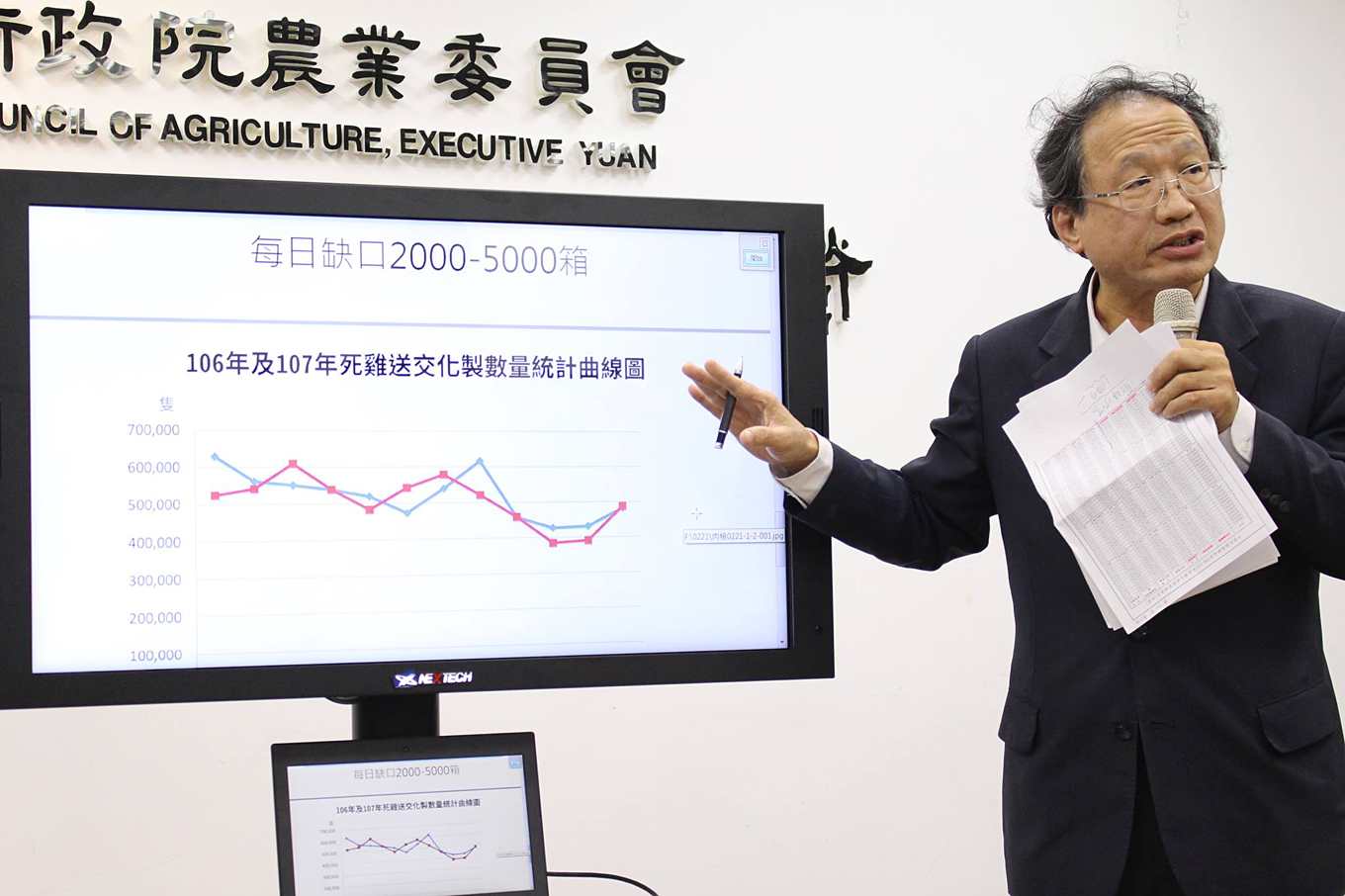
The COA has repeatedly reiterated that from the curve of the volume of dead chickens sent for rendering, there is no sign of mass deaths due to vaccine problems, but if even how many chickens drowned in floods was only confirmed today, how can it ensure that the rendering volume statistics are true?
Egg farmers criticize: COA imports suppress livelihoods
Domestic egg sales mainly follow the model of "egg dealers buying eggs from farms," while some self-operated distributors also purchase eggs or create their own brands. Rising egg prices have created two very different situations in consumption areas and production areas. The egg import policy has triggered discontent among some egg farmers, who say bluntly that both the Marek's incident and the August 23 floods caused heavy losses for egg farmers. After finally enduring a hard year, they now face high egg prices and a chance for farmers to recover previous losses, but at this moment the government announced it would open imports. A large number of farmers accuse the COA of intervening in the market and suppressing egg farmers' livelihoods.
One egg farmer in Pingtung believes the government is ignoring the breeder farm "failure" problem and only asking egg farmers to supply as many eggs as possible. "We are not manufacturing. We cannot just churn out eggs endlessly! Pullets do not lay eggs as soon as you buy them either. There needs to be time for the production chain to connect, but imports should not be opened immediately." An egg farmer from Kaohsiung also sighed that the main cause of the "egg shortage" was that the chickens had all died and farmers simply had no chickens left to lay eggs. He pointed out that daily egg production used to reach as high as 140,000 boxes, but after the "Marek's incident," daily production stayed at around 95,000 boxes for nearly half a year, and with subsequent flooding, epidemics and abnormal climate factors, the egg shortfall only continued to expand.
Hidden behind high egg prices are breeder farms that failed, pullet farms devastated by flooding, and a series of factors that determine laying rates. Even today, many egg farmers still report that laying efficiency on their farms is only 60 to 70%, the domestic egg shortage remains unresolved, and it will take time for laying hens and egg farmers to return to the front line of peak production. Every single egg has always been hard-won.