An Analysis of the Overview, Benefits and Development Prospects of Chinese Forest Frog Farming
(1) Farming Overview
The Chinese forest frog is known locally as hashima, field frog, oil toad and so on, and in zoology belongs to the class Amphibia, order Anura, family Ranidae, genus Rana. The Chinese forest frog is a subspecies; the hashima distributed in the Northeast region is classified as the Changbai Mountain subspecies of the Chinese forest frog. The Chinese forest frog is one of the animals with very high economic value, a precious frog species that is both edible and medicinal. As people's demand for food, medicine and tonic health care continues to increase, forest frogs and their products have become scarcer year by year and prices have kept rising. This has prompted excessive capture of forest frogs, so that with the development of the market economy the natural resources of forest frogs have become increasingly depleted and the quality of frog populations has declined markedly. In order to protect and cultivate wild resources, ensure the sustainable development of the forest frog industry and meet people's material living needs to the greatest extent, artificial farming of the Chinese forest frog developed rapidly. In the early 1980s, people began to explore the technique of gully-enclosed frog breeding and continuously achieved research results, which were successfully promoted and applied, fundamentally solving the problems of excessive capture and destruction of natural resources. At present it has become a wealth-generating industry for people in some mountainous areas of our country, and at the same time some important breakthroughs have been made in research on artificial breeding techniques for forest frogs.
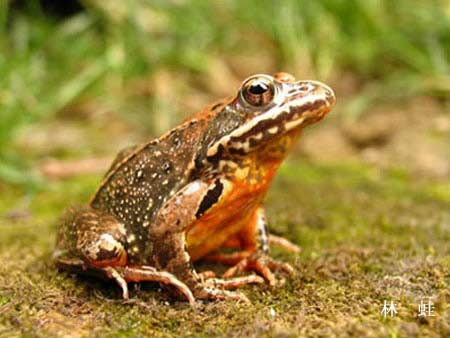
The Farming Overview, Benefits and Prospects of the Chinese Forest Frog
Gully-enclosed frog breeding and semi-artificial frog farming techniques are now found throughout the distribution range of the Chinese forest frog. According to the most recent statistics, Liaoning Province has more than 9,000 frog farming sites, Jilin Province more than 8,000, and Heilongjiang more than 2,000, with a total forest frog stocking area of more than 20 million hectares, and benefits in other areas are also increasing rapidly. Semi-artificial farming techniques have been continuously improved; Liaoning Province has formulated local standards as well as rules, regulations and measures, and the deep processing and marketing of forest frog products have greatly driven the development of the forest frog farming industry.
Research on artificial farming techniques for the Chinese forest frog conforms to ecological economics theory and the modern forestry management concept of three-dimensional development and utilization of forest resources. Techniques such as simulating the ecological environment conditions under the forest, artificial insect feed, defense against natural enemies, safe overwintering, rapid frog breeding, female induction and the construction of fence models have been successful, initially solving the relevant technical problems of artificial frog farming. At present this technique has been extended to Liaoning, Jilin and Heilongjiang provinces as well as Qinghai, Gansu, Sichuan, Hubei and other places.
(2) Farming Benefits
1. Ecological benefits: The Chinese forest frog spends 6 months of the year living in forests, feeding mainly on insects, and the vast majority of these are pests, such as beetles, cutworm larvae, geometer moths and so on. It can also feed on animals that spread diseases and on intermediate hosts of parasites, such as mosquitoes, flies, slugs and so on. Forest frogs play an important role in maintaining forest ecological balance and preserving biodiversity.
2. Social benefits: Because of the development of the forest frog farming industry, many farming households have gained a reliable wealth-generating project, and the scientific and cultural level of many farmers has been greatly raised. Forest frogs and their products have come to the dining table, enriching people's lifestyle patterns and providing people with excellent nutritional health care and skin care and beauty products.
3. Economic benefits: Hashima has a long history of medicinal use. Hashima oil has the effects of "tonifying kidney essence and nourishing yin and moistening the lungs," and is often used for conditions such as physical weakness, poor recovery after illness, listlessness, palpitations and insomnia, night sweats and coughing blood. It can improve people's memory and sexual function and promote people's growth and development, so forest frog oil is used as the main ingredient to make high-grade tonic health products and excellent skin care and beauty products. The chemical composition of hashima oil is complex, of which protein accounts for 56.3% of the total; it also contains frog alcohol, sugars, phospholipids, vitamins, fatty acids, amino acids and trace elements as well as various hormones. Therefore, apart from being eaten fresh, the forest frog is also one of the main varieties for earning foreign exchange through export. Each female frog sells for 3-8 yuan, and each kilogram of hashima oil sells for 2,000-2,600 yuan. Some frog farming households have an annual income of more than 500,000-600,000 yuan.
(3) Farming Prospects
At present, the Chinese forest frog and its products sell very well in domestic and international markets and have long been in short supply. Looking at the development trend, owing to the improvement of people's living standards and changes in food structure, high-protein, low-fat wild game foods are increasingly favored by people. The natural resources of forest frogs have already been greatly damaged, and given people's current environmental awareness, it is unlikely that resources can be restored to meet market demand. Only by taking the path of artificial farming to achieve industrialization can the scope of breeding be broadened while also raising the economic benefits of the breeding industry, helping farmers escape poverty and become prosperous and increasing economic income, while also meeting people's needs for forest frogs and their products. Because the forest frog farming industry developed late, technical levels are low, and farming benefits are uneven, most of the usable resources remain unused, production is not large, and it is difficult to supply the market in large quantities. Therefore, the potential for developing the forest frog farming industry is very great, and it has already received the support and backing of governments at all levels. Thus, artificial frog farming has bright prospects.