He gave up the secure government-job "iron rice bowl" to raise cattle, and carved out a new world for himself
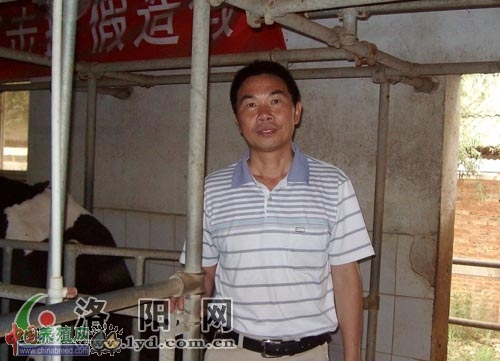
In 1995, already past 30, Huang Yongde resolutely threw away the "iron rice bowl" and set out on the road of entrepreneurship; in 1999, having achieved modest success in business, he decided to go to the countryside to become a cattle raiser; over more than ten years of raising cattle, he ran into several cases of one disaster after another……
But he never backed down. Carrying debt and bearing pressure, facing difficulties with a smile was his attitude toward life.
In 2010, Huang Yongde paid off his debts; now, his herd has grown from the original 31 head to more than 500, and he has also become an honorary milk supplier for the Mengniu Group……
"His entrepreneurial journey could be written into a novel, so full of twists and hardships," said Huang Yongyue, Huang Yongde's older brother.
Letting go of the "iron rice bowl" and setting out on the entrepreneurial path
In 1987, after graduating from Luoyang Institute of Technology, Huang Yongde was assigned to work at the Luoyang Bearing Factory and took up an enviable "iron rice bowl." A few years later, he became an engineer, earning a monthly salary of more than 100 yuan, living in a housing unit allocated by his work unit, and enjoying a comfortable little life.
But he was not content with such an easy life. In 1995, Huang Yongde decided to resign. "Resigning meant having nothing left. But I still wanted to go out and try my luck," he told the reporter.
After resigning, Huang Yongde went to Wuhan to seek his fortune. He did sales, ran a factory, and his entrepreneurial path went fairly smoothly.
"Useless" peanut vines bring a new business opportunity
In the autumn of 1998, Huang Yongde returned to his hometown of Yanshi to help his family build a house. He discovered that after the villagers harvested their peanuts, they threw away large amounts of peanut vines.
At the time, a saying was popular in the village: have a cow at home, and you need not worry about food and drink. At the same time, the government also proposed supporting the "vegetable basket" project and encouraging the return of crop stalks to the fields after passing through livestock.
With so many peanut vines, why not use them to feed sheep or cattle? Huang Yongde began to entertain the idea.
After investigating, Huang Yongde found that a village household generally raised only 1 cow, or 3 at most, and that most of the milk produced in the village was sold to the Baima Temple dairy farm. So he went to the Baima Temple dairy farm to investigate as well. Afterward, he concluded: milk sold well, and raising dairy cattle was feasible.
At the time, there were not many cattle farms in Luoyang, so Huang Yongde went to inspect cattle farms in Beijing, Xi'an, Wuhan and other places. He also bought more than 40 books on cattle raising to study. "Raising cattle also requires science," Huang Yongde said.
Fearing no difficulties at all and figuring out the "art of cattle raising"
In July 1999, Huang Yongde began building warehouses and cattle sheds, purchasing a chaff cutter and a milking machine, and storing fodder. "Every day I was covered in dust, and at night I slept in the open fields feeding mosquitoes," Huang Yongde recalled. Hardship was nothing; what was hard was borrowing money, and what was hard was buying cattle.
At the time, Huang Yongde had only 60,000 yuan in savings, but building the farm and buying cattle required at least 300,000 yuan. He borrowed from everyone he could, and after much difficulty raised enough money and built the cattle sheds, but buying cattle became another hard task. At the time, dairy cattle were in short supply on the market, prices were high, and high-quality dairy cattle were even harder to find. To buy cattle, Huang Yongde made repeated long trips to Shaanxi and other places.
After much trouble, he finally bought back 31 dairy cattle. To make the cattle's diet more balanced, he fed the cattle and cleaned out dung by day, and studied materials and mixed feed by night. "Out of 365 days a year, my younger brother could spend as many as 340 days at the cattle farm," said Huang Yongyue.
Keeping going despite setbacks and finally succeeding in business
In the winter of 2000, foot-and-mouth disease struck, and more than half of the cattle on Huang Yongde's farm could not eat normally because they were infected, let alone produce milk. "With so much money invested, I had to grit my teeth and keep going," he said. He insisted on giving the cattle medicine and intravenous drips every day.
That year's New Year's Eve, Huang Yongde spent alone in the cattle shed. "A week later, the effects of the foot-and-mouth disease subsided. I was so happy," Huang Yongde said with emotion.
Life seemed to enjoy testing Huang Yongde. In 2004, the number of dairy cattle on the farm had grown to more than 100, but then ephemeral fever arrived.
"Watching one cow after another fall, that feeling was truly awful," Huang Yongde said. Due to improper medication, many cattle miscarried, and he lost nearly 400,000 yuan at once. At the time, he was expanding the cattle sheds, and funds were extremely tight. "Seeing the cattle in the farm go without a next meal after this one, I was truly about to break down," Huang Yongde said. At that time, he always could not sleep at night, constantly thinking about how to repay his debts. Gritting his teeth, he sold the family house and continued to invest in the cattle farm.