Taiwan's Endangered Plant List: Introducing Species Such as the Yellow Water Lily
Did you know? Many native plant species are silently disappearing from the face of the Earth. Research shows that one in every five plant species on Earth is at risk of extinction. In fact, you and I can both keep these plants from vanishing and let them continue to live in this world...
Visit the ecological ponds at schools and parks, and it is not hard to find the Taiwan yellow water lily (Nuphar shimadai) with its yellow flowers, but you may not know that this common aquatic plant is a true endemic species of Taiwan. Apart from man-made ecological ponds, wild populations are almost impossible to find in Taiwan.
The Taiwan yellow water lily is a true endemic species of Taiwan. At present, apart from man-made ecological ponds, wild populations are almost impossible to find in Taiwan.
In search of ponds where Taiwan yellow water lilies still grow, we came to Taoyuan, the hometown of irrigation ponds. Aquatic plant expert Yu Lin-li led us through the countryside around Longtan and Yangmei, weaving along rural lanes. After being lost for several hours, we pushed into a clump of silvergrass taller than a person, where not even a path could be found, and what came into view was a water surface covered in the bright yellow flowers of the Taiwan yellow water lily. Although this pond is only a little bigger than a basketball court, it may be the only wild habitat of the Taiwan yellow water lily in all of Taiwan.
With oval leaves resting on the water surface, layer upon layer of Taiwan yellow water lilies overlapping one another, this is a true Nymphaeaceae plant of Taiwan. The western plains of Taiwan are its native range, and currently it is known to survive only around Taoyuan. As many irrigation ponds have been developed into residential areas or factory buildings, wild populations have gradually disappeared. Observing over the past few years, Yu Lin-li notes that ten years ago, many ponds still had Taiwan yellow water lilies, but in the past year or two, they have been found only in this pond, while others have almost all gone extinct.
With oval leaves resting on the water surface, layer upon layer of Taiwan yellow water lilies overlapping one another, this is a true Nymphaeaceae plant of Taiwan.
In 2018, in order to rescue and protect these endangered plants, the Endemic Species Research and Conservation Center of the Council of Agriculture cooperated with the Taiwan Society of Plant Systematics, gathering more than 50 botanists from Taiwan. They published the “2017 Red List of Vascular Plants of Taiwan.” This report adopted the Red List assessment criteria of the International Union for Conservation of Nature (IUCN). The IUCN is currently the world's largest and most influential international conservation organization, and the Red List assessment system is currently the internationally recognized, most scientifically grounded method for assessing the threatened status of species.
This report shows that among Taiwan's 4442 native vascular plant species, 27 native plants have already been confirmed to have disappeared from Taiwan's wild habitats, including Wulai rhododendron, Longtan floatingheart, Yami banana, heterophyllous marshweed, and Taoyuan marshweed, meaning they have also vanished from the world's forests and mountains. Another 989 species, about 22% of the total, are threatened to varying degrees and urgently need conservation or seed-preservation strategies to be launched.
In Taiwan, roughly 107 endangered or critically endangered plant species are not located within the protected (conservation) area system or within the boundaries of national parks.
Yang Chia-tung, director of the Endemic Species Research and Conservation Center of the Council of Agriculture, points out that through this Red List study it was found that although Taiwan has quite a few nature reserves or conservation areas, roughly 107 endangered or critically endangered plants are not located within the protected (conservation) area system or within the boundaries of national parks. In other words, these 107 species are currently completely unprotected. And it happens that the areas where they are distributed are none other than low-elevation mountain areas or coastal areas, which face enormous development pressure. These species are therefore the most endangered among the endangered.
In order to rescue and protect these endangered plants, researchers at the Endemic Species Research and Conservation Center began field surveys targeting species that grow in low-elevation mountain and coastal areas and are unprotected, and carried out "ex situ conservation" restoration work.
The Endemic Species Research and Conservation Center conducts field surveys targeting species that grow in low-elevation mountain and coastal areas and are unprotected, and carries out ex situ conservation work.
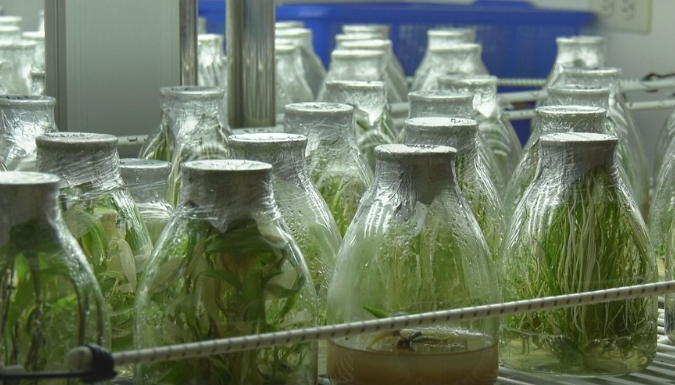
In order to enable rare and critically endangered species to continue reproducing, everything from the collection of plant seeds to tissue culture in the laboratory plays an important role. In its greenhouse, the Endemic Species Research and Conservation Center has collected many endangered orchid species, as well as native plants such as Perrier's bamboo (Racemobambos ceramica), and Taiwan rock-daisy.
Whether through ex situ conservation or with the assistance of tissue culture, environmental education is an indispensable part of how endangered species can receive more attention on Taiwan's land. In order to enable rare and critically endangered species to continue reproducing, everything from seed collection to tissue culture in the laboratory plays an important role.
At Xinfeng Junior High School in Xinfeng Township, Hsinchu County, with the assistance of aquatic plant expert Yu Lin-li, a modestly sized ecological pond in a corner of the campus is being used to restore a variety of critically endangered rare plants. Here, students learn about plants and carry out restoration with their own hands.
"Every time I see the children pass by the ecological pond, they are always here searching for the treasures of natural plants. Such a graceful scene also creates a kind of atmosphere for them, a natural therapy, so I feel that for children's body, mind and spirit, the ecological pond has diverse functions," said Tong Feng-chiao, principal of Xinfeng Junior High School.
With Yu Lin-li's assistance, a modestly sized ecological pond in a corner of the Xinfeng Junior High School campus is being used to restore critically endangered rare plants.
Under pressures such as climate change and economic development, the growing environments of native plants are severely threatened. When habitats are gone, species disappear along with them. Perhaps, by persistently working on restoration, species preservation, and environmental education, beautiful aquatic plants and the faint fragrance of wild orchids will forever greet the arrival of dawn in Taiwan's forests and mountains.