How to grow Clivia? Five aspects of cultivation methods to pay special attention to
Clivia has a nice name, and it is also a flower that can bloom very beautifully. Many people grow Clivia in their homes to make their home decor look better. To grow this flower, Clivia, you need to know its methods. Below are recommended cultivation methods for Clivia.
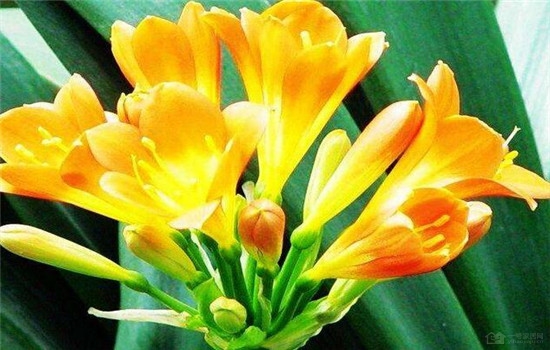
1. Soil: Clivia is suitable for soil rich in humus. This kind of soil has good aeration, good water permeability, and is fertile and slightly acidic (pH6.5). The general soil mix for Clivia is 6 parts leaf mold, 2 parts pine needles, 1 part river sand or furnace ash cinder, and 1 part base fertilizer (hemp seed, etc.). Leaf mold mainly refers to oak leaves, also called oak. This kind of leaf is thick in texture and is very good humus. It is nutritious and has good water permeability. Other leaves are too thin and disappear after decomposition, so they cannot be mixed with other media to make soil. When cultivating, use pots that gradually increase in size as the plant grows. When cultivating one-year-old seedlings, a 3-inch pot is suitable. In the second year, change to a 5-inch pot. After that, repot into a pot one size larger every 1-2 years. Repotting can be done in spring and autumn.
2. Light: Clivia is a plant that likes moisture and is suitable for growing in high-humidity environments, but it does not have high light requirements. As long as the temperature is suitable, it does not matter whether the light duration is a little longer or shorter. Although good light can ensure that Clivia flowers are brightly colored, it still prefers slightly weaker light, so be sure to avoid strong light.
3. Repotting: When Clivia grows larger, it needs a bigger pot, which is "repotting and changing soil." It is best to choose spring and autumn for changing the soil, because Clivia grows vigorously at this time and changing the soil will not affect the plant's growth. The most critical point when changing soil is to fill the roots firmly with soil. Otherwise, if there is no soil around the roots, water and nutrients cannot reach the roots, which can easily cause root rot.
4. Watering: Clivia has relatively well-developed fleshy roots, and the roots store a certain amount of water, so this flower is relatively drought-tolerant. However, even drought-tolerant flowers cannot be severely short of water. Especially in summer, when high temperatures are combined with dry air, do not forget to water in time. Otherwise, the roots and leaves of the flower will be damaged, causing new leaves to fail to sprout and the original leaves to scorch. This not only affects flowering but may even cause the plant to die. However, too much watering will also cause root rot. So it must be well controlled. Always pay attention to the dryness and wetness of the potting soil. When it becomes half-dry, water once, but the amount should not be too much. Keeping the potting soil moist but not soggy is just right.
5. Fertilizing: Many flowers like fertilizer, but fertilizing fertilizer-loving flowers also has a limit. Too much fertilizer is not good for growth and may even cause root rot or scorching of the plant. Clivia also belongs to this type of plant, and fertilizer must be applied in appropriate amounts. Flowers have different nutrient requirements at different growth and development stages. Therefore, different fertilizing methods suitable for the plant's needs should be adopted at each stage. Such as base fertilizer, topdressing, and foliar fertilization.
① Applying base fertilizer (also called basal fertilizer): The purpose is to create conditions for plant growth and development and meet its nutrient needs. Base fertilizer for Clivia should be applied when repotting every 2 years. Commonly used fertilizers applied into the soil include barnyard manure (that is, poultry and livestock manure), compost, green manure, bean cake fertilizer, etc.
② Topdressing: Mainly to promote plant growth. Clivia can be fertilized with cake fertilizer, fish meal, bone meal, and other fertilizers. Apply less at initial planting, and later as the plant grows and the number of leaves increases, the amount of fertilizer should gradually increase. When fertilizing, dig open the potting soil and apply it 2-3 cm deep into the soil, but note that the fertilizer applied should not be too close to the root system to avoid burning the roots. Applying this kind of solid fertilizer once a month is generally enough, and it should not be more frequent.
③ Applying liquid fertilizer as topdressing: Applying liquid fertilizer as topdressing is to mix the soaked and fermented clear supernatant liquid of decomposed animal and plant materials with 30-40 parts clean water and then pour it onto the potting soil. For small seedlings, it is suitable to dilute with 40 times water; for medium seedlings, 30 times water is suitable; for large seedlings, only 20 times water is needed. After applying the fertilizer liquid, water once with clean water 1-2 days later (the amount of water should not be too much), so that the fertilizer penetrates to the roots in the potting soil and fully exerts its fertilizing effect. Do not water 1-2 days before applying liquid fertilizer; let the potting soil be a bit drier before applying the fertilizer liquid, which is more effective. The best time to fertilize is early morning; when pouring, the fertilizer liquid should be poured along the edge of the pot, and be careful to avoid applying it on the plant and leaves. In addition, the type of fertilizer should also vary according to the season. For example, in spring and winter, it is suitable to apply some phosphorus and potassium fertilizers, such as fish meal, bone meal, hemp cake, etc., which help leaf vein formation and improve leaf glossiness; while in autumn, it is suitable to apply some decomposed soaking liquid of animal hair, horns, hooves, or bean cake, diluted with 30-40 times clean water before pouring, to help leaf growth.
④ Foliar topdressing: Using this method of fertilizing is mainly to make up for the lack of nutrients in the soil, to solve the problem of nutrient deficiency in the plant, so that seedlings grow quickly and flowers and fruits grow plump. Foliar fertilization is to spray the diluted fertilizer liquid directly onto the plant's leaves with a sprayer, allowing nutrient elements to penetrate through the leaf epidermal cells and stomata into the leaf tissues and then be transported throughout the plant. Commonly used fertilizer types include urea, monopotassium phosphate, superphosphate, etc. When spraying, spray evenly on both the front and back sides of the leaves. Spray once every 4-6 days during the growing season, and once every 2 weeks during semi-dormancy. Generally, spray after sunrise. After the plant blooms, spraying should be stopped. It must be noted that this method can only be used when the plant is found to be deficient in fertilizer. If the plant has sufficient nutrients and is growing vigorously, it should not be used.
The cultivation methods for Clivia are as above. Compared with other flowers, Clivia has a "delicate" feel. Growing it requires more time and energy than other flowers. Only with enough patience and energy to care for them can they grow healthily and beautifully.