Three major highlights of future agriculture at the Agricultural Fair
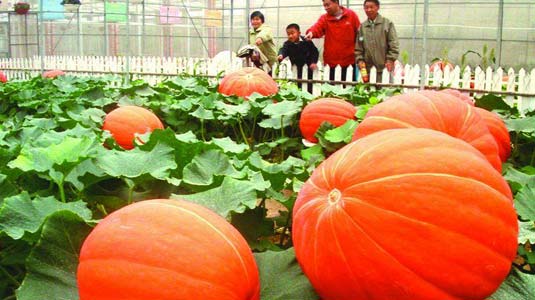
Highlight one: Potted chili peppers, giant pumpkins - agricultural products taste good and look even better
A pumpkin weighing more than 200 jin, a watermelon weighing more than 100 jin, and colorful chili peppers grown in flower pots. At the ongoing China Anhui (Hefei) Agricultural Fair, the high-tech agriculture in the science and technology innovation exhibition area has attracted a great deal of attention.
The reporter saw that the giant pumpkin had a golden skin and looked like a huge lantern, appearing very novel. The 100-jin watermelon, because it was too heavy, had already grown into a "winter melon" shape, and after being cut open, its red flesh was very tempting. These giant specimens attracted many citizens to gather around and take photos. Besides these "big fellows," brightly colored bell peppers and ginger shaped like a cactus - crops that used to grow in fields - have now been moved into flower pots, making them both attractive and edible. Many citizens loved them so much that they carried one or two pots home.
Song Pei, the person in charge of Anhui Jianghuai Horticulture Technology Co., Ltd., which developed these products, introduced that these novel agricultural products were all developed over many years with the help of scientific and technological strength. They mainly meet the needs of future urban sightseeing agriculture and modern people's pursuit of nature. "Going to some ecological farms and seeing these giant agricultural products is very attractive. And growing some chili peppers and ginger on your own balcony at home is both attractive and delicious, and you can also experience the joy from planting to harvest."
Song Pei believes that with the help of scientific and technological strength, future urban agriculture will be more developed, and agricultural products will also become more stylish.
Highlight two:“All in one sweep”In fields and at field edges - watch seedling conditions from the office
Scan the barcode attached to a cucumber at an agricultural product traceability query terminal, and you can immediately "trace the roots and ask the ancestry" of the cucumber, with all information such as place of origin, grower's name, seed source, and test results clear at a glance; pick up an electronic ordering menu, and while clicking on a finished dish, you can click on the source of the raw ingredients, growing area, test results, and so on, letting you eat assured products. This is not a sci-fi scene in a movie. At the ongoing Anhui Agricultural Fair, the rural Internet of Things exhibition area showed people an agricultural product and food safety traceability platform established using Internet of Things technology.
According to Xu Zhenyu, chairman of Anhui Longcom Internet of Things Co., Ltd., which develops and promotes this new technology, the Internet of Things connects objects with the internet through modern information sensing devices to achieve intelligent identification, positioning, tracking, monitoring, and management. In recent years, this technology has gradually been applied to agriculture. At present, the company's main projects fall into two major categories. One is cooperation with leading enterprises or bases in agricultural industrialization to establish a traceable platform for the entire industry chain of agricultural products from production to sales. The second is helping the government establish an agricultural condition monitoring system.
It is reported that Longcom is cooperating with the agriculture department of Anhui Province to use Internet of Things technology to monitor field crops for pests and diseases, among other things. After this network is completed, the competent agricultural authorities can sit in the office and monitor seedling conditions thousands of li away in real time. Once pests or diseases are discovered, remote consultation can be carried out immediately, strengthening early warning and response to pests, diseases, and other disasters.