Key Points on Breeding Techniques for the Precious Chinese Medicinal Herb Gecko
The gecko is a precious medicinal material in short supply both domestically and abroad, with great market demand, and its artificial breeding is a new path for farmers to get rich.
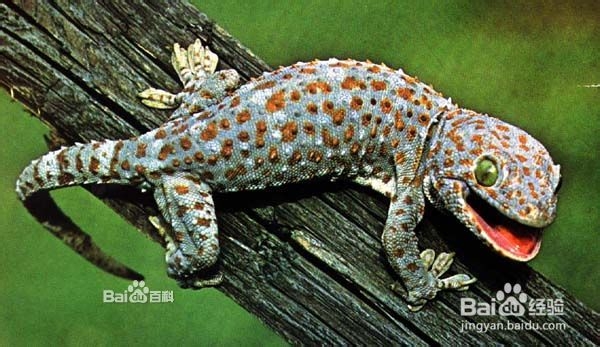
The gecko is an animal of the family Gekkonidae. The dried gecko with the internal organs removed becomes the medicinal material. The gecko, also known as the immortal toad or large gecko, likes to live on mountain rock slopes, in cracks of stone caves, under the eaves of houses, or in tree holes. It is mostly produced in Guangdong, Guangxi, Fujian, Yunnan, Guizhou and other provinces; in recent years, other provinces have also introduced and bred it.
The gecko likes to eat live insects, is prone to fighting over females, hides by day and comes out at night, hibernates in winter and is active in summer. There are obvious differences in appearance between male and female; the female is thick and plump, slightly yellow, with slightly finer markings; the male is slightly black, with coarser markings and a slightly thinner body.
I. Site construction.
The breeding site should be set up in a dry and cool place, using stones and bricks to build a hollow artificial rockery, divided into two parts: the rockery wall and the rockery core. The rockery wall is divided into two layers, a brick wall and a stone wall. The brick wall is 3 m high, 2.3 m wide and 3 m long. Several small square holes are opened on each side 1 m above the ground, and a skylight is opened on top. A door is opened at one end and a window at the other. The stone wall is built with stone blocks, closely attached to the outside of the brick wall. Directly opposite the small square holes in the brick wall, triangular small holes are left. The window, door and small holes are all fitted with iron wire gauze. The rockery core is built with stones. It is located inside the brick wall, 1.7 m long and 1 m wide, with one end connected to the top of the brick wall. More than 1 m above the ground, many small holes are opened around it as resting places for the geckos. A walkway more than 30 cm wide is left around the rockery for observation.
II. Feeding.
The feed is mainly insects. Installing a 20-watt black light lamp, the insects trapped in one night can basically feed more than 400 large geckos. When the feed is insufficient, artificially bred ground beetles, cockroaches or silkworm moths can be added; they also eat salted rice porridge and cooked pumpkin, winter melon, sweet potato, etc. After eating their fill once, they can go 3-5 days without seeking food again. The gecko only begins to move when the temperature is above 15°C, begins to feed above 17°C-18°C, and is most active at 22°C-30°C. If the room temperature exceeds 32°C, water should be sprinkled to cool it down. The gecko's habitat is relatively humid, and the relative humidity should be maintained at 70%-90%.
III. Breeding.
Females about to lay eggs are kept in cages and separated with paper grids. A thin layer of paper is pasted inside the paper grids, and the geckos lay eggs on the thin paper, making it convenient to pull down the thin paper to collect the eggs. The outside of the cage is shaded with cloth so that the geckos can lay eggs quietly. A female gecko lays a pair of eggs each time, and about 50 days later lays another pair of eggs, producing 4 times a year, that is, 4 pairs of eggs. The eggs do not need to be incubated by male and female. Under suitable humidity conditions, with the temperature controlled at 30°C-33°C, small geckos can hatch after 70-80 days. Therefore, appropriately raising the temperature for eggs laid early can shorten the incubation period, so that the young geckos have a longer living time in the year they hatch and a lower mortality rate when winter comes; lowering the temperature for eggs laid late and delaying hatching until the weather warms the following year can greatly increase the survival rate. In a group of 20-30 geckos, it is best to have only one male. Too many males will fight with each other over females and food. They bite off their tails, reducing medicinal value. Although the tail regenerates two months after being broken off, it is not as long as the original tail. Male geckos will also chase and bite small geckos. Therefore, after each batch grows up, the numbers of males and females must be clearly distinguished, and most of the males should be sold to ensure smooth breeding. In order to prevent soft-shelled eggs, from the very beginning of spring attention should be paid to adding calcium, phosphorus, protein, salts and other substances to the feed.