Oysters off the coast of Guangdong exceed copper limits by 740 times, multiple seafood species exceed heavy metal limits
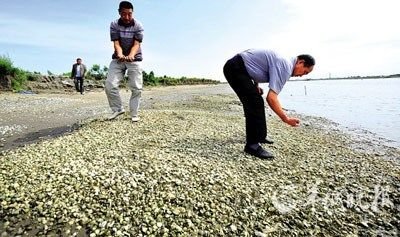
Oil pollution invades Bohai Bay, causing severe damage to the fishery and aquaculture industry in Laoting County, Hebei
The outfall of Guangzhou Jianqiao Chemical discharges sewage into the coastal waters. Photo by reporter Yang Hui
At 5 p.m. on September 28, at the outfall leading to the sea from Guangzhou Jianqiao (Nansha) Petrochemical Co., Ltd., yellow waves churned. The outfall continuously discharged yellow sewage into the sea, dyeing the surrounding waters completely yellow-brown, and the entire bay was filled with a pungent odor.
"It's hard to catch big fish now. With so many chemical plants, many fish are gone," old Zhang, a nearby fisherman, told the reporter.
The bay where old Zhang's fishing boat is located has to its east Guangdong Huakai Oil and Natural Gas Company, Jianqiao Chemical, Development BP (British Petroleum) Oil Products Co., Ltd. and a power plant, and to its north Xiaohu Island, whose main industry is the chemical industry.
A marine bulletin recently released by the Guangdong Ocean and Fishery Bureau shows that in the waters adjacent to the outfall of Jianqiao (Nansha) Petrochemical Company, the inorganic nitrogen content has exceeded the fourth-class seawater quality standard, the quality of the marine ecological environment is in a poor state, and the seawater quality cannot meet the requirements of the corresponding marine use functions and environmental protection objectives.
The 2010 Guangdong marine bulletin shows that 40% of the sewage outfalls into the sea in Guangdong's coastal waters discharge sewage exceeding standards, and 16% of the coastal waters are being polluted. In 2010, the eight major outlets of the Pearl River and major rivers entering the sea such as Rongjiang, Shenzhen River and Dongjiang carried 1.08 million tons of pollutants including petroleum hydrocarbons, arsenic and heavy metals into the sea. Among them, pollutants discharged into the sea by the Pearl River accounted for 70% of the total.
"A large number of existing studies show that many heavy metals and persistent organic pollutants in the water and sediments of the Pearl River Estuary exceed standards. These pollutants accumulate and become enriched in aquatic organisms such as fish and zooplankton, and pose toxic hazard risks to them. More seriously, the toxicity is amplified through the food chain, endangering human health," said Dr. Guo Pengran, associate researcher at the Guangdong Provincial Key Laboratory of Chemical Hazard Emergency Detection Technology.
Serious pollution in coastal fishing ports
Dr. Guo Pengran previously studied the underwater sediments of Guishan Island, a large island in the coastal waters of the Pearl River Delta. The island is located on the main shipping channel on the east side of the Pearl River Estuary, is a docking place for large oil tankers in the Pearl River Estuary, and is also one of Guangdong's largest marine cage aquaculture bases.
Guo Pengran's research results show that in the surface sediments of the seabed near Guishan Island, the contents of three heavy metals, copper, lead and zinc, all exceed the estuarine background values to varying degrees. The assessment result is that "in this mariculture base, heavy metals in the surface sediments have potential or chronic toxic effects on benthic organisms."
Guishan Island is an island far from the coast, and its pollution situation is lower than that of coastal fishing ports. The situation of Guangdong's coastal fishing ports is even less optimistic. Just like the feelings of fishermen in the waters near Jianqiao (Nansha) Petrochemical Company, sea fish caught by fishermen at the Shenzhen Bay fishing port also have a smell of rancid oil, and local restaurant owners call them "stinky oil fish."
"The copper and zinc contents in the sediments of the fishing ports of Shenzhen, Zhuhai and Macao, China are far higher than those of domestic estuaries and bays, and the cadmium content is also significantly higher than domestic estuary and bay levels. The heavy metal content levels of other fishing ports are similar to those of domestic estuaries and bays. Compared with ports around the world, the heavy metal content in the sediments of fishing ports in the Pearl River Delta region is at a medium level. Among them, the copper content in the sediments of the Shenzhen fishing port has already ranked among the highest in the world, second only to the reported New Bedford port in the United States, which is severely polluted by heavy metals," pointed out researcher Zhang Gan of the State Key Laboratory of Organic Geochemistry, Guangzhou Institute of Geochemistry, Chinese Academy of Sciences.
Researcher Zhang Gan said that the fishing ports of the Pearl River Delta all have "high" or "medium" potential heavy metal ecological risks, among which the heavy metals copper and cadmium have "high" potential ecological risks. The overall potential ecological risk of Guangdong's fishing ports, from high to low, is: Macao, China > Shenzhen > Zhuhai > Maoming.
Zhang Gan believes that the high degree of industrialization and urbanization in the Pearl River Delta has had a serious environmental impact on its adjacent waters, and the heavy metal pollution in fishing port sediments is inseparable from the industrialization and urbanization of the areas surrounding the fishing ports.