Tomatoes yield up to 30,000 jin per mu, cultivated by vegetable expert Ying Fangqing
If you ran into her on the street, you would certainly take her for an ordinary rural woman. In reality, she is a vegetable expert who has won nearly 30 awards of various levels from the State Council, the Ministry of Agriculture, Henan Province, and Zhengzhou City.
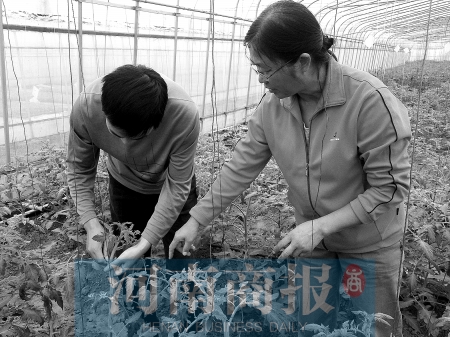
Vegetable expert Ying Fangqing: the tomatoes she cultivated yield up to 30,000 jin per mu
Her name is Ying Fangqing, and she heads the tomato research program at the Zhengzhou Vegetable Research Institute. An ordinary mu of tomatoes yields about 15,000 jin, while the varieties she has cultivated can reach around 30,000 jin at high yields.
On October 7, a reporter from Henan Business Daily came to the Zhengzhou Vegetable Research and Development Center to work in the fields alongside the agricultural scientists.
The high-yield tomato she cultivated is called Fenda
"Hello, could you tell me where Teacher Ying Fangqing is?" When the reporter arrived at the tomato greenhouses of the Zhengzhou Vegetable Research and Development Center at 1 p.m. yesterday, two women could be seen working inside.
Hearing the reporter's inquiry, the older woman looked up. Her face was red and dark, clearly weathered by much sun, and her hair was casually combed back and pinned up. "I am her. You must be the reporter who called just now? Didn't you say you wanted to join our work? Perfect timing, come and prune the tomato suckers." There was not the slightest polite formality in her tone.
The girl working alongside Ying Fangqing was a graduate of Huazhong Agricultural University who had just graduated this year.
"The varieties here are not high-yield ones; each plant only produces six or seven trusses, and a mu yields only about 15,000 jin." The high-yield tomato Teacher Ying cultivated is called Fenda, which has now been promoted and planted on nearly 100,000 mu.
"Fenda is an indeterminate growth variety. Each plant can produce about 15 trusses, and a mu can yield as much as 30,000 jin. Its fruiting period is also long. For example, if you sow in early September, you can harvest the fruit not long after New Year's Day and keep harvesting until the end of May. An ordinary mu of tomatoes yields only about 15,000 jin."
⟦13
While teaching the reporter hand by hand how to prune the tomato suckers, Ying Fangqing introduced her new variety: "Fenda has relatively high growing requirements. It needs a suitable solar greenhouse and sufficient sunlight. In addition, it has certain temperature-retention requirements and must be grown over winter. One crop takes almost ten months of work."
Ying Fangqing taught the reporter how to prune tomato side shoots by hand while introducing her new variety: “Fenda has relatively high growing requirements. It needs a suitable solar greenhouse with sufficient sunlight. It also has certain temperature-retention requirements and must be grown over winter. One crop takes almost ten months of work.”
While the high-yield tomato brought benefits to vegetable farmers, it also brought honors to Ying Fangqing. In 2007, she won the first prize for scientific and technological achievements from the Henan Academy of Agricultural Sciences for it. In 2008, Henan Province and Zhengzhou City each awarded the project the second prize for scientific and technological progress.
Soilless cultivation on a home balcony costs only 700 yuan
Working with Ying Fangqing, everyone was especially brisk. Before 2 p.m., the suckers on a whole mu of tomatoes had been pruned. "Let's go help Gong Pan with his work."
Gong Pan is another researcher at the Vegetable Research and Development Center, mainly working on ornamental vegetables. "Because the workload is heavy, everyone is going to work at his place today."
Walking into the greenhouse Gong Pan is responsible for, the reporter found that, unlike the dirt floor in Ying Fangqing's greenhouse, most of the ground here was paved with bricks and swept very clean.
"This section of the trellis is for soilless cultivation. In a moment we'll plant Hong Kong soft-leaf lettuce in it." As she spoke, a colleague came over carrying vegetable seedlings. Taking a seedling, wrapping a ring of sponge around the outside of the small plastic pot at its roots, and then placing it into the water channel, a lettuce was planted.
"The sponge mainly serves to hold it in place," Ying Fangqing explained. Once planted, the lettuce would grow to a finished product in about a month. "The water in the channel is not ordinary water either; it is a prepared nutrient solution."
The soilless cultivation trellis is made up of plastic growing columns, with the columns connected by plastic pipes. Two such growing columns can stand per square meter, and each column has 60 water channels, where 60 vegetables can be planted.