The under-forest economy has great prospects and broad development potential
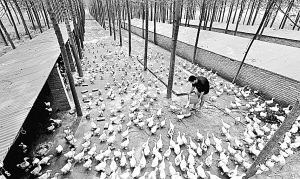
Raising ducks under the forest has enriched the people
The under-forest economy is an ecological agricultural model in which, after the reform of the collective forest rights system, farmers make full use of under-forest land resources to engage in three-dimensional composite production and operation such as under-forest planting and breeding. The under-forest economy requires little investment, yields quick results, is easy to operate and has great potential. It is of great significance for shortening the forestry economic cycle, increasing the added value of forestry, opening up new channels for farmers to increase their incomes and developing a circular economy. Our city has a forestland area of 14.433 million mu. Last year, the city's forestry output value reached 8 billion yuan, ranking among the top in the province. Here, our newspaper selects counties with outstanding characteristics in under-forest economic development to showcase, so that the power of examples can inject a new vitality into the city's under-forest economic development.
Editor's note
Sample one: Xixia
Display content
Five under-forest economic models: forest-vegetable intercropping, forest-medicine interplanting, forest-poultry mutual raising, forest-fungus symbiosis and forest-tourism integration
"My one mu of kiwifruit brings in more than 1,000 yuan, and together with the peanuts interplanted in the field, an income of 3,000 yuan is no problem. Developing the under-forest economy is really great." A few days ago, when talking about the under-forest economy, Chen Hailin, a farmer from Chengou Village, Danshui Town, Xixia County, praised it endlessly.
As the province's largest forestry county, Xixia in recent years has focused on cultivating five under-forest economic models: forest-vegetable intercropping, forest-medicine interplanting, forest-poultry mutual raising, forest-fungus symbiosis and forest-tourism integration, opening up a new path for farmers to increase their incomes and become rich.
Forest-vegetable intercropping. Vegetables such as peppers and chives are intercropped in kiwifruit orchards, making full use of land gaps and promoting efficient planting models to increase farmers' incomes. Li Sanxi, a farmer from Huangshi Village, Wuliqiao Town, in the county, achieved income growth through the forest-vegetable intercropping model. He interplanted 3 mu of peppers in his kiwifruit field and this year increased his net income by more than 8,000 yuan. At present, the county has developed 22,000 mu of forest-vegetable intercropping bases, with an annual output value of 69 million yuan.
Forest-medicine interplanting. Medicinal plants such as Chuandao bupleurum, astragalus and blood ginseng are intercropped in forestland or unforested land. Du Shuwei, a medicine farmer from Taiping Town in the county, interplanted 5 mu of blood ginseng in barren hill forestland and earned more than 30,000 yuan this year, making him a well-known "medicine king" in the county. At present, the county's under-forest interplanted Chinese medicinal herb area is 16,000 mu, with an annual output value of 78 million yuan.
Forest-poultry mutual raising. Making use of under-forest space to raise chickens, ducks, geese and other poultry and develop the breeding industry, achieving forest-poultry symbiosis and mutual benefit. Li Junliang, a villager from the Sanlihao group of Xiahe Village, Taiping Town, in the county, leased 60 mu of land and raised 12,000 free-range chickens under a dogwood forest, achieving an annual income of nearly 500,000 yuan and becoming a breeding expert who has become rich and is often talked about with relish by nearby villagers.
Forest-fungus symbiosis. Making use of the high air humidity and low light intensity under the forest shade and the characteristics of edible fungi that prefer shade and moisture, with corn, rice straw and other stalks as the main raw materials, straw-rotting fungi are vigorously developed. This development model has already been promoted on a large scale in the northern mountain townships of the county. The county plants more than 9,600 mu of edible fungi annually, mainly Dictyophora and white oyster mushrooms, driving more than 16,000 farming households, with an annual output value of 380 million yuan.
Forest-tourism integration. Making use of forest ecological resources such as the Laojieling Scenic Area, forest eco-tourism is vigorously developed. Through holding flower-viewing festivals and picking festivals, the county has actively explored and implemented the "forest-tourism integration" model, building 18 forest-tourism integration demonstration villages, including the eco-tourism village of Huashan Village in Shuanglong Town, the 3,000-mu cherry picking garden in Sanlimiao Village, Danshui Town, and the 10,000-mu forest-fruit sightseeing garden in Sungou, Tianguan Township, with an annual comprehensive income of 330 million yuan.
Three-dimensional planting, multiple sources of income growth. Xixia County has cultivated and formed more than 120 under-forest economic demonstration villages of various types, 68,000 mu of demonstration bases and 3,800 demonstration households, embarking on a win-win path in which the country gains greenery and farmers gain profits.
Sample two: Dengzhou
Display content
Rewards instead of subsidies to support the development of under-forest planting, under-forest breeding and forestland tourism
In Zhuxi Village, Taoying Township, Dengzhou City, more than 8,000 mu of pumpkins are planted under the forest, generating revenue of more than 10 million yuan and an average household income increase of more than 16,000 yuan. Speaking of the returns from planting pumpkins under the forest, melon farmer Liu Qundian happily told the reporter: "This year I interplanted 10 mu of pumpkins under the forest and have already made a profit of more than 10,000 yuan. Truly, planting pumpkins under the forest brings first-rate returns!"