Overseas-educated PhD Lou Mengliang Raises Chickens in Remote Mountains, Finds a Path to Prosperity
In Wangmushan Village, Deqing County Economic and Technological Development Zone, there is an unremarkable yet unusual chicken farm.
It is unremarkable because it sits in a small mountain hollow, requiring a winding journey along the village road, twisting and turning until you reach beneath the Hangzhou-Nanjing Expressway overpass. Asking villagers along the way, you see a sign at the entrance reading "Deqing County Wukang Jiade Grandparent Stock Chicken Farm." Even upon seeing the seven or eight neat buildings, it is still hard to believe this is a place for raising chickens.
It is unusual because when the reporter walked into this vast chicken farm, there was not a trace of chicken manure smell, not a single chicken running about, and more importantly, the "chicken commander" here is a PhD who studied overseas.
A shallow pool is dug at the entrance. A staff member explained: "This contains disinfectant. If a large vehicle comes in, it must be disinfected first." Disinfection is the first checkpoint here. The reporter changed into work shoes, spent 5 minutes in the ultraviolet room for disinfection, walked through a 2-meter-long disinfection pool, passed through three rooms, and after this series of strict disinfection procedures, was finally "cleared" to enter the chicken farm office and meet the legendary Dr. Lou.
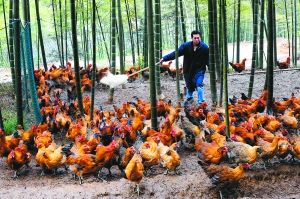
Dr. Lou is named Lou Mengliang, in his 40s. He wears a pair of thick-lensed glasses on his nose, a set of work clothes that are neither new nor old, and his trousers are tucked into a pair of tall rain boots. "The environment here is good, open, and the transportation is very convenient. This is also why, after surveying the areas around Hangzhou, I ultimately settled in Wangmushan Village." Regarding the tedious disinfection process upon entry, Dr. Lou explained, "Because we raise grandparent stock chickens here, the environmental requirements are relatively stricter. Staff must even shower before entering."
What are grandparent stock chickens? "To put it simply, if the commercial chickens we usually buy in the market are the son generation, the chickens in a breeding farm are the parent generation, and grandparent stock chickens are the grandparent generation." Dr. Lou's explanation was very accessible. "In other words, the chicks we hatch are specifically supplied to breeding farms."
Dr. Lou is a native of Dongyang. In the early 1980s, he studied the improved breeding system for livestock and poultry at Zhejiang Agricultural University, then went overseas to study animal nutrition and poultry breeding, and obtained his doctorate in the UK. Returning to China to run a grandparent stock chicken farm was, in his view, exactly putting his learning into practice. "After returning from studying abroad, I found that there were very few proper grandparent stock chicken farms in China. Breeding stock chicks were generally self-bred and cultivated by breeding farms, with generally low quality and relatively low breeding efficiency." So he conceived the idea of building a grandparent stock chicken farm, using professional knowledge to cultivate "the best of the best breeds."
It is understood that since the Jiade Grandparent Stock Chicken Farm was completed in 2006, the total chicken house area is 4,500 sq m, with a rearing scale of 20,000 birds. Currently, it mainly raises two breeds: the JA57 yellow-feathered breeding chicken and the Redbro breeding chicken. The chicks are air-freighted from Hubbard, a French broiler genetics and breeding company with over a hundred years of high-tech selective breeding experience. The cost of imported chicks alone exceeds 500,000 yuan per year, and each newly hatched chick imported from France costs over 200 yuan per bird. The breeding chicken chicks hatched each year number about 400,000 sets (a "set" being a male and female paired in a reasonable ratio), sold to breeding farms in over twenty provinces and cities nationwide.