College-graduate village official Song Kai takes root in rural areas and serves as a good leader in getting rich
Since 2008, Hebei Province has openly recruited more than 3,000 college-graduate village officials across the province. In an instant, a youthful and energetic young team took root in various parts of Hebei. Along with the growth of the first batch of village officials, the small villages where they were based gradually took on a new look and became new rural communities that delighted the people. Song Kai, who was still studying at school at the time, felt that rural areas were places that needed young teams even more, "No matter what kind of job you find in society, it is not as good as going to the grassroots level, where you can gain experience and also demonstrate the value of your life."
In 2009, the Organization Department of the Hebei Provincial Party Committee began selecting and hiring the second batch of college-graduate village officials. That year, Song Kai, who had just graduated from the Law Department of Baoding Radio and Television University in Hebei, felt that this was a good opportunity to temper himself and devote himself to social practice, so he decisively signed up. After rounds of selection, in December he was smoothly assigned to Xianrenqiao Village, Shiqiao Township, Qingyuan County, Baoding City, Hebei Province, and took up the post of assistant to the village Party branch secretary.
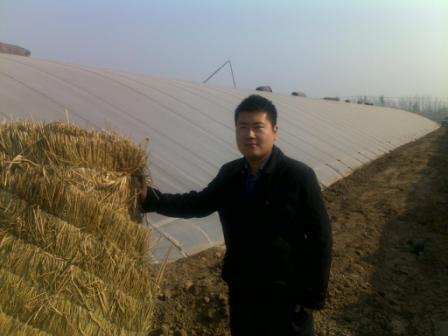
College-graduate village official Song Kai
A college student came to the village. The village leaders were curious, and the ordinary people found it novel. They thought that college students were gentle and only knew how to study and write, and that they should be both unfamiliar with and averse to the villagers who came from the mud and soil of the village. But Song Kai, who was born in a rural area, had special feelings for rural areas. He said: "Xianrenqiao Village is unfamiliar to me, but rural areas are not unfamiliar to me, and I believe that after going deep into the village to study and live, I will certainly become a qualified village official who does good and practical things for the village and makes the people happy and satisfied." As soon as he took office, Song Kai plunged into the village, from time to time walking through the streets and alleys to chat with farming households, often squatting by walls and at the bridgehead to talk with villagers during their slack farming season, and he could often be seen in the fields working alongside farmers. The villagers all joked that he was a warm-hearted young man who loved to "drop by" and a young person who had broad vision and could also mingle with the common people.
After taking up his post in Xianrenqiao Village, Song Kai learned that Xianrenqiao Village had vast and fertile land resources and a long history of vegetable cultivation, but the local people only planted some traditional field vegetable crops. In addition, the low prices of seasonal vegetables meant that although the local farmers guarded fertile land, their income level was not high. Therefore, Song Kai developed the idea of making an effort in vegetable cultivation and starting from increasing the scale of the vegetable industry to raise the people's income.
Through in-depth and detailed market research, Song Kai learned that the market prospects for growing off-season pollution-free vegetables such as Dutch cucumbers, eggplants, and bell peppers were very broad, while market supply had an obvious cyclical nature. As long as the market launch cycle was accurately grasped, good economic value could certainly be obtained. After careful consideration, in October 2010, Song Kai cooperated with the two committees of Xianrenqiao Village to jointly establish "Qingyuan County Sihai Fruit and Vegetable Professional Cooperative." The cooperative adopted the "farmer-supermarket direct purchase" model and, through the method of "combining planting and breeding and deep development," organically integrated the cultivation and processing of off-season vegetables, three-dimensional planting and breeding, specialty breeding, and the development and utilization of renewable energy to build an environmentally friendly, efficient, and circularly developing agricultural ecological base.